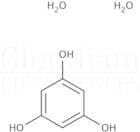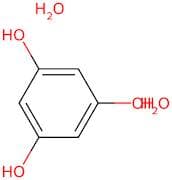
CAS 6099-90-7
:1,3,5-Benzenetriol, hidrato (1:2)
Descripción:
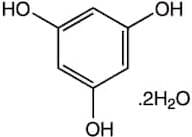
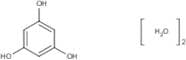
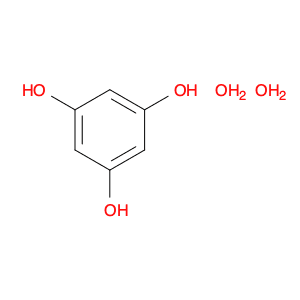
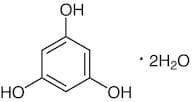
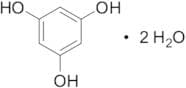
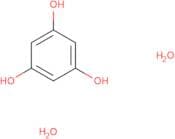
1,3,5-Benzenetriol, hidrato (1:2), con el número CAS 6099-90-7, es un compuesto químico caracterizado por la presencia de tres grupos hidroxilo (-OH) unidos a un anillo bencénico en las posiciones 1, 3 y 5. Este triol exhibe propiedades típicas de los compuestos fenólicos, incluida la posible actividad antioxidante y la capacidad de formar enlaces de hidrógeno debido a sus grupos hidroxilo. La designación "hidratado (1:2)" indica que el compuesto existe en una forma hidratada, incorporando moléculas de agua en su estructura, lo que puede influir en su solubilidad y estabilidad. En términos de propiedades físicas, generalmente es un sólido a temperatura ambiente y puede aparecer como una sustancia cristalina blanca a blanco sucio. La presencia de múltiples grupos hidroxilo mejora su reactividad, haciéndolo útil en varias reacciones químicas y aplicaciones, incluidos productos farmacéuticos y síntesis orgánica. Además, su solubilidad en agua y solventes orgánicos puede variar, dependiendo de las condiciones específicas y el grado de hidratación.
Fórmula:C6H10O5
InChI:InChI=1/C6H6O3.2H2O/c7-4-1-5(8)3-6(9)2-4;;/h1-3,7-9H;2*1H2
Clave InChI:InChIKey=MPYXTIHPALVENR-UHFFFAOYSA-N
SMILES:OC1=CC(O)=CC(O)=C1.O
Sinónimos:- 1,3,5-Benzenetriol dihydrate
- 1,3,5-Benzenetriol, hydrate (1:2)
- 1,3,5-Trihydroxy Benzene Dihydrate
- 1,3,5-Trihydroxybenzene dihydrate
- 1,3,5-Trihydroxybenzene.2H2O
- Benzene-1,3,5-Triol Dihydrate
- Phloroglucinol dehydrate
- Phloroglucinol, dihydrate
- PHLOROGLUCONOL extrapure AR
- 1,3,5-Trihydro-Benzene
- PHLOROGLUCINOL,REAGENT
- Phloroglucinoldihydrate,98%
- PHLOROGLUCINOL(RG)
- 1,3,5-TRIHYDROXYBENZENE
- PHLOROGLUCIN
- PHLOROGLUCIN DIHYDRATE
- PHLOROGLUCINOL
- phloroglucinol---plant cell culture*tested
- PHLOROGLUCINOL DIHYDRATE R. G.
- PHLORGLUCINOL DIHYDRATE
- Phlorogluctinol
- PHLOROGLUEIN (1,3,5-TRINYDROCYBENZENE)
- PHLOROGLUCINOL2-HYDRATE
- Ver más sinónimos
Ordenar por
Pureza (%)
0
100
|
0
|
50
|
90
|
95
|
100
Encontrado 10 productos.
Phloroglucinol dihydrate, 98%
CAS:Phloroglucinol dihydrate is utilized in the preparation of active pharmaceutical ingredients such as flopropione. It acts as a reagent for the Tollens’ test for pentoses. It is mixed with hydrochloric acid and plays an important role for the detection of lignin (Wiesner test). It is involved in tFórmula:C6H10O5Pureza:98%Forma y color:Crystals or powder or crystalline powder, White to cream to brownPeso molecular:162.14Phloroglucinol dihydrate
CAS:Phloroglucinol dihydrate analytical standard provided with chromatographic purity, to be used as reference material for qualitative determination.Fórmula:C6H6O3H2OPureza:(HPLC) ≥95%Forma y color:PowderPeso molecular:162.15Benzene-1,3,5-triol dihydrate
CAS:Fórmula:C6H10O5Pureza:98%Forma y color:SolidPeso molecular:162.1406Phloroglucinol dihydrate
CAS:Phloroglucinol dihydrate is a useful organic compound for research related to life sciences. The catalog number is T124553 and the CAS number is 6099-90-7.Fórmula:C6H10O5Forma y color:SolidPeso molecular:162.141Phloroglucinol dihydrate
CAS:Fórmula:C6H6O32H2OPureza:≥ 97.5%Forma y color:White to brown or cream powder or crystalsPeso molecular:162.14Phloroglucinol Dihydrate
CAS:Fórmula:C6H6O3·2H2OPureza:>98.0%(GC)Forma y color:White to Yellow to Orange powder to crystalPeso molecular:162.14Phloroglucinol Dihydrate
CAS:Applications Phloroglucinol Dihydrate is a reactant used in the synthesis of [2-13C, 4-13C]-(2R,3S)-catechin and [2-13C, 4-13C]-(2R,3R)-epicatechin.
References Sharma, P.K., et. al.: J. Labelled Compd. Rad., 53, 605 (2010)Fórmula:C6H6O3·2H2OForma y color:Yellow SolidPeso molecular:162.14Phloroglucinol dihydrate
CAS:Phloroglucinol dihydrate is a chemical substance that can be used as a denaturant, conditioner and deodorant. It is soluble in water and has been shown to have enzyme-inhibiting properties. Phloroglucinol dihydrate has been shown to have anti-inflammatory properties by inhibiting the production of prostaglandins. This compound also has optical properties, which are determined by its chromene structure. There is no phase transition temperature for this compound because it does not melt or freeze.
Fórmula:C6H6O3•(H2O)2Pureza:Min. 95%Forma y color:PowderPeso molecular:162.14 g/mol