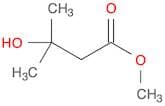
CAS 6149-45-7
:Ácido butanoico, 3-hidroxi-3-metil-, éster metílico
Descripción:
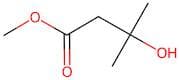
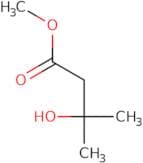
Ácido butanoico, 3-hidroxi-3-metil-, éster metílico, también conocido como metilo 3-hidroxi-3-metilbutanoato, es un compuesto orgánico caracterizado por su grupo funcional éster derivado del ácido butanoico. Presenta una estructura ramificada con un grupo hidroxilo y un grupo metilo unidos al tercer carbono de la cadena del ácido butanoico. Este compuesto típicamente aparece como un líquido incoloro a amarillo pálido con un olor afrutado, lo que lo hace relevante en aplicaciones de sabor y fragancia. Es soluble en disolventes orgánicos y exhibe una solubilidad moderada en agua debido a la presencia del grupo hidroxilo. El compuesto es conocido por su posible uso en la síntesis de varios productos químicos y como un intermedio en reacciones orgánicas. Además, puede tener aplicaciones en la producción de polímeros biodegradables y como agente saborizante en la industria alimentaria. Los datos de seguridad indican que, al igual que muchos ésteres, debe manejarse con cuidado, ya que puede causar irritación al contacto con la piel o los ojos.
Fórmula:C6H12O3
Sinónimos:- 4-Bromo-2,18-diaminopyridine
- Methyl 3-hydroxy-3-methylbutanoate
- 3-Hydroxy-3-methylbutanoic acid methyl ester
- Butanoic acid, 3-hydroxy-3-methyl-, methyl ester
- methyl β-hydroxy-β-methylbutyrate
Ordenar por
Pureza (%)
0
100
|
0
|
50
|
90
|
95
|
100
Encontrado 4 productos.
3-Hydroxy-3-methylbutanoic acid methyl ester
CAS:Fórmula:C6H12O3Pureza:95%Forma y color:LiquidPeso molecular:132.1577Methyl 3-Hydroxy-3-Methylbutanoate
CAS:Methyl 3-Hydroxy-3-MethylbutanoatePureza:98%Peso molecular:132.15g/molMethyl 3-hydroxy-3-methylbutanoate
CAS:<p>Methyl 3-hydroxy-3-methylbutanoate is a reactive compound that can be used as a building block in organic synthesis. It is used to synthesize a variety of compounds, including pharmaceuticals and agrochemicals. Methyl 3-hydroxy-3-methylbutanoate has been shown to react with methoxy groups to form methyl hydroxy groups. This reaction is catalyzed by the protonation of the oxygen atom on the reactant's oxygen atom, which leads to a cyclic transition state. Kinetic studies have been performed and show that the rate of this reaction increases with an increase in temperature. The kinetic parameters for this reaction are not currently known, but it has been shown that the nucleophilic attack on the carbon atom adjacent to the leaving group occurs from primary alcohols and alkyl halides.</p>Fórmula:C6H12O3Pureza:Min. 95%Peso molecular:132.16 g/mol