CAS 616-13-7
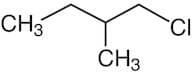
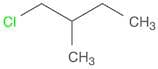
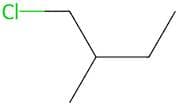
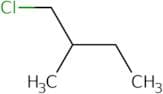
:1-cloro-2-metilbutano
Descripción:
1-cloro-2-metilbutano es un compuesto orgánico clasificado como un halogenuro de alquilo, específicamente un cloroalcano. Presenta una estructura de cadena de butano de cuatro carbonos con un átomo de cloro y un grupo metilo unidos al segundo carbono. Esta estructura le da la fórmula molecular C5H11Cl. El compuesto es típicamente un líquido incoloro con un olor característico y es conocido por su volatilidad moderada. Es soluble en disolventes orgánicos, pero tiene una solubilidad limitada en agua debido a su cadena hidrocarbónica hidrofóbica. 1-cloro-2-metilbutano se utiliza en síntesis orgánica y como intermediario en la producción de varios productos químicos. Puede sufrir reacciones de sustitución nucleofílica, lo que lo convierte en un reactivo útil en la química orgánica sintética. Se requieren precauciones de seguridad al manipular este compuesto, ya que puede ser irritante para la piel y los ojos y puede representar riesgos para la salud si se inhala o se ingiere. Es esencial un almacenamiento adecuado en un área fresca y bien ventilada, alejada de sustancias incompatibles, para garantizar la seguridad.
Fórmula:C5H11Cl
InChI:InChI=1S/C5H11Cl/c1-3-5(2)4-6/h5H,3-4H2,1-2H3
Clave InChI:InChIKey=IWAKWOFEHSYKSI-UHFFFAOYSA-N
SMILES:C(CC)(CCl)C
Sinónimos:- 2-Methylbutyl chloride
- Butane, 1-chloro-2-methyl-
- Chloromethylbutane
- (±)-1-Chloro-2-methylbutane
- 1-Chloro-2-methylbutane
Ordenar por
Pureza (%)
0
100
|
0
|
50
|
90
|
95
|
100
Encontrado 4 productos.
1-Chloro-2-methylbutane
CAS:Fórmula:C5H11ClPureza:>95.0%(GC)Forma y color:Colorless to Light yellow to Light orange clear liquidPeso molecular:106.591-Chloro-2-methylbutane
CAS:1-Chloro-2-methylbutane is a reactive, chiral molecule that has been used as a reagent to introduce the methyl group into organic compounds. 1-Chloro-2-methylbutane reacts with iodides in an acid solution to form the methyliodide salt and hydrogen gas. The reaction occurs at temperatures between 50°C and 150°C, but not at higher temperatures. The yield of this reaction depends on the concentration of iodide ions present, with lower concentrations producing a higher yield of product. A variety of frequencies can be used to irradiate the compound with light energy, each producing different results. At low frequencies (less than 10 Hz), the compound absorbs energy and heats up to produce vibrational modes. At high frequencies (greater than 100 Hz), the compound breaks down into two molecules, one containing chlorine and one containing iodine. Irradiation at wavelengths between 250 nm and 400 nm causes bond cleavage in the molecule, yieldingFórmula:C5H11ClPureza:Min. 95%Forma y color:Clear LiquidPeso molecular:106.59 g/mol