CAS 6205-08-9
:N-Acetil-L-ornitina
Descripción:
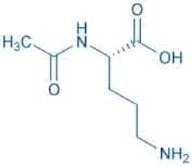
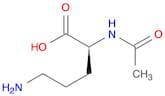
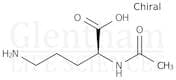
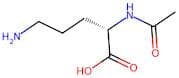
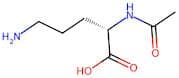
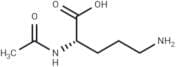
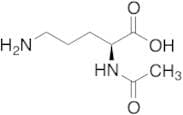
N-Acetil-L-ornitina es un derivado del aminoácido ornitina, caracterizado por la adición de un grupo acetilo al átomo de nitrógeno del grupo amino. Es un polvo cristalino blanco a blanco amarillento que es soluble en agua y presenta un pH ligeramente ácido a neutro. Este compuesto juega un papel significativo en el ciclo de la urea, donde participa en la síntesis de arginina y está involucrado en varios procesos metabólicos. N-Acetil-L-ornitina se utiliza a menudo en investigaciones bioquímicas y tiene aplicaciones potenciales en los campos de la nutrición y la medicina, particularmente en estudios relacionados con trastornos metabólicos y el metabolismo de aminoácidos. Su fórmula molecular refleja su estructura, que contiene átomos de carbono, hidrógeno, nitrógeno y oxígeno. Además, es importante manejar este compuesto con cuidado, siguiendo las pautas de seguridad adecuadas, como con cualquier sustancia bioquímica. En general, N-Acetil-L-ornitina sirve como un compuesto importante tanto en funciones fisiológicas como en aplicaciones de investigación.
Fórmula:C7H14N2O3
InChI:InChI=1/C7H14N2O3/c1-5(10)9-6(7(11)12)3-2-4-8/h6H,2-4,8H2,1H3,(H,9,10)(H,11,12)/t6-/m0/s1
Clave InChI:InChIKey=JRLGPAXAGHMNOL-LURJTMIESA-N
SMILES:[C@@H](NC(C)=O)(C(O)=O)CCCN
Sinónimos:- (2S)-2-Acetamido-5-aminopentanoic acid
- (2S)-5-Amino-2-acetamidopentanoic acid
- <span class="text-smallcaps">L</span>-Ornithine, N<sup>2</sup>-acetyl-
- Ac-Orn-OH
- N-Acetyl-<span class="text-smallcaps">L</span>-ornithine
- N-Acetylornithine
- N<sup>2</sup>-Acetyl-<span class="text-smallcaps">L</span>-ornithine
- N<sup>α</sup>-Acetyl-<span class="text-smallcaps">L</span>-ornithine
- N<sup>α</sup>-Acetylornithine
- N~2~-acetyl-L-ornithine
- Ornithine, N<sup>2</sup>-acetyl-
- Ornithine, N<sup>2</sup>-acetyl-, <span class="text-smallcaps">L</span>-
- N2-Acetyl-L-ornithine
- Ornithine, N2-acetyl-
- L-Ornithine, N2-acetyl-
- Ornithine, N2-acetyl-, L-
- Nα-Acetyl-L-ornithine
- N-ACETYL-L-ORN
- N-ALPHA-ACETYL-L-ORNITHINE
- AC-ORNITHINE
- ACETYL-L-ORNITHINE
- N-A-acetyl-L-ornithine crystalline
- Nα-Acetyl-L-ornithine≥ 98% (HPLC)
- Ver más sinónimos
Ordenar por
Pureza (%)
0
100
|
0
|
50
|
90
|
95
|
100
Encontrado 11 productos.
Ac-Orn-OH
CAS:Bachem ID: 4002042.
Fórmula:C7H14N2O3Pureza:> 99%Forma y color:White PowderPeso molecular:174.2N-Acetyl-L-ornithine
CAS:Fórmula:C7H14N2O3Pureza:≥ 95%Forma y color:White to off-white powderPeso molecular:174.20Nα-Acetyl-L-ornithine-5,5-d2
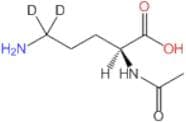
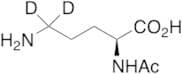
CAS:Fórmula:H2NCD2(CH2)2CH(NHCOCH3)COOHPureza:98 atom % DForma y color:White SolidPeso molecular:176.113N-Acetylornithine
CAS:N-Acetylornithine is found in human blood plasma (avg. 1.1±0.4 μmol/L) and urine (~1 μmol/day).Fórmula:C7H14N2O3Pureza:99.86% - ≥95%Forma y color:SolidPeso molecular:174.2Nalpha-Acetyl-L-ornithine
CAS:Producto controladoFórmula:C7H14N2O3Forma y color:Off-WhitePeso molecular:174.2NAlpha-Acetyl-L-ornithine-d2
CAS:Producto controladoApplications Nα-Acetyl-L-ornithine (AORN) is a substrate for the identification, differentiation and characterization of N(α)-acetyl-L-ornithine deacetylase(s) and of N-Acetyl-l-ornithine transcarbamylase(s) (AOTCase).
References McGregor, W., et al.: J. Am. Chem. Soc., 127, 14100 (2005); Morizono, H., et al.: J. Bacetriol., 188, 2974 (2006);Fórmula:C7D2H12N2O3Forma y color:NeatPeso molecular:176.21N-alpha-Acetyl-L-ornithine
CAS:N-alpha-Acetyl-L-ornithine is an intermediate in the urea cycle that has been shown to be a potential biomarker for metabolic disorders. It has also been shown to inhibit glutamate synthesis and nitrogen oxidation by inhibiting arginase and nitric oxide synthase. N-alpha-Acetyl-L-ornithine is synthesized from L-arginine and acetyl coenzyme A, catalyzed by synthetases. The reaction requires ATP, magnesium ion, and a molecule of NADPH. This synthetic pathway can be monitored using high performance liquid chromatography (HPLC). N-alpha-Acetyl-L ornithine can be used as a precursor in the production of caproic acid, which is an important organic acid used in chemical biology.Fórmula:C7H14N2O3Pureza:Min. 95%Peso molecular:174.2 g/mol