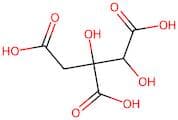
CAS 6205-14-7
:Ácido 1,2-dihidroxipropano-1,2,3-tricarboxílico
Descripción:
Ácido 1,2-dihidroxipropano-1,2,3-tricarboxílico, comúnmente conocido como ácido cítrico, es un ácido orgánico débil caracterizado por sus tres grupos carboxilo (-COOH) y dos grupos hidroxilo (-OH). Este compuesto es un sólido cristalino incoloro e inodoro que es altamente soluble en agua, lo que lo convierte en una sustancia importante en varios procesos biológicos e industriales. El ácido cítrico juega un papel crucial en el ciclo del ácido cítrico (ciclo de Krebs), que es esencial para el metabolismo celular en los organismos vivos. Se utiliza ampliamente como conservante natural y agente saborizante en alimentos y bebidas debido a su sabor ácido. Además, el ácido cítrico actúa como un agente quelante, ayudando a unir iones metálicos en soluciones, lo que es beneficioso en diversas aplicaciones, incluidos productos de limpieza y farmacéuticos. Su capacidad para actuar como un tampón de pH lo hace valioso en formulaciones cosméticas y entornos de laboratorio. En general, el ácido cítrico es un compuesto versátil con una importancia significativa tanto en la naturaleza como en la industria.
Fórmula:C6H8O8
InChI:InChI=1S/C6H8O8/c7-2(8)1-6(14,5(12)13)3(9)4(10)11/h3,9,14H,1H2,(H,7,8)(H,10,11)(H,12,13)
Clave InChI:InChIKey=ZMJBYMUCKBYSCP-UHFFFAOYSA-N
SMILES:C(C(C(O)=O)O)(CC(O)=O)(C(O)=O)O
Sinónimos:- 1,2,3-Propanetricarboxylic acid, 1,2-dihydroxy-
- 1,2-Dihydroxy-1,2,3-propanetricarboxylic acid
- 1,2-Dihydroxypropane-1,2,3-tricarboxylic acid
- 3-C-carboxy-2-deoxypentaric acid
- Hca-K
- Hydroxycitric acid
- Hydroxycitricacidanditstrisodiumsalt
- N~3~-cyclohexyl-2-(2,3-dihydro-1,4-benzodioxin-2-ylmethyl)-N~7~-[3-(methylsulfanyl)phenyl]-1-oxo-1,2,3,6,7,7a-hexahydro-3a,6-epoxyisoindole-3,7-dicarboxamide
- Pentaric acid, 3-C-carboxy-2-deoxy-
- Potassium Hydroxycitrate
- Regulator
- Tripotassium-2-Hydroxycditracte
- Ver más sinónimos
Ordenar por
Pureza (%)
0
100
|
0
|
50
|
90
|
95
|
100
Encontrado 6 productos.
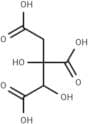
Hydroxycitric acid
CAS:(-)-Hydroxycitric acid (HCA) can inhibit fat synthesis and reduces food intake, the primary mechanism of action of HCA appears to be related to its ability toFórmula:C6H8O8Forma y color:SolidPeso molecular:208.12Hydroxycitric Acid Tripotassium Salt Monohydrate
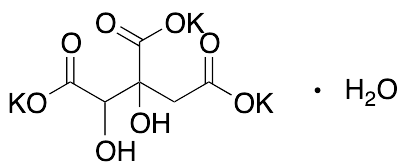
CAS:Stability Hygroscopic
Applications Hydroxycitric Acid is the hydroxyl derivative of citric acid with potential for modulation of lipid metabolism.
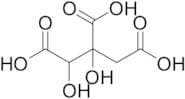
References Shara, M. et al.: Mol. Chem. Biochem., 254, 339 (2003);Fórmula:C6H5O8K3·H2OForma y color:NeatPeso molecular:340.411,2-Dihydroxypropane-1,2,3-tricarboxylic acid
CAS:1,2-Dihydroxypropane-1,2,3-tricarboxylic acid is the sodium salt of a plant metabolite that is found in beans and has been shown to have anti-inflammatory effects. It has been shown to inhibit the enzyme activities of lipoxygenase and cyclooxygenase as well as the toxicity of metal hydroxides in vitro. 1,2-Dihydroxypropane-1,2,3-tricarboxylic acid also inhibits protein synthesis and induces apoptosis in k562 cells.Fórmula:C6H8O8Pureza:Min. 95%Forma y color:PowderPeso molecular:208.12 g/mol