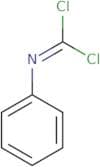
CAS 622-44-6
:Dicloruro de N-fenilcarbonimida
Descripción:
Dicloruro de N-fenilcarbonimida, con el número CAS 622-44-6, es un compuesto orgánico caracterizado por su estructura de derivado de ácido imídico, que presenta un grupo fenilo unido a un átomo de carbono que también está unido a dos átomos de cloro. Este compuesto es típicamente un líquido o sólido incoloro a amarillo pálido, dependiendo de su estado físico a temperatura ambiente. Es conocido por su reactividad, particularmente como agente clorante, y se utiliza a menudo en síntesis orgánica para introducir el moiety fenilcarbonimidico en varios sustratos. La presencia del grupo funcional dicloruro lo convierte en un potente electrófilo, permitiéndole participar en reacciones de sustitución nucleofílica. Las precauciones de seguridad son esenciales al manipular este compuesto, ya que puede ser corrosivo y puede representar riesgos para la salud al exponerse. El almacenamiento adecuado en un lugar fresco y seco, alejado de la humedad y sustancias incompatibles, es crucial para mantener su estabilidad y prevenir la degradación.
Fórmula:C7H5Cl2N
InChI:InChI=1S/C7H5Cl2N/c8-7(9)10-6-4-2-1-3-5-6/h1-5H
Clave InChI:InChIKey=TTWWZVGVBRPHLE-UHFFFAOYSA-N
SMILES:N(=C(Cl)Cl)C1=CC=CC=C1
Sinónimos:- (Phenylimino)carbonyl dichloride
- 1,1-Dichloro-N-phenylmethanimine
- Benzenamine, N-(dichloromethylene)-
- Carbonic dichloride, (phenylimino)-
- Carbonimidic dichloride, N-phenyl-
- Carbonimidic dichloride, phenyl-
- Dichloro(phenylimino)methane
- Imidocarbonyl chloride, phenyl-
- N-(Phenylimino)phosgene
- N-(dichloromethylene)aniline
- N-Phenylcarbimide dichloride
- N-Phenylcarbonimidic dichloride
- N-Phenylimidophosgene
- N-Phenylimidoyl dichloride
- N-Phenyliminocarbonyl dichloride
- NSC 2051
- Phenyl carbylamine chloride
- Phenylcarbonimidic Dichloride
- Phenylimidocarbonyl chloride
- Phenylisonitrile dichloride
- Ver más sinónimos
Ordenar por
Pureza (%)
0
100
|
0
|
50
|
90
|
95
|
100
Encontrado 1 productos.
Phenyl isocyanide dichloride
CAS:Producto controladoPhenyl isocyanide dichloride (PIC) is a chemical compound that has been shown to have antihypertensive activity. PIC binds to the receptor site of the angiotensin II receptor, which inhibits the binding of angiotensin II to this receptor. PIC also has been shown to produce x-ray crystal structures and inhibit chemical reactions in which alkoxy radicals are formed. The ability of PIC to inhibit these chemical reactions may be due to its ability to bind with high affinity at the receptor site for the angiotensin II receptor, thereby preventing it from binding with an angiotensin II molecule. This prevents activation of the enzyme that catalyzes the reaction and leads to inhibition of the chemical reaction. PIC also has been shown as a potential treatment for autoimmune diseases such as multiple sclerosis, rheumatoid arthritis and psoriasis. It has been shown that PIC can reduce inflammation by inhibiting an enzyme known as p-Fórmula:C7H5Cl2NPureza:Min. 95%Peso molecular:174.03 g/mol