CAS 622-60-6
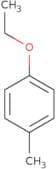
:1-etoxi-4-metilbenceno
Descripción:
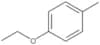
1-etoxi-4-metilbenceno, también conocido como p-etoxitolueno, es un compuesto orgánico caracterizado por su estructura aromática, que consiste en un anillo de benceno sustituido con un grupo etoxi (-OCH2CH3) y un grupo metilo (-CH3) en las posiciones para. Este compuesto es un líquido incoloro a amarillo pálido con un agradable olor aromático. Es moderadamente soluble en agua pero más soluble en disolventes orgánicos como el etanol y el éter. La presencia de los grupos etoxi y metilo influye en su reactividad química, lo que lo convierte en un intermediario útil en la síntesis orgánica y en varias reacciones químicas, incluida la sustitución aromática electrofilica. Además, 1-etoxi-4-metilbenceno exhibe propiedades típicas de los compuestos aromáticos, como estabilidad y resonancia. Es importante manejar esta sustancia con cuidado, ya que puede representar riesgos para la salud si se inhala o se ingiere, y se deben tomar las medidas de seguridad adecuadas durante su uso en entornos de laboratorio o industriales.
Fórmula:C9H12O
InChI:InChI=1S/C9H12O/c1-3-10-9-6-4-8(2)5-7-9/h4-7H,3H2,1-2H3
Clave InChI:InChIKey=WSWPHHNIHLTAHB-UHFFFAOYSA-N
SMILES:O(CC)C1=CC=C(C)C=C1
Sinónimos:- Phenetole, p-methyl-
- 1-Ethoxy-4-methylbenzene
- 4-Methylphenetole
- p-Methylphenetole
- Benzene, 1-ethoxy-4-methyl-
Ordenar por
Pureza (%)
0
100
|
0
|
50
|
90
|
95
|
100
Encontrado 1 productos.
1-Ethoxy-4-methylbenzene
CAS:1-Ethoxy-4-methylbenzene (EMB) is a chemical intermediate that can be used to produce methanesulfonate, an intermediate in the synthesis of pharmaceuticals. It is a colorless liquid with a boiling point of 119 degrees Celsius and a molecular weight of 130.11. The yield of EMB varies depending on the conditions used, but it is typically between 33% and 75%. Kinetics studies have been conducted using termini, which are dyes that react with the carbonyl group on EMB to produce fluorescent products. The kinetics can be seen through microscopy and high-performance liquid chromatography techniques. Nitrate has been shown to be a good catalyst for this reaction mechanism, which involves the formation of an alkyl radical from the splitting of water molecules and the oxidation of metoprolol by nitrate radicals. High concentrations are needed for this reaction to occur because metoprolol is unstable at low concentrations.BR>Fórmula:C9H12OPureza:Min. 95%Peso molecular:136.19 g/mol