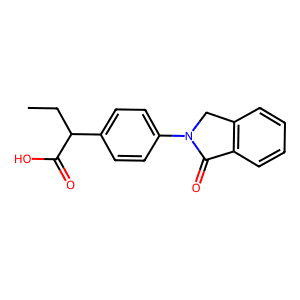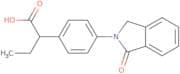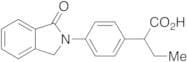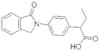
CAS 63610-08-2
:Indobufeno
- (2R)-2-[4-(1-oxo-1,3-dihydro-2H-isoindol-2-yl)phenyl]butanoic acid
- 1-Oxo-2-[p-[(α-ethyl)carboxymethyl]phenyl]isoindoline
- 2-(4-(1-Oxoisoindolin-2-yl)phenyl)butanoic acid
- 2-[4-(1-oxo-1,3-dihydro-2H-isoindol-2-yl)phenyl]butanoic acid
- 2-[p-(1-Oxo-2-isoindolinyl)phenyl]butyric acid
- 4-(1,3-Dihydro-1-oxo-(2H)-isoindol-2-yl)-alpha-ethylbenzeneacetic acid
- 4-(1,3-Dihydro-1-oxo-2H-isoindol-2-yl)-α-ethylbenzeneacetic acid
- Benzeneacetic acid, 4-(1,3-dihydro-1-oxo-2H-isoindol-2-yl)-α-ethyl-
- Ibustrin
- K 2930
- K 3920
- Ver más sinónimos
Indobufen
CAS:Fórmula:C18H17NO3Pureza:>98.0%(GC)(T)Forma y color:White to Light yellow powder to crystalPeso molecular:295.34(2S)-2-[4-(3-oxo-1H-isoindol-2-yl)phenyl]butanoic acid
CAS:Fórmula:C18H17NO3Pureza:97%Forma y color:SolidPeso molecular:295.3325Indobufen
CAS:Indobufen (Ibustrin) is an inhibitor of platelet aggregation and is a reversible platelet cyclooxygenase (Cox) activity inhibitor.Fórmula:C18H17NO3Pureza:99.27% - 99.44%Forma y color:SolidPeso molecular:295.332-(4-(1-Oxoisoindolin-2-Yl)Phenyl)Butanoic Acid
CAS:2-(4-(1-Oxoisoindolin-2-Yl)Phenyl)Butanoic AcidPureza:99%Peso molecular:295.33g/molIndobufen
CAS:Indobufen is a drug that belongs to the group of non-steroidal anti-inflammatory drugs. It has been shown to be effective in treating infectious diseases, including malaria and bacterial infections. Indobufen has been shown to inhibit the production of prostaglandin E2 (PGE2) in an experimental model at low doses. This inhibition leads to reduced levels of PGE2 receptor activity and decreased enzyme activities such as cyclooxygenase and lipoxygenase, which are involved in inflammation. This drug also inhibits platelet aggregation and increases bleeding time. The effects of indobufen on human pharmacokinetics have been studied using human serum and platelet samples from healthy volunteers. Indobufen is rapidly absorbed, with a half-life of 1 hour, and it is metabolized by cytochrome P450 (CYP450). Indobufen has also been shown to increase cardiac contractility without affecting heart rate or blood pressure levels.
Fórmula:C18H17NO3Pureza:Min. 95%Forma y color:PowderPeso molecular:295.33 g/molIndobufen
CAS:Producto controladoApplications Indobufen is a platelet aggregation inhibitor. Indobufen is the anticoagulant drug and platelet aggregation inhibitor, which has anti-inflammatory analgesic effect. Indobufen is used as an antithrombotic.
References Diener, H., et al.: J. Neurol. Sci., 143, 1 (1996), Brainin, M., et al.: Eur. J. Neurol., 7, 5 (2005), Culebras, A., et al.: Neurology, 62, 1073 (2004), Lopez, A., et al.: Lancet, 367, 1747 (2006),Fórmula:C18H17NO3Forma y color:NeatPeso molecular:295.33
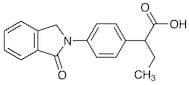

![(2S)-2-[4-(3-oxo-1H-isoindol-2-yl)phenyl]butanoic acid](/_next/image/?url=https%3A%2Fstatic.cymitquimica.com%2Fproducts%2FIN%2Fthumb%2FDA01CBW2.jpg&w=3840&q=75)