CAS 6552-68-7
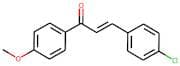
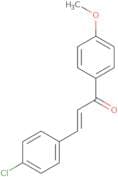
:3-(4-clorofenil)-1-(4-metoxifenil)prop-2-en-1-ona
Descripción:
3-(4-clorofenil)-1-(4-metoxifenil)prop-2-en-1-ona, también conocido como un tipo de chalcona, es un compuesto orgánico caracterizado por su sistema de enlaces dobles conjugados y la presencia de anillos aromáticos. Este compuesto presenta una estructura de prop-2-en-1-ona, que contribuye a su reactividad y potencial actividad biológica. La presencia de un grupo 4-clorofenilo y un grupo 4-metoxifenilo mejora su lipofilia y puede influir en su interacción con objetivos biológicos. Las chalconas son conocidas por sus diversas propiedades farmacológicas, incluyendo actividades antiinflamatorias, antioxidantes y anticancerígenas. La estructura del compuesto permite aplicaciones potenciales en química medicinal y ciencia de materiales. Se sintetiza típicamente a través de la reacción de condensación de Claisen-Schmidt, y sus propiedades pueden verse influenciadas por los sustituyentes en los anillos aromáticos. Al igual que con muchos compuestos orgánicos, se deben observar precauciones de seguridad y manejo, ya que puede exhibir toxicidad o efectos irritantes.
Fórmula:C16H13ClO2
InChI:InChI=1/C16H13ClO2/c1-19-15-9-5-13(6-10-15)16(18)11-4-12-2-7-14(17)8-3-12/h2-11H,1H3
SMILES:COc1ccc(cc1)C(=O)C=Cc1ccc(cc1)Cl
Ordenar por
Pureza (%)
0
100
|
0
|
50
|
90
|
95
|
100
Encontrado 2 productos.
3-(4-Chlorophenyl)-1-(4-methoxyphenyl)prop-2-en-1-one
CAS:3-(4-Chlorophenyl)-1-(4-methoxyphenyl)prop-2-en-1-onePureza:≥95%4-Chloro-4'-methoxychalcone
CAS:4-Chloro-4'-methoxychalcone (4MC) is a chalcone with an antibacterial activity. It is synthesized from 4,4'-dimethoxychalcone by substitution of one or two methoxy groups on the aromatic ring with chlorine atoms. 4MC has shown to be active against a number of different bacterial strains, including Staphylococcus aureus and Pseudomonas aeruginosa. The dilution method is used for the determination of the minimal inhibitory concentrations (MICs). This method involves serial dilutions in which bacteria are grown in liquid media containing increasing concentrations of the test compound. The lowest concentration of the test compound that inhibits bacterial growth is determined and recorded as MIC. Plutella xylostella larvae were found to be resistant to 4MC because they lack esterase enzymes that hydrolyze 4MC. Irradiation can be used to produce esters that are more reactive towardsFórmula:C16H13ClO2Pureza:Min. 95%Forma y color:PowderPeso molecular:272.73 g/mol