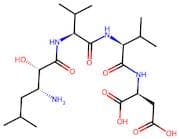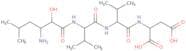
CAS 67655-94-1
:Amastatina
Descripción:
Amastatina es un inhibidor potente y selectivo de aminopeptidasas, particularmente efectivo contra la enzima aminopeptidasa N (APN). Es un compuesto que ocurre de forma natural derivado de la fermentación de ciertos microorganismos, específicamente de especies de actinobacterias. Amastatina se caracteriza por su capacidad para inhibir la hidrólisis de aminoácidos desde el N-terminal de los péptidos, lo que juega un papel crucial en varios procesos biológicos, incluyendo el metabolismo de proteínas y la modulación de la respuesta inmune. El compuesto ha despertado interés en la investigación farmacéutica debido a sus posibles aplicaciones en el tratamiento de enfermedades donde se implica la actividad de aminopeptidasa, como el cáncer y las infecciones virales. Amastatina se estudia típicamente en ensayos bioquímicos para evaluar su eficacia y especificidad, y su estructura incluye una disposición única de aminoácidos que contribuye a su actividad inhibitoria. Al igual que con muchos compuestos bioactivos, entender su mecanismo de acción y los posibles efectos secundarios es esencial para su desarrollo en contextos terapéuticos.
Fórmula:C21H38N4O8
InChI:InChI=1/C21H38N4O8/c1-9(2)7-12(22)17(28)20(31)25-16(11(5)6)19(30)24-15(10(3)4)18(29)23-13(21(32)33)8-14(26)27/h9-13,15-17,28H,7-8,22H2,1-6H3,(H,23,29)(H,24,30)(H,25,31)(H,26,27)(H,32,33)/t12-,13+,15+,16+,17+/m1/s1
Sinónimos:- Brn 4727847
- N-((2S,3R)-3-Amino-2-hydroxy-5-methyl-1-oxohexyl)-L-valyl-L-valyl-L-aspartic acid
- L-Aspartic acid, N-((2S,3R)-3-amino-2-hydroxy-5-methyl-1-oxohexyl)-L-valyl-L-valyl-
- L-Aspartic acid, N-(N-(3-amino-2-hydroxy-5-methyl-1-oxohexyl)-L-valyl)-L-valyl)-, (S-(R*,S*))-
- L-Aspartic acid, N-(N-(N-(3-amino-2-hydroxy-5-methyl-1-oxohexyl)-L-valyl)-L-valyl)-, (S-(R*,S*))-
- N-[(2S,3R)-3-amino-2-hydroxyheptanoyl]-L-norvalyl-L-norvalyl-L-aspartic acid
- N-[(2S,3R)-3-amino-2-hydroxy-5-methylhexanoyl]-L-valyl-L-valyl-L-aspartic acid
Ordenar por
Pureza (%)
0
100
|
0
|
50
|
90
|
95
|
100
Encontrado 5 productos.
Amastatin
CAS:AmastatinFórmula:C21H38N4O8Pureza:By hplc: >99% (Typical Value in Batch COA)Forma y color: white powderPeso molecular:474.55g/molAmastatin
CAS:Amastatin is a natural protease inhibitor that has been shown to bind to the active site of serine proteases, such as trypsin and chymotrypsin. It also binds to other peptide substrates, such as angiotensin II, vasopressin and bradykinin. Amastatin is used in research as a tool for the study of protein interactions, receptor-ligand binding and ion channel activity. Amastatin is an activator of the high-affinity state of the beta-adrenergic receptor.Fórmula:C21H38N4O8Pureza:Min. 95%Peso molecular:474.55 g/molAmastatin
CAS:Amastatin is a natural compound that possesses antimicrobial activity. Amastatin has been shown to bind to the enzyme aminopeptidase, which is involved in the synthesis of peptide hormones and peptides. Amastatin also inhibits the activity of polymerase chain, an enzyme that catalyzes the production of RNA from DNA. The binding of amastatin to these enzymes causes cell lysis, leading to cell death.Fórmula:C21H38N4O8Pureza:Min. 95%Peso molecular:474.5 g/molAmastatin
CAS:Amastatin is a non-toxic inhibitor of aminopeptidase A and leucine aminopeptidase, and its Ki for aminopeptidase A is 1 μM .Fórmula:C21H38N4O8Pureza:98%Forma y color:SolidPeso molecular:474.55Amastatin
CAS:Amastatin is a synthetic product that inhibits peptidases. It is an inhibitor of the protease enzyme and can be used in the treatment of bladder infections caused by Chlamydia parvum. Amastatin has also been shown to inhibit Aminopeptidase, which is an enzyme that cleaves amino acids from proteins, thereby inhibiting protein synthesis. Amastatin has been shown to have an inhibitory effect on proteases in the striatal membranes of rats and may be useful in treating neurodegenerative disorders such as Parkinson's disease.
Fórmula:C21H38N4O8Pureza:Min. 95%Peso molecular:474.55 g/mol