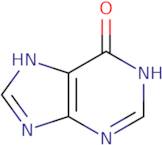
CAS 68-94-0
:hipoxantina
Descripción:
hipoxantina es una base purínica que juega un papel crucial en el metabolismo de los nucleótidos. Es un compuesto que se encuentra de forma natural en varios sistemas biológicos, particularmente como un producto del metabolismo de la adenina y la guanina. hipoxantina tiene la fórmula molecular C5H4N4O y una masa molar de aproximadamente 136.1 g/mol. Se caracteriza por su apariencia cristalina blanca a blanco sucio y es soluble en agua, con solubilidad limitada en disolventes orgánicos. hipoxantina está involucrado en varias vías bioquímicas, incluida la vía de recuperación de purinas, donde se convierte en monofosfato de inosina (IMP) por la enzima hipoxantina-guanina fosforribosiltransferasa (HGPRT). Este compuesto también es un precursor del ácido úrico, que es significativo en el contexto de la gota y otros trastornos metabólicos. Además, se ha estudiado hipoxantina por sus posibles roles en la señalización celular y como antioxidante. Su número CAS es 68-94-0, que lo identifica de manera única en las bases de datos químicas.
Fórmula:C5H4N4O
InChI:InChI=1S/C5H4N4O/c10-5-3-4(7-1-6-3)8-2-9-5/h1-2H,(H2,6,7,8,9,10)
Clave InChI:InChIKey=FDGQSTZJBFJUBT-UHFFFAOYSA-N
SMILES:O=C1C2=C(NC=N1)N=CN2
Sinónimos:- 1,7-Dihydro-6H-purin-6-one
- 1,9-Dihydro-6H-purin-6-one
- 1,9-Dihydro-purin-6-one
- 1H,7H-Hypoxanthine
- 1H,9H-Hypoxanthine
- 1H-Purin-6(9H)-one
- 3,5-dihydro-6H-purin-6-one
- 3,7-dihydro-6H-purin-6-one
- 3H-Purin-6-ol
- 6-Hydroxy-1H-purine
- 6-Hydroxypurine
- 6-Oxopurine
- 6H-Purin-6-one, 1,7-dihydro-
- 6H-Purin-6-one, 1,9-dihydro-
- 9H-Purin-6(1H)-one
- 9H-Purin-6-ol
- Hypoxanthine 6-Hydroxypurine
- Hypoxanthine enol
- Nsc 129419
- Nsc 14665
- Purin-6(1H)-on
- Purin-6(3H)-one
- Purin-6-ol
- Sarcine
- Sarkin
- Sarkine
- purin-6(1H)-ona
- purin-6(1H)-one
- purine-6(1H)-one
- Ver más sinónimos
Ordenar por
Pureza (%)
0
100
|
0
|
50
|
90
|
95
|
100
Hypoxanthine
CAS:Hypoxanthine is a nucleoside that is found in human cells. It is synthesized from guanine by the enzyme, xanthine oxidoreductase. Hypoxanthine is also produced from xanthine by adenosine deaminase and converted back to xanthine, which can then be reused for DNA synthesis. Hypoxanthine has been shown to inhibit the growth of photosynthetic bacteria, such as Rhodopseudomonas viridis and Rhodobacter sphaeroides. This inhibition may be due to an equilibrative nucleotide effect on the folate receptor. The x-ray diffraction data collected from the chrysanthemum flower (a source of hypoxanthine) showed that hypoxanthine has a calcium salt structure.
Fórmula:C5H4N4OPureza:Min. 95%Forma y color:White PowderPeso molecular:136.11 g/mol