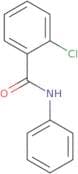
CAS 6833-13-2
:2-cloro-N-fenilbenzamida
Descripción:
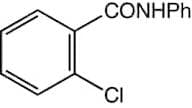
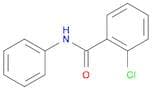
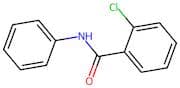
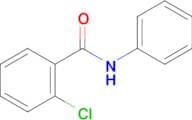
2-cloro-N-fenilbenzamida es un compuesto orgánico caracterizado por su grupo funcional amida, que consiste en un anillo de benceno sustituido con un grupo cloro y un grupo N-fenilo. Este compuesto típicamente aparece como un sólido a temperatura ambiente y es soluble en disolventes orgánicos. La presencia del sustituyente cloro introduce una reactividad única, haciéndolo útil en varias reacciones químicas, incluyendo sustituciones nucleofílicas y reacciones de acoplamiento. El enlace amida contribuye a su estabilidad e influye en sus propiedades físicas, como los puntos de fusión y ebullición. Además, 2-cloro-N-fenilbenzamida puede exhibir actividad biológica, lo que lo hace de interés en la investigación farmacéutica. Su estructura molecular permite interacciones potenciales con objetivos biológicos, que pueden ser exploradas para aplicaciones terapéuticas. Al igual que con muchos compuestos clorados, es esencial manejar esta sustancia con cuidado debido a su potencial toxicidad y preocupaciones ambientales. Se deben observar las medidas de seguridad adecuadas al trabajar con este químico en entornos de laboratorio.
Fórmula:C13H10ClNO
InChI:InChI=1/C13H10ClNO/c14-12-9-5-4-8-11(12)13(16)15-10-6-2-1-3-7-10/h1-9H,(H,15,16)
SMILES:c1ccc(cc1)N=C(c1ccccc1Cl)O
Sinónimos:- Benzamide, 2-chloro-N-phenyl-
Ordenar por
Pureza (%)
0
100
|
0
|
50
|
90
|
95
|
100
Encontrado 5 productos.
2-Chloro-N-phenylbenzamide, 97%
CAS:This Thermo Scientific Chemicals brand product was originally part of the Alfa Aesar product portfolio. Some documentation and label information may refer to the legacy brand. The original Alfa Aesar product / item code or SKU reference has not changed as a part of the brand transition to Thermo Sci
Fórmula:C13H10ClNOPureza:97%Peso molecular:231.682-Chlorobenzanilide
CAS:2-Chlorobenzanilide is a chlorine compound that has been used to inhibit the growth of soil microorganisms. It is also an inhibitor of phenanthridone, which is an important intermediate in the synthesis of many herbicides. 2-Chlorobenzanilide can be prepared by reacting phenylhydrazine with chloroacetanilide. It can also be prepared by treating benzene with phosphorus chloride and then adding aniline to the reaction product. The rate of this reaction depends on the concentration of reactants, temperature, and pH. If more water is added to the reaction mixture, there will be a lower rate of reaction because hydroxide ions will compete with chloride ions for reactant molecules. The kinetic equation for this reaction follows:Fórmula:C13H10ClNOPureza:Min. 95%Peso molecular:231.68 g/mol