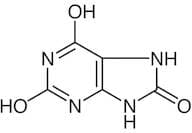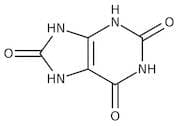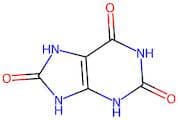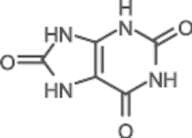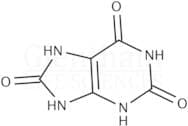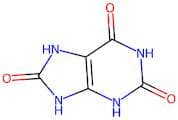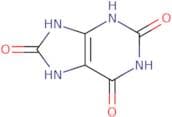
CAS 69-93-2
:Ácido úrico
- 1H-Purine-2,6,8(3H)-trione, 7,9-dihydro-
- 1H-Purine-2,6,8-triol
- 2,3,6,7,8,9-Hexahydro-1H-purine-2,6,8-trione
- 2,6,8-Trihydroxypurine
- 2,6,8-Trioxopurine
- 2,6,8-Trioxypurine
- 6,8(3H)-trione,7,9-dihydro-1H-Purine-2
- 7,9-Dihydro-1H-purine-2,6,8(3H)-trione
- 8(3H)-Trione,7,9-Dihydro-1H-Purine-6
- Acide urique
- Acido Urico
- Harnsaure
- Lithic acid
- Nsc 3975
- Purine-2,6,8(1H,3H,9H)-trione
- Purine-3,6,8(1H,3H,9H)-trione
- Uric acid hyperuricemia
- Ver más sinónimos
Uric Acid
CAS:Fórmula:C5H4N4O3Pureza:>98.0%(T)Forma y color:White to Light yellow powder to crystalPeso molecular:168.11Uric acid, 99%
CAS:Uric acid acts as a strong reducing agent (electron donors) and potent antioxidant. It is used as a precursor in cell culture systems and in cosmetics. Further, it is useful for serum-free medium supplement. In addition to this, it is used as a reagent in the determination of uricase and tungstate.
Fórmula:C5H4N4O3Pureza:99%Forma y color:White to pale cream, Powder or crystals or crystalline powderPeso molecular:168.112,3,6,7,8,9-hexahydro-1H-purine-2,6,8-trione
CAS:Fórmula:C5H4N4O3Pureza:98%Forma y color:SolidPeso molecular:168.1103Uric Acid
CAS:Uric Acid (Lithic acid) is an oxidation product of oxypurines. Uric Acid is the final oxidation product of purine catabolism in humans and primates.Fórmula:C5H4N4O3Pureza:97.10% - 99.62%Forma y color:White Or Off-White Powder Or CrystalsPeso molecular:168.11Uric acid
CAS:Fórmula:C5H4N4O3Pureza:≥ 99.0%Forma y color:White to off-white crystalline powderPeso molecular:168.11Uric acid
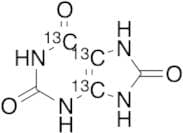
CAS:Uric acidFórmula:C5H4N4O3Pureza:By hplc: 99.0% by area (Typical Value in Batch COA)Forma y color: white to slightly off white crystlaline powderPeso molecular:168.11g/molUric Acid-13C3
CAS:Producto controladoApplications Isotope labelled Uric Acid is a heterocyclcic compound that is created when purine nucleotides are broken down of by the human body. High blood concetration of Uric Acid is known as hyperuricemia and is often associated with a wide range of disorders and medical conditions such as gout, diabetes and metabolic syndrome. Uric acid may be a marker of oxidative stress and may have a potential therapeutic role as an antioxidant.
References Heinig, M. et al.: Cle. Clin. J. Med., 73, 1059 (2006); Glantzounis, G.K. et al.: Curr. Pharmac. Des., 11, 4145 (2005); Dehghan, A. et al.: Diab. Care, 31, 361 (2008); Nakagawa, T. et al.: Am. J. Physiol. Renal Physiol., 290, F625 (2006);Fórmula:C213C3H4N4O3Forma y color:NeatPeso molecular:171.09Uric Acid
CAS:Applications Uric Acid is a heterocyclcic compound that is created when purine nucleotides are broken down of by the human body. High blood concetration of Uric Acid is known as hyperuricemia and is often associated with a wide range of disorders and medical conditions such as gout, diabetes and metabolic syndrome. Uric acid may be a marker of oxidative stress and may have a potential therapeutic role as an antioxidant.
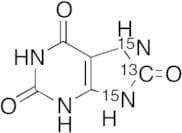
References Heinig, M. et al.: Cle. Clin. J. Med., 73, 1059 (2006); Glantzounis, G.K. et al.: Curr. Pharmac. Des., 11, 4145 (2005); Dehghan, A. et al.: Diab. Care, 31, 361 (2008); Nakagawa, T. et al.: Am. J. Physiol. Renal Physiol., 290, F625 (2006);Fórmula:C5H4N4O3Forma y color:NeatPeso molecular:168.11Uric Acid-13C,15N2
CAS:Producto controladoFórmula:CC4H415N2N2O3Forma y color:Off-White To Light YellowPeso molecular:171.09Uric acid
CAS:For the quantitative enzymatic determination of uric acid in serum. Uric acid measurements are useful in the diagnosis of numerous renal and metabolic disorders. Uric acid is a substrate for the enzyme uricase. Uric acid is oxidized by oxygen in a reaction catalyzed by the enzyme uricase forming hydrogen peroxide and allantoin. Production of hydrogen peroxide can be assayed by 4-aminoantipyrine (4-AAP) in combination with 2-hydroxy-3,5-dichloro-benzenesulfonate (HDCBS) in the presence of horseradish peroxidase (HRP) through the production of an intensely red dye.Fórmula:C5H4N4O3Pureza:Min. 99.0 Area-%Peso molecular:168.11 g/molUric Acid extrapure AR, 99%
CAS:Fórmula:C5H4N4O3Pureza:min. 99%Forma y color:White to off - white, Crystalline compound, Clear, Colourless to pale yellowPeso molecular:168.11