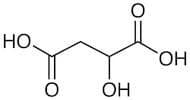
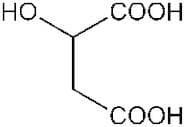
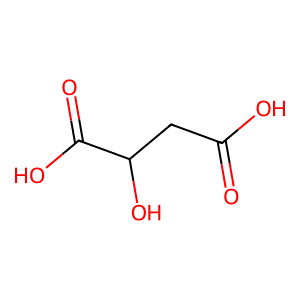
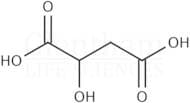
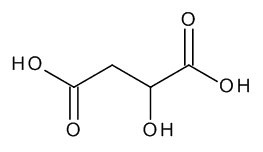
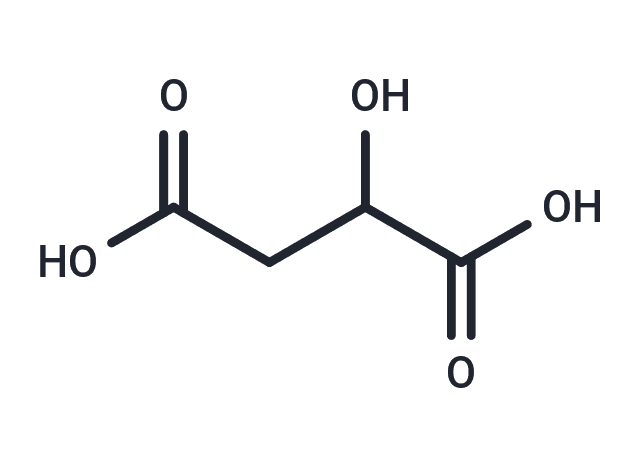
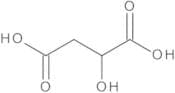
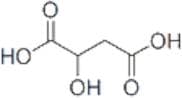
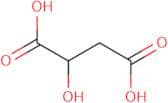
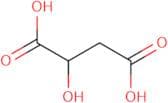
CAS 6915-15-7
:Ácido málico
- (2R)-2-hydroxybutanedioate
- 2-Hydroxybutanedioic Acid
- 2-Hydroxyethane-1,2-dicarboxylic acid
- 2-Hydroxysuccinic acid
- <span class="text-smallcaps">DL</span>-Malic acid
- Acide malique
- Acido Malico
- Apfelsaeure
- Apfelsaure
- Butanedioic Acid, Hydroxy-, (D,L)-
- Butanedioic acid, 2-hydroxy-
- Butanedioic acid, hydroxy-
- DL-Hydroxysuccinic acid
- Deoxytetraric acid
- Dl-Malic Acid, Hydroxysuccinic Acid
- E 296
- Fda 2018
- Hydroxybutanedioic acid
- Hydroxysuccinic acid
- Malic Acid, Dl
- Malic acid
- Malicacidpfelsure
- Monohydroxybutanedioic acid
- Musashi-no-Ringosan
- Nanoveson M
- Nsc 25941
- Pomalus Acid
- Purac MA
- Purac Powder MA
- R,S(.+-.)-Malic acid
- Xeros
- Ver más sinónimos
DL-Malic Acid
CAS:Fórmula:C4H6O5Pureza:>99.0%(T)Forma y color:White to Almost white powder to crystalPeso molecular:134.09DL-Malic acid, 98%
CAS:DL-Malic acid is used as a food additive. It is a component of some artificial vinegar flavors. Further, it is used in the preparation of chiral compounds, including -opioid rece. It is utilized for chiral resolution by ligand-exchange capillary electrophoresis. This Thermo Scientific Chemicals braFórmula:C4H6O5Pureza:98%Forma y color:White to cream, Crystalline powder or crystalsPeso molecular:134.09Malic Acid
CAS:Carboxylic acids w/ alcohol function but w/o other oxygen function and their derivatives, nesoiFórmula:C4H6O5Forma y color:White Crystalline PowderPeso molecular:134.02152DL-Malic acid
CAS:Fórmula:C4H6O5Pureza:99.0 - 100.5 %Forma y color:White crystalline powderPeso molecular:134.09Malic acid
CAS:Malic acid reduces L. monocytogenes in poultry and may help treat calcium kidney stones.Fórmula:C4H6O5Pureza:99.86% - BRForma y color:Colorless Crystals DrypowderPeso molecular:134.09DL-Malic Acid
CAS:Applications The naturally occuring isomer is the L-form which has been found in apples and many other fruits and plants. Selective α-amino protecting reagent for amino acid derivatives. Versatile synthon for the preparation of chiral compounds including κ-opioid receptor agonists, 1α,25-dihydroxyvitamin D3 analogue, and phoslactomycin B.
References Rindi, G., et al.: Biochem. J., 80, 214 (1961), Wolfgang, M., et al.: J. Biol. Chem., 281, 37265 (2006), Navarro, D., et al.: Metab. Brain Dis., 23, 115 (2008),Fórmula:C4H6O5Forma y color:WhitePeso molecular:134.09DL-Malic Acid pure, 99%
CAS:Fórmula:C4H6O5Pureza:min. 99%Forma y color:White, Crystalline compound, Clear, ColourlessPeso molecular:134.09DL-Malic acid - food grade
CAS:DL-Malic acid is an organic acid that plays a role in the citric acid cycle. It is also used as an antimicrobial agent, and has been shown to be effective against fungi and bacteria. DL-Malic acid binds to the active site of complex enzymes involved in energy metabolism and has been shown to inhibit transcriptional regulation of numerous genes. DL-Malic acid has also shown to have a positive effect on metabolic disorders such as diabetes mellitus and hypoglycemia. DL-Malic acid may be synthesized with sodium salts or sodium citrate, depending on the desired end product. This compound can also be produced by laser ablation of malonic acid or by enzymatic oxidation of tartaric acid, which is a natural source of this chemical.
Fórmula:C4H6O5Pureza:Min. 95%Peso molecular:134.09 g/molDL-Malic acid
CAS:DL-Malic acid is a natural product that can be found in plants and animals. It is a white crystalline solid with an acidic taste. DL-Malic acid has been shown to have many biological properties, including inhibition of the HIV-1 protease enzyme, inhibition of the citric acid cycle enzyme aconitase, and inhibition of the mammalian fatty acid synthase enzyme. DL-Malic acid also has binding constants to other molecules and structures that are useful for analytical methods such as surface methodology, chemical structures, and hydrogen bonds. DL-Malic acid is soluble in water, alcohols, ethers, acetone and chloroform.
Fórmula:C4H6O5Pureza:Min. 95%Peso molecular:134.09 g/mol