CAS 7085-55-4
:Troxerutina
Descripción:
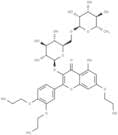
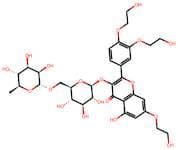
Troxerutina, con el número CAS 7085-55-4, es un compuesto flavonoide derivado de la familia de la rutina, conocido principalmente por sus propiedades antioxidantes y antiinflamatorias. Es un derivado semisintético de la rutina, que mejora su biodisponibilidad y efectos terapéuticos. Troxerutina se utiliza comúnmente en el tratamiento de la insuficiencia venosa y condiciones relacionadas debido a su capacidad para mejorar la microcirculación y fortalecer las paredes capilares. El compuesto exhibe una variedad de actividades farmacológicas, incluyendo efectos anti-edematosos, que ayudan a reducir la hinchazón y mejorar el flujo sanguíneo. Además, se ha estudiado por sus posibles efectos neuroprotectores y su papel en la gestión del estrés oxidativo. Troxerutina se administra típicamente en formas orales o tópicas, y su perfil de seguridad es generalmente favorable, con pocos efectos secundarios reportados. Su solubilidad en agua es moderada, lo que influye en su absorción y eficacia en varias formulaciones. En general, Troxerutina es reconocido por sus efectos beneficiosos en la salud vascular y sus posibles aplicaciones en diversas áreas terapéuticas.
Fórmula:C22H34O3
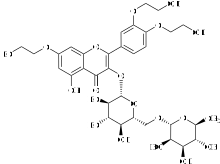
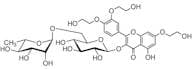
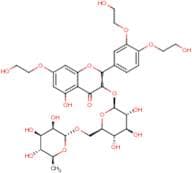
InChI:InChI=1/C33H42O19/c1-14-23(38)26(41)28(43)32(49-14)48-13-21-24(39)27(42)29(44)33(51-21)52-31-25(40)22-17(37)11-16(45-7-4-34)12-20(22)50-30(31)15-2-3-18(46-8-5-35)19(10-15)47-9-6-36/h2-3,10-12,14,21,23-24,26-29,32-39,41-44H,4-9,13H2,1H3/t14-,21+,23-,24+,26+,27-,28+,29+,32+,33?/m0/s1
Clave InChI:InChIKey=IYVFNTXFRYQLRP-VVSTWUKXSA-N
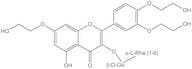
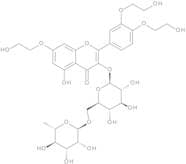
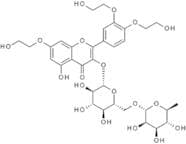
SMILES:O(C1=C(OC=2C(C1=O)=C(O)C=C(OCCO)C2)C3=CC(OCCO)=C(OCCO)C=C3)[C@@H]4O[C@H](CO[C@H]5[C@H](O)[C@H](O)[C@@H](O)[C@H](C)O5)[C@@H](O)[C@H](O)[C@H]4O
Sinónimos:- 2-[3,4-Bis(2-hydroxyethoxy)phenyl]-3-[[6-O-(6-deoxy-α-<span class="text-smallcaps">L</smallcap>-mannopyranosyl)-β-<smallcap>D</span>-glucopyranosyl]oxy]-5-hydroxy-7-(2-hydroxyethoxy)-4H-1-benzopyran-4-one
- 2-[3,4-bis(2-hydroxyethoxy)phenyl]-5-hydroxy-7-(2-hydroxyethoxy)-4-oxo-4H-chromen-3-yl 6-O-(6-deoxy-alpha-L-mannopyranosyl)-D-glucopyranoside
- 2-[3,4-bis(2-hydroxyethoxy)phenyl]-5-hydroxy-7-(2-hydroxyethoxy)-4-oxo-4H-chromen-3-yl 6-O-(6-deoxy-alpha-L-mannopyranosyl)-beta-D-glucopyranoside
- 2-[3,4-bis(2-hydroxyethoxy)phenyl]-5-hydroxy-7-(2-hydroxyethoxy)-4-oxo-4H-chromen-3-yl 6-O-(6-deoxyhexopyranosyl)hexopyranoside
- 3',4',7-Tris[O-(2-hydroxyethyl)]rutin
- 3,5-Dihydroxy-3′,4′,7-tris(2-hydroxyethoxy)flavone 3-rutinoside
- 3′,4′,7-Tri-O-(β-hydroxyethyl)rutoside
- 3′,4′,7-Tris(hydroxyethyl)rutin
- 4H-1-Benzopyran-4-one, 2-[3,4-bis(2-hydroxyethoxy)phenyl]-3-[[6-O-(6-deoxy-α-<span class="text-smallcaps">L</smallcap>-mannopyranosyl)-β-<smallcap>D</span>-glucopyranosyl]oxy]-5-hydroxy-7-(2-hydroxyethoxy)-
- Factor P-Zyma
- Flavone, 3,5-dihydroxy-3′,4′,7-tris(2-hydroxyethoxy)-, 3-[6-O-(6-deoxy-α-<span class="text-smallcaps">L</smallcap>-mannopyranosyl)-β-<smallcap>D</span>-glucopyranoside]
- Posorutin
- Rufen-P4
- Ruven
- Toxerutin
- TriHER
- Trihydroxylrutin
- Trioxyethylrutin
- Tris(hydroxyethyl)rutin
- Tris(hydroxyethyl)rutoside
- Tris-O-(2-hydroxyethyl)rutin
- Tris-O-(β-hydroxyethyl)rutoside
- Troxerutin
- Troxerutine
- Troxevazin
- Vastribil
- Veinamitol
- Veniten
- Venoruton P<sub>4</sub>
- Vitamin P<sub>4</sub>
- Z 6000
- 2-[3,4-Bis(2-hydroxyethoxy)phenyl]-3-[[6-O-(6-deoxy-α-L-mannopyranosyl)-β-D-glucopyranosyl]oxy]-5-hydroxy-7-(2-hydroxyethoxy)-4H-1-benzopyran-4-one
- Flavone, 3,5-dihydroxy-3′,4′,7-tris(2-hydroxyethoxy)-, 3-[6-O-(6-deoxy-α-L-mannopyranosyl)-β-D-glucopyranoside]
- 4H-1-Benzopyran-4-one, 2-[3,4-bis(2-hydroxyethoxy)phenyl]-3-[[6-O-(6-deoxy-α-L-mannopyranosyl)-β-D-glucopyranosyl]oxy]-5-hydroxy-7-(2-hydroxyethoxy)-
- 2-[3,4-BIS(2-HYDROXYETHOXY)PHENYL]-3-[[6-O-(6-O-DEOXY-A-L-MANNOPYRANOSYL)-BETA-D-GLUCOPYRANOSYL]OXY]-5-HYDROXY-7-(2-HYDROXYETHOXY)-4H-1-BENZOPYRAN-4-ONE
- Venoruton
- 3μ,4μ,7-Tris[O-(2-hydroxyethyl)]rutin, Troxerutin
- Troxerutin,Trihydroxyethylrutin
- 4H-1-Benzopyran-4-one, 2-3,4-bis(2-hydroxyethoxy)phenyl-3-6-O-(6-deoxy-.alpha.-L-mannopyranosyl)-.beta.-D-glucopyranosyloxy-5-hydroxy-7-(2-hydroxyethoxy)-
- 3,5-Dihydroxy-3',4',7-tris(2-hydroxyethoxy)flavone 3-rutinoside
- Trihydroxyethylrutoside
- VITAMIN P4 (TROXERUTIN)
- 7,3’,4’-tris[O-(2-hydroxyethyl)]rutin
- 2-[3,4-Bis(2-hydroxethoxy)phenyl]-3-[[6-O-(6-O-deoxy-a-L-mannopyranosyl)-B-D-glucopyranosyl]oxy]-5-hydroxy-7-(2-hydroxyethoxy)-4H-1-benzopyran-4-one, Posorutin, Ruven, Vastribil,
- TRIHYDROXYETHYLRUTIN
- Ver más sinónimos
Ordenar por
Pureza (%)
0
100
|
0
|
50
|
90
|
95
|
100
Encontrado 15 productos.
4H-1-Benzopyran-4-one,2-[3,4-bis(2-hydroxyethoxy)phenyl]-3-[[6-O-(6-deoxy-a-L-mannopyranosyl)-b-D-glucopyranosyl]oxy]-5-hydroxy-7-(2-hydroxyethoxy)-
CAS:Fórmula:C33H42O19Pureza:%Forma y color:SolidPeso molecular:742.6752Troxerutin
CAS:Troxerutin (Trihydroxyethylrutin), a natural bioflavonoid, is isolated from Sophora japonica. It has many benefits and medicinal properties.Fórmula:C33H42O19Pureza:98.28% - 99.24%Forma y color:Light Yellow PowderPeso molecular:742.68Troxerutin
CAS:Fórmula:C33H42O19Pureza:>90.0%(HPLC)Forma y color:White to Orange to Green powder to crystalPeso molecular:742.68Tris-o-(2-hydroxyethyl)rutin
CAS:Rutin derivativeFórmula:C33H42O19Pureza:≥ 80.0 % (HPLC)Forma y color:PowderPeso molecular:742.69Troxerutin-d12 (>85%)
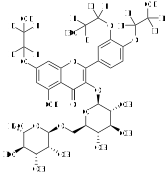
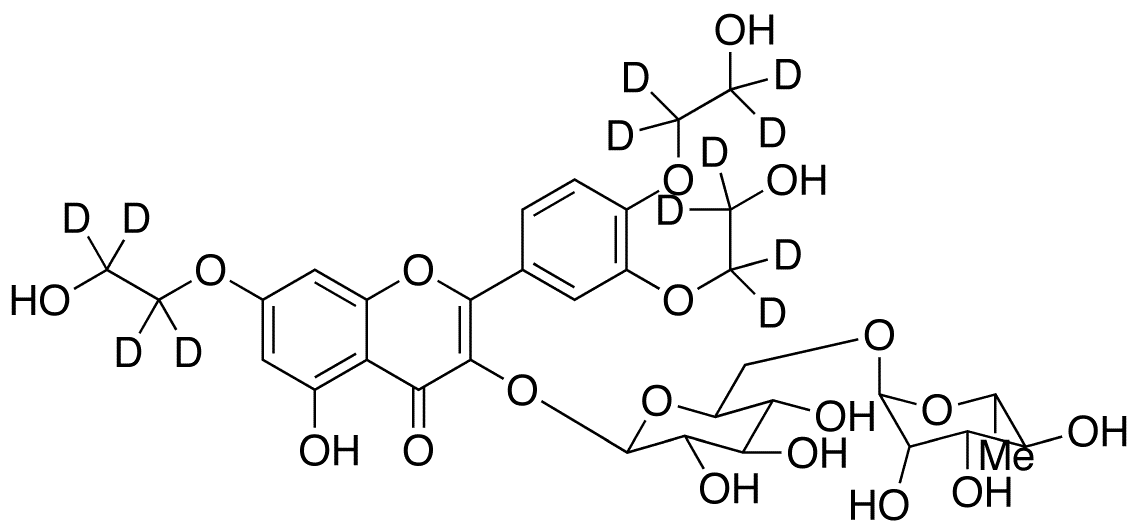
CAS:Producto controladoFórmula:C33D12H30O19Pureza:>85%Forma y color:NeatPeso molecular:754.749Troxerutin (85%)
CAS:Applications Used in the treatment of venous disorders.
References Courbat, P., et al.: Helv. Chim. Acta, 49, 1203 (1966), Hackett, A.M., et al.: Arzneim.-Forsch., 26, 925 (1976),Fórmula:C33H42O19Pureza:85%Forma y color:NeatPeso molecular:742.68Troxerutin
CAS:Troxerutin is a flavonoid compound, which is derived from the natural bioflavonoid rutin, typically sourced from plants such as Sophora japonica. Its mode of action is primarily through its vasoprotective, antioxidant, and anti-inflammatory properties. Troxerutin acts by stabilizing vascular endothelial cells, reducing capillary permeability, and enhancing microcirculation. It also scavenges free radicals and inhibits lipid peroxidation, which helps in mitigating oxidative stress.Fórmula:C33H42O19Pureza:Min. 95%Forma y color:Yellow PowderPeso molecular:742.68 g/mol


![4H-1-Benzopyran-4-one,2-[3,4-bis(2-hydroxyethoxy)phenyl]-3-[[6-O-(6-deoxy-a-L-mannopyranosyl)-b-D-…](/_next/image/?url=https%3A%2Fstatic.cymitquimica.com%2Fproducts%2FIN%2Fthumb%2FDA00IC3Y.jpg&w=3840&q=75)