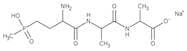
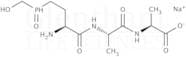
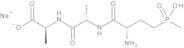
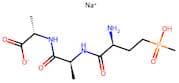
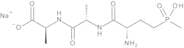
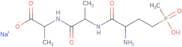
CAS 71048-99-2
:sal sódica de bilanafos
Descripción:
sal sódica de bilanafos, con el número CAS 71048-99-2, es un compuesto químico conocido principalmente por su aplicación como fungicida. Pertenece a la clase de derivados del ácido fosfónico y exhibe propiedades que lo hacen efectivo contra una variedad de patógenos fúngicos. El compuesto se caracteriza típicamente por su capacidad para inhibir la síntesis de ciertos metabolitos esenciales en los hongos, interrumpiendo así su crecimiento y reproducción. sal sódica de bilanafos es soluble en agua, lo que mejora su utilidad en formulaciones agrícolas. Su modo de acción implica la interferencia con la biosíntesis de ácidos nucleicos y proteínas en los organismos objetivo. Además, es importante señalar que, aunque el bilanafos es efectivo en el control de enfermedades fúngicas, su uso está sujeto a pautas regulatorias para garantizar la seguridad de los humanos, los animales y el medio ambiente. Al igual que con muchos agroquímicos, las prácticas adecuadas de manejo y aplicación son esenciales para minimizar los riesgos potenciales asociados con su uso.
Fórmula:C11H22N3O6P·Na
InChI:InChI=1S/C11H22N3O6P.Na/c1-6(9(15)14-7(2)11(17)18)13-10(16)8(12)4-5-21(3,19)20;/h6-8H,4-5,12H2,1-3H3,(H,13,16)(H,14,15)(H,17,18)(H,19,20);/t6-,7-,8-;/m0./s1
Clave InChI:InChIKey=LTQMGPNHTOPWMM-WQYNNSOESA-N
SMILES:[C@H](C(N[C@H](C(O)=O)C)=O)(NC([C@H](CCP(C)(=O)O)N)=O)C.[Na]
Sinónimos:- (2S)-2-{[(2S)-2-({(2S)-2-Amino-4-[hydroxy(methyl)phosphoryl]butanoyl}amino)propanoyl]amino}propanoic acid
- 35597-43-4
- 4-[Hydroxy(methyl)phosphinoyl]-L-homoalanyl-L-alanyl-L-alanine
- <span class="text-smallcaps">L</smallcap>-Alanine, (2S)-2-amino-4-(hydroxymethylphosphinyl)butanoyl-<smallcap>L</span>-alanyl-, monosodium salt
- <span class="text-smallcaps">L</smallcap>-Alanine, (2S)-2-amino-4-(hydroxymethylphosphinyl)butanoyl-<smallcap>L</span>-alanyl-, sodium salt (1:1)
- <span class="text-smallcaps">L</smallcap>-Alanine, γ-(hydroxymethylphosphinyl)-<smallcap>L</smallcap>-α-aminobutyryl-<smallcap>L</span>-alanyl-, monosodium salt
- Bialaphos sodium salt
- Bilanafos sodium
- Bilanafos sodium salt
- Bilanaphos sodium
- Bilanaphos sodium salt
- Herbi-Ace
- Herbie
- L-alanine, N-[(2S)-2-amino-4-(hydroxymethylphosphinyl)-1-oxobutyl]-L-alanyl-
- Mw 801
- N-{(2S)-2-Amino-4-[hydroxy(methyl)phosphoryl]butanoyl}-L-alanyl-L-alanin
- Sf 1293
- L-Alanine, γ-(hydroxymethylphosphinyl)-L-α-aminobutyryl-L-alanyl-, monosodium salt
- N-{(2S)-2-Amino-4-[hydroxy(méthyl)phosphoryl]butanoyl}-L-alanyl-L-alanine
- N-{(2S)-2-Amino-4-[hydroxy(methyl)phosphoryl]butanoyl}-L-alanyl-L-alanine
- L-Alanine, (2S)-2-amino-4-(hydroxymethylphosphinyl)butanoyl-L-alanyl-, sodium salt (1:1)
- Ver más sinónimos
Ordenar por
Pureza (%)
0
100
|
0
|
50
|
90
|
95
|
100
Encontrado 7 productos.
Bialaphos sodium, 85%
CAS:Bialaphos (bilanafos) sodium, 71048-99-2, is a salt form of bialaphos, a tripeptide phytotoxin with herbicidal properties produced in specific Streptomyces species. Learn more.Fórmula:C11H21N3NaO6PPureza:85%Forma y color:Pale orange, PowderPeso molecular:345.27Bialaphos sodium salt
CAS:Fórmula:C11H21N3O6P·NaPureza:≥ 80.0%Forma y color:White to light-brown crystalline powderPeso molecular:345.27Bilanafos sodium 100 µg/mL in Water
CAS:Fórmula:C11H21N3O6P·NaForma y color:Single SolutionPeso molecular:345.26Bialaphos sodium salt
CAS:Bialaphos sodium saltFórmula:C11H21N3O6P·NaPureza:By hplc: 93.4% (Typical Value in Batch COA)Forma y color: pale orange-coloured powderPeso molecular:345.26g/molBialaphos Sodium Salt
CAS:Stability Hygroscopic
Applications Bialaphos Sodium Salt is a herbicide.
Not a dangerous good if item is equal to or less than 1g/ml and there is less than 100g/ml in the package
References Mase, S.: Japan Pesticide Info., 45, 27 (1984)Fórmula:C11H21N3O6P·NaForma y color:WhitePeso molecular:345.26Bialaphos sodium
CAS:Bialaphos is a plant growth regulator that inhibits the growth of bacteria, fungi and other microorganisms. It acts by binding to bacterial ribosomes and interfering with protein synthesis. Bialaphos also has an effect on plants, as it inhibits the production of chlorophyll in marine organisms and plantlets. It is not active against Gram-positive bacteria such as Staphylococcus aureus or Enterococcus faecalis. Bialaphos has been shown to be effective against Gram-negative bacteria such as Pseudomonas aeruginosa and Escherichia coli. Resistance to Bialaphos has been observed in some Gram-positive organisms, including Staphylococcus aureus, Enterococcus faecalis, Bacillus subtilis, and Bacillus cereus. This resistance may be due to mutations in the 16S ribosomal RNA gene which results in an alteration of the shape of the molecule's binding site for BFórmula:C11H21N3NaO6PPureza:Min. 95%Peso molecular:345.26 g/mol