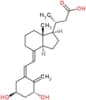
CAS 71204-89-2
:Ácido calcitróico
Descripción:
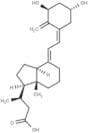
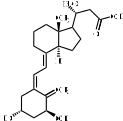
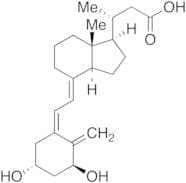
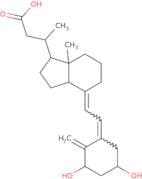
Ácido calcitróico, con el número CAS 71204-89-2, es un compuesto químico que sirve como metabolito del calcitriol, la forma activa de la vitamina D. Se caracteriza por su papel en la regulación del metabolismo del calcio y el fosfato en el cuerpo. Estructuralmente, Ácido calcitróico presenta un grupo hidroxilo y un grupo ácido carboxílico, que contribuyen a su solubilidad en agua y su actividad biológica. Este compuesto está principalmente involucrado en la regulación de retroalimentación de los niveles de vitamina D, influyendo en la síntesis y degradación del calcitriol. Su presencia en sistemas biológicos es significativa para mantener la salud ósea y la homeostasis del calcio. Además, Ácido calcitróico puede tener implicaciones en varios procesos fisiológicos, incluida la función inmunológica y la diferenciación celular. Si bien las aplicaciones específicas en medicina o industria pueden no estar ampliamente documentadas, comprender sus vías bioquímicas es crucial para entender el metabolismo de la vitamina D y sus efectos en la salud humana.
Fórmula:C23H34O4
InChI:InChI=1S/C23H34O4/c1-14(11-22(26)27)19-8-9-20-16(5-4-10-23(19,20)3)6-7-17-12-18(24)13-21(25)15(17)2/h6-7,14,18-21,24-25H,2,4-5,8-13H2,1,3H3,(H,26,27)/b16-6+,17-7-/t14-,18-,19-,20+,21+,23-/m1/s1
Clave InChI:InChIKey=MBLYZRMZFUWLOZ-ZTIKAOTBSA-N
SMILES:C[C@@]12[C@](\C(=C\C=C\3/C(=C)[C@@H](O)C[C@H](O)C3)\CCC1)(CC[C@@]2([C@@H](CC(O)=O)C)[H])[H]
Sinónimos:- (βR,1R,3aS,4E,7aR)-4-[(2Z)-2-[(3S,5R)-3,5-Dihydroxy-2-methylenecyclohexylidene]ethylidene]octahydro-β,7a-dimethyl-1H-indene-1-propanoic acid
- 1α-Hydroxycalcioic acid
- 1H-Indene-1-propanoic acid, 4-[(2Z)-2-[(3S,5R)-3,5-dihydroxy-2-methylenecyclohexylidene]ethylidene]octahydro-β,7a-dimethyl-, (βR,1R,3aS,4E,7aR)-
- 24-Nor-9,10-secochola-5,7,10(19)-trien-23-oic acid, 1,3-dihydroxy-, (1α,3β,5Z,7E)-
- Calcitroic acid
Ordenar por
Pureza (%)
0
100
|
0
|
50
|
90
|
95
|
100
Encontrado 5 productos.
Calcitroic acid
CAS:Calcitroic acid is a vitamin D receptor (VDR) agonist that activates VDR-mediated transcription. It is the primary metabolite of 1,25-dihydroxyvitamin D3, showing the highest concentrations in the liver and mucosa of mice. The compound exhibits metabolic stability and extremely low toxicity.Fórmula:C23H34O4Forma y color:SolidPeso molecular:374.514Calcitroic Acid
CAS:Producto controladoStability Light Sensitive
Applications Calcitroic Acid is a major metabolite of Calcitriol (C144500).
Not a dangerous good if item is equal to or less than 1g/ml and there is less than 100g/ml in the package
References Esvelt, R.P. et al.: Arch. Biochem. Biophys., 206, 403 (1981); Onisko, B.L. et al.: Biochemistry, 19, 4124 (1980); Reddy, G.S. et al.: Biochemistry, 28, 1763 (1989);Fórmula:C23H34O4Pureza:>85%Forma y color:NeatPeso molecular:374.51Calcitroic acid
CAS:Calcitroic acid is a metabolite of vitamin D, which is derived from the enzymatic degradation of calcitriol, the hormonally active form of vitamin D3. This compound is found within biological systems as a result of the breakdown processes occurring in the liver and kidneys, orchestrated by specific enzyme activities that convert calcitriol into calcitroic acid. Its mode of action involves participation in the metabolic pathways that facilitate the regulation of calcium and phosphate homeostasis in the body, albeit as a less active form compared to its precursor, calcitriol.Fórmula:C23H34O4Pureza:Min. 95%Peso molecular:374.5 g/mol