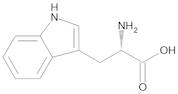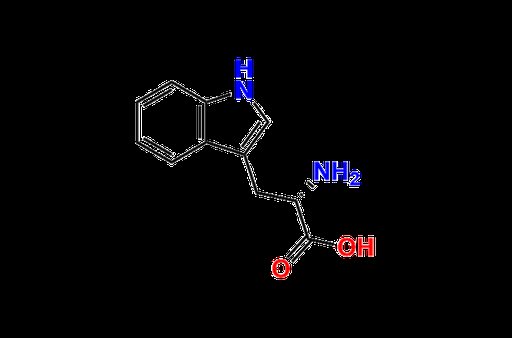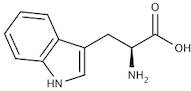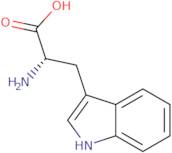
CAS 73-22-3
:L-Triptófano
Descripción:
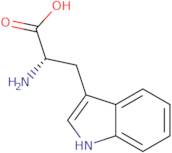
L-Triptófano es un aminoácido esencial que desempeña un papel crucial en la síntesis de proteínas y sirve como precursor de varias biomoléculas importantes, incluyendo serotonina, melatonina y niacina. Se clasifica como un aminoácido no polar e hidrofóbico debido a su cadena lateral de indol, que contribuye a sus propiedades únicas. L-Triptófano se encuentra típicamente en diversas fuentes dietéticas, como carne, productos lácteos, nueces y semillas. En términos de su estructura química, tiene una fórmula molecular de C11H12N2O2 y presenta un grupo amino, un grupo carboxilo y una cadena lateral de indol. Este compuesto es conocido por su papel en la regulación del estado de ánimo y los patrones de sueño, ya que está involucrado en la producción de serotonina. L-Triptófano también se utiliza en suplementos dietéticos y se estudia por sus posibles efectos terapéuticos en condiciones como la depresión y el insomnio. Sin embargo, es importante tener en cuenta que la ingesta excesiva puede provocar efectos secundarios, y su suplementación debe abordarse con precaución.
Fórmula:C11H12N2O2
InChI:InChI=1S/C11H12N2O2/c12-9(11(14)15)5-7-6-13-10-4-2-1-3-8(7)10/h1-4,6,9,13H,5,12H2,(H,14,15)/t9-/m0/s1
Clave InChI:InChIKey=QIVBCDIJIAJPQS-VIFPVBQESA-N
SMILES:C([C@@H](C(O)=O)N)C=1C=2C(NC1)=CC=CC2
Sinónimos:- (-)-Tryptophan
- (2S)-2-Amino-3-(1H-indol-3-yl)propanoic acid
- (2S)-2-Azaniumyl-3-(1H-indol-3-yl)propanoate
- (S)-2-Amino-3-(1H-indol-3-yl)propanoic acid
- (S)-2-Amino-3-(3-Indolyl)Propionic Acid
- (S)-Tryptophan
- (S)-α-Amino-1H-indole-3-propanoic acid
- (S)-α-Amino-β-indolepropionic acid
- (S)-α-Aminoindole-3-propionic acid
- 1H-Indole-3-alanine, (S)-
- 1H-Indole-3-propanoic acid, α-amino-, (S)-
- 2-Amino-3-indolylpropanoic acid
- 3-Indol-3-ylalanine
- 486: PN: US20070042361 SEQID: 496 claimed protein
- <span class="text-smallcaps">L</span>-(-)-Tryptophan
- <span class="text-smallcaps">L</span>-Alanine, 3-(1H-indol-3-yl)-
- <span class="text-smallcaps">L</span>-Tryptophane
- Eh 121
- L-Alanine, 3-(1H-indol-3-yl)-
- L-Tryptophan (Amino Acid)
- L-Tryptophane
- L-triptofano
- L-α-Aminoindole-3-propionic acid
- Lyphan
- Nsc 13119
- Secretory peptide (human clone HCQCJ56 precursor)
- Tryptophan, <span class="text-smallcaps">L</span>-
- Tryptophan, L-
- Tryptophane
- h-Trp-oh
- l-β-3-Indolylalanine
- 2-Amino-3-(1H-indol-3-yl)propanoic acid
- L-Tryptohan
- Indole-3-alanine
- L-Tryptophan
- L-alphs-Amino-3-indolepropionic acid
- Ver más sinónimos
Filtrar por
Porcentaje de pureza
0
100
|
0
|
50
|
90
|
95
|
100
- Precio más bajo
- Precio más alto
- Pureza más baja
- Pureza más alta
- Entrega estimada más rápida
L-Tryptophan
CAS:Applications Essential amino acid.
References Goze, C., et al.: Eur. J. Pharmacol., 643, 153 (2010), Bhandare, P., et al.: J. Chem. Pharm. Res., 2, 372 (2010),Fórmula:C11H12N2O2Forma y color:NeatPeso molecular:204.23L-Tryptophan ExiPlus, Multi-Compendial, 99%
CAS:Fórmula:C11H12N2O2Pureza:min. 99%Forma y color:White to off-white, Crystalline powder, ClearPeso molecular:204.23L-Tryptophan extrapure CHR, 99%
CAS:Fórmula:C11H12N2O2Pureza:min 99%Forma y color:White to off-white, Crystalline powder, ClearPeso molecular:204.23L-Tryptophan for tissue culture, 99%
CAS:Fórmula:C11H12N2O2Pureza:min. 99%Forma y color:White to off-white, Crystalline powder, ClearPeso molecular:204.23L-Tryptophan
CAS:L-tryptophan is a non-essential amino acid that is used as a building block in the synthesis of proteins. It has been used in research and as a starting material for the production of other chemicals. L-tryptophan has also been shown to have antidepressant effects, although it is not approved by the FDA for this use. L-tryptophan can be found in protein-rich foods such as meat, eggs, and soybeans.Fórmula:C11H12N2O2Pureza:Min. 98.0 Area-%Peso molecular:204.23 g/molL-Tryptophan
CAS:Tryptophan is a non-essential amino acid that has been shown to have an effect on mood, appetite, and sleep. L-Tryptophan is an essential amino acid. It is involved in the synthesis of serotonin and melatonin. The body breaks down tryptophan into 5-hydroxytryptophan (5HTP) and then into serotonin. Serotonin can be converted into melatonin by the pineal gland. Tryptophan levels are often low in people with depression and anxiety disorders. Tryptophan also has an effect on human gastrointestinal function, as it can stimulate gut motility and secretion of gastric acid and pepsinogen from the stomach lining. Tryptophan may also play a role in the discovery process, as it was found to increase the number of spontaneous oxidations in rat urine samples, which may be indicative of a new chemical reaction or drug discovery process.Fórmula:C11H12N2O2Pureza:Min. 98 Area-%Forma y color:White PowderPeso molecular:204.23 g/mol