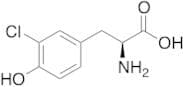
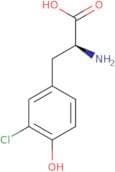
CAS 7423-93-0
:3-Cloro-L-tirosina
Descripción:
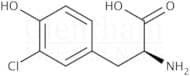
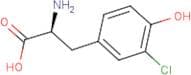
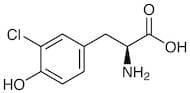
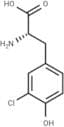
3-Cloro-L-tirosina es un derivado halogenado del aminoácido tirosina, caracterizado por la presencia de un átomo de cloro en la posición meta del anillo aromático. Este compuesto se clasifica típicamente como un aminoácido no proteico, lo que significa que no se incorpora a las proteínas durante la traducción. Exhibe propiedades similares a las de la L-tirosina, incluida la capacidad de participar en varias reacciones bioquímicas, pero la sustitución de cloro puede influir en su reactividad e interacciones con enzimas y receptores. 3-Cloro-L-tirosina se estudia a menudo por sus posibles roles en las vías bioquímicas, particularmente en la síntesis de neurotransmisores y otras moléculas biológicamente activas. Además, puede servir como una herramienta útil en la investigación relacionada con la estructura y función de proteínas, así como en el desarrollo de productos farmacéuticos. El compuesto es soluble en disolventes polares, y su estabilidad puede verse afectada por condiciones ambientales como el pH y la temperatura. Al igual que con muchos compuestos halogenados, se deben tomar precauciones de seguridad al manipular 3-Cloro-L-tirosina debido a su posible toxicidad e impacto ambiental.
Fórmula:C9H10ClNO3
InChI:InChI=1S/C9H10ClNO3/c10-6-3-5(1-2-8(6)12)4-7(11)9(13)14/h1-3,7,12H,4,11H2,(H,13,14)/t7-/m0/s1
Clave InChI:InChIKey=ACWBBAGYTKWBCD-ZETCQYMHSA-N
SMILES:C([C@@H](C(O)=O)N)C1=CC(Cl)=C(O)C=C1
Sinónimos:- (2S)-2-Amino-3-(3-chloro-4-hydroxyphenyl)propanoic acid
- 2: PN: WO2005055810 PAGE: 59 claimed protein
- 3-Chloro-4-hydroxy-L-phenylalanine~H-Tyr(3-Cl)-OH
- 3-Chloro-<span class="text-smallcaps">L</span>-tyrosine
- 3-Chlorotyrosine
- <span class="text-smallcaps">L</span>-Tyrosine, 3-chloro-
- H-Tyr(3-Cl)-OH
- Monochlorotyrosine
- Tyrosine, 3-chloro-, <span class="text-smallcaps">L</span>-
- L-Tyrosine, 3-chloro-
- 3-Chloro-L-tyrosine
- Ver más sinónimos
Ordenar por
Pureza (%)
0
100
|
0
|
50
|
90
|
95
|
100
Encontrado 9 productos.
3-Chloro-L-tyrosine
CAS:Fórmula:C9H10ClNO3Pureza:≥ 98.0%Forma y color:White to off-white powderPeso molecular:215.64(2S)-2-Amino-3-(3-chloro-4-hydroxy-phenyl)propanoic acid
CAS:(2S)-2-Amino-3-(3-chloro-4-hydroxy-phenyl)propanoic acidPureza:98%Peso molecular:215.63g/molH-Tyr(3-Cl)-OH
CAS:Fórmula:C9H10ClNO3Pureza:>95.0%(T)(HPLC)Forma y color:White to Light yellow powder to crystalPeso molecular:215.633-Chloro-L-Tyrosine
CAS:3-Chloro-L-Tyrosine (Chlorotyrosine), a marker of myeloperoxidase-catalyzed oxidation, is markedly elevated in LDL isolated from human atherosclerotic intima.Fórmula:C9H10ClNO3Pureza:98.18% - 98.68%Forma y color:SolidPeso molecular:215.633-Chloro-L-tyrosine
CAS:Producto controladoStability Hygroscopic
Applications 3-Chloro-L-tyrosine was used in the enzymatic synthesis of halogen derivatives of aromatic amino acids labeled with hydrogen isotope. 3-Chloro-L-tyrosine exhibited stronger antioxidant properties in Hb-induced oxidative stress as was evident by higher efficiency of reduction of ferryl species.
References Winnicka, E., et al.: J. Chem. Eng., 8, 54 (2014); Lu, N., et al.: Toxicol. In Vitro, 28, 847 (2014);Fórmula:C9H10NO3ClForma y color:NeatPeso molecular:215.633-Chloro-L-tyrosine
CAS:3-Chloro-L-tyrosine (3CT) is a reactive, nitrogen containing molecule that has been used as a model system to study oxidative injury in the heart. The molecule reacts with the air and oxygen in the environment, producing reactive oxygen species (ROS) that can cause oxidative injury. 3CT has been shown to inhibit ATP binding cassette transporter A1 (ABCA1), which is involved in cholesterol efflux from macrophages. 3CT also promotes the release of eosinophil peroxidase from eosinophils and induces tumor necrosis factor alpha (TNF-α). The analytical method for 3CT includes liquid chromatography-mass spectrometry/mass spectrometry (LC-MS/MS).Fórmula:C9H10NO3ClPureza:Min. 95%Forma y color:PowderPeso molecular:215.63 g/mol3-Chloro-L-tyrosine
CAS:M06094 - 3-Chloro-L-tyrosine
Fórmula:C9H10ClNO3Pureza:98%Forma y color:SolidPeso molecular:215.63