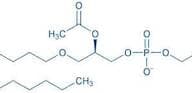
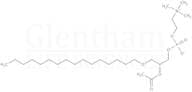
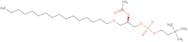
CAS 74389-68-7
:Factor activador de plaquetas
Descripción:
Factor activador de plaquetas (PAF), con el número CAS 74389-68-7, es un mediador fosfolipídico que juega un papel crucial en varios procesos fisiológicos y patológicos. Es un lípido bioactivo potente que está principalmente involucrado en la inflamación, la trombosis y las respuestas alérgicas. El PAF se caracteriza por su capacidad para activar plaquetas, lo que lleva a la agregación y la liberación de varios mediadores. Estructuralmente, es un fosfolípido enlazado por éter, lo que lo distingue de otros fosfolípidos. El PAF se sintetiza a partir de fosfolípidos de membrana por la acción de enzimas específicas, como la fosfolipasa A2. Sus efectos biológicos son mediados a través de receptores específicos, conocidos como receptores de PAF, que están ampliamente distribuidos en varios tejidos. El PAF también está implicado en varias enfermedades, incluyendo asma, trastornos cardiovasculares y sepsis, lo que lo convierte en un objetivo para intervenciones terapéuticas. Debido a sus potentes efectos a concentraciones muy bajas, el PAF se considera una molécula de señalización significativa tanto en la salud como en la enfermedad.
Fórmula:C26H54NO7P
InChI:InChI=1S/C26H54NO7P/c1-6-7-8-9-10-11-12-13-14-15-16-17-18-19-21-31-23-26(34-25(2)28)24-33-35(29,30)32-22-20-27(3,4)5/h26H,6-24H2,1-5H3/t26-/m1/s1
Clave InChI:InChIKey=HVAUUPRFYPCOCA-AREMUKBSSA-N
SMILES:[C@H](COP(OCC[N+](C)(C)C)(=O)[O-])(COCCCCCCCCCCCCCCCC)OC(C)=O
Sinónimos:- (2R)-2-Acetoxy-3-(hexadecyloxy)propyl 2-(trimethylammonio)ethyl phosphate
- 1-Hexadecyl-2-acetyl-sn-glycero-3-phosphocholine
- 1-O-Hexadecyl-2-Acetyl-Sn-Glycero-3-Phosphocholine
- 1-O-Hexadecyl-2-O-acetyl-sn-glycero-3-phosphocholine
- 1-O-Hexadecyl-2-O-acetyl-sn-glyceryl-3-phosphorylcholine
- 1-O-Hexadecyl-2-acetyl-sn-glycerophosphocholine
- 1-O-Hexadecyl-2-acetyl-sn-glyceryl-3-phosphorylcholine
- 1-O-Hexadecyl-platelet-activating factor
- 3,5,9-Trioxa-4-phosphapentacosan-1-aminium, 7-(acetyloxy)-4-hydroxy-N,N,N-trimethyl-, inner salt, 4-oxide, (7R)-
- 3,5,9-Trioxa-4-phosphapentacosan-1-aminium, 7-(acetyloxy)-4-hydroxy-N,N,N-trimethyl-, inner salt, 4-oxide, (R)-
- Blood platelet-activating factor
- Blood platelet-activating factor acether
- C<sub>16</sub>-PAF
- C<sub>16</sub>-PAF acether
- Ethanaminium, 2-[[[[(2R)-2-(acetyloxy)-3-(hexadecyloxy)propyl]oxy]hydroxyphosphinyl]oxy]-N,N,N-trimethyl-, inner salt
- PAF acether
- Paf 16
- Paf C 16
- Platelet-activating factor
- Platelet-activating factor (1-O-hexadecyl)
- Ver más sinónimos
Ordenar por
Pureza (%)
0
100
|
0
|
50
|
90
|
95
|
100
Encontrado 6 productos.
1-O-Hexadecyl-2-O-acetyl-sn-glycero-3-phosphocholine
CAS:Accelerated cognitive decline in Alzheimer’s patients is associated with accumulation of choline-containing phospholipids. One of them, C16-PAF, is specifically elevated in brains of Alzheimer’s patients. Enhanced exposure to this platelet-activating factor ultimately leads to neuronal death.Fórmula:C26H54NO7PPureza:> 99%Forma y color:WhitePeso molecular:523.693,5,9-Trioxa-4-phosphapentacosan-1-aminium,7-(acetyloxy)-4-hydroxy-N,N,N-trimethyl-, inner salt, 4-oxide, (7R)-
CAS:Fórmula:C26H54NO7PPureza:98%Peso molecular:523.6832PAF (C16)
CAS:PAF (C16) is a potent MAPK and MEK/ERK activator that induces increased vascular permeability.Fórmula:C26H54NO7PPureza:98%Forma y color:SolidPeso molecular:523.68PAF (C16)
CAS:PAF, short for Platelet-activating factor, is a mediator of platelet aggregation and a ligand for PAF receptors. It has roles in many other leukocyte functions around inflammation and immune response, as well as, chemotaxis and vasuclar changes. The PAF signaling system can trigger significant inflammatory and thrombotic cascades, and has been show to have roles in septic shock.
Fórmula:C26H54NO7PPureza:Min. 95%Peso molecular:523.68 g/mol