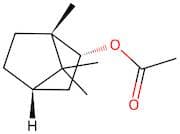
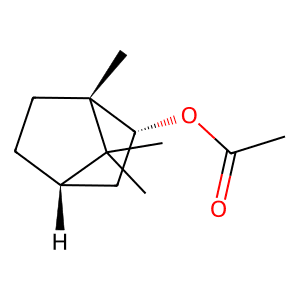
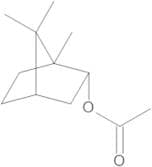
CAS 76-49-3
:(±)-Acetato de bornilo
Descripción:
(±)-Acetato de bornilo es un compuesto orgánico clasificado como un éster, específicamente derivado del alcohol bornílico y del ácido acético. Es un líquido incoloro a amarillo pálido con un aroma característico agradable, similar al pino, lo que lo hace popular en las industrias de fragancias y sabores. El compuesto tiene un punto de ebullición relativamente bajo y es soluble en disolventes orgánicos, pero solo ligeramente soluble en agua. Su fórmula molecular es C12H20O2, y presenta una estructura bicíclica típica de los terpenos, que contribuye a su aroma distintivo. (±)-Acetato de bornilo se utiliza a menudo en perfumes, cosméticos y saborizantes alimentarios debido a sus propiedades aromáticas. Además, exhibe algunas actividades antimicrobianas y repelentes de insectos, lo que lo hace de interés en diversas aplicaciones más allá de la fragancia. Como compuesto quiral, existe en dos formas enantioméricas, pero la mezcla racémica se conoce comúnmente como (±)-Acetato de bornilo. Los datos de seguridad indican que debe manejarse con cuidado, ya que puede causar irritación al contacto con la piel o los ojos.
Fórmula:C12H20O2
InChI:InChI=1/C12H20O2/c1-8(13)14-10-7-9-5-6-12(10,4)11(9,2)3/h9-10H,5-7H2,1-4H3/t9-,10+,12+/s2
Clave InChI:InChIKey=KGEKLUUHTZCSIP-QJUVKGSQNA-N
SMILES:C[C@@]12[C@H](OC(C)=O)C[C@@](C1(C)C)(CC2)[H]
Sinónimos:- 1,7,7-Trimethylbicyclo(2.2.1)heptan-2-ol acetate
- 1,7,7-Trimethylbicyclo(2.2.1)heptan-2-yl acetate, endo-
- 2-Camphanol acetate
- 2-Camphanyl acetate
- Acetate de endo-1,7,7-trimethylbicyclo[2.2.1]hept-2-yle
- Acetate, 1,7,7-Trimethyl-Bicyclo(2.2.1)Hept-2-Yl, Endo-
- Acetato De Endo-1,7,7-Trimetilbiciclo[2.2.1]Hept-2-Ilo
- Ai3-00665
- Bicyclo(2.2.1)heptan-2-ol, 1,7,7-trimethyl-, 2-acetate, (1R,2S,4R)-rel-
- Bicyclo(2.2.1)heptan-2-ol, 1,7,7-trimethyl-, acetate, (1R,2S,4R)-rel-
- Bicyclo(2.2.1)heptan-2-ol, 1,7,7-trimethyl-, acetate, endo-
- Borneol, acetate
- Borneol, acetate (8CI)
- Borneyl acetate
- Bornyl acetic ester
- Bornyl acetic ether
- Bornyl ethanoate
- Endo-1,7,7-trimethylbicyclo[2.2.1]hept-2-yl aceatate
- FEMA No. 2159
- Nsc 407158
- dl-Bornyl acetate
- endo-1,7,7-Trimethylbicyclo(2.2.1)hept-2-yl acetate
- endo-1,7,7-Trimethylbicyclo[2.2.1]hept-2-ylacetat
- endo-2-Camphanyl ethanoate
- endo-Bornyl acetate
- Ver más sinónimos
Ordenar por
Pureza (%)
0
100
|
0
|
50
|
90
|
95
|
100
Encontrado 10 productos.
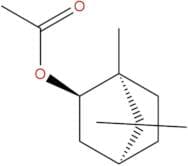
Bicyclo[2.2.1]heptan-2-ol,1,7,7-trimethyl-, 2-acetate, (1R,2S,4R)-rel-
CAS:Fórmula:C12H20O2Pureza:97%Peso molecular:196.2860Bornyl acetate
CAS:Bornyl acetate (Isobornyl acetate) has an anti-inflammatory effect. It is the volatile ingredient in some Chinese traditional herbs and numerous conifer oils.Fórmula:C12H20O2Pureza:99.19%Forma y color:LiquidPeso molecular:196.29Bornyl acetate
CAS:Fórmula:C12H20O2Pureza:≥ 90.0%Forma y color:Clear, colourless to pale yellow liquidPeso molecular:196.29Bornyl Acetate (Mixture of Diastereomers)
CAS:Applications Bornyl Acetate (Mixture of Diastereomers) is a monoterpene ester, and also the main, natural constituent of valerian root oil. Bornyl acetate also has analgesic and anti-inflammatory properties.
References Buchbauer, G., et al.: Die Pharm., 47, 620 (1992); Oh, H., et al.: Appl. Micro., 15, 777 (1967); Wu, X., et al.: J. Chinese Med. Mat., 27, 438 (2004)Fórmula:C12H20O2Forma y color:NeatPeso molecular:196.29(+/-)-Bornyl acetate
CAS:(-)Bornyl acetate is a natural product that has been shown to have antimicrobial properties. It is extracted from plants such as the Boronia and has been shown to inhibit the growth of bacteria. (-)Bornyl acetate interacts with hydroxyl groups on proteins, inhibiting their function. This interaction leads to the production of reactive oxygen species, which causes cellular damage and death. Bornyl acetate also can interact with other sites on proteins, including the nitro group, which may lead to reduced nitric oxide production and decreased inflammatory response. The compound class of (-)bornyl acetate includes alkanoic acids and fatty acids. Molecular docking analysis has identified a number of possible binding sites for this molecule in protein structures. -Bornyl acetate is not active against viruses or fungi.br>br> Bornyl acetate has been shown to be an anti-inflammatory agent that inhibits prostaglandin synthesis and exhibits anti-infective properties.br>brFórmula:C12H20O2Pureza:Min. 95%Forma y color:Clear LiquidPeso molecular:196.29 g/mol
![Bicyclo[2.2.1]heptan-2-ol,1,7,7-trimethyl-, 2-acetate, (1R,2S,4R)-rel-](/_next/image/?url=https%3A%2Fstatic.cymitquimica.com%2Fproducts%2FIN%2Fthumb%2FDA0038GL.jpg&w=3840&q=75)