CAS 76115-06-5
:Fenol, 4-(trifeniletenil)-
Descripción:
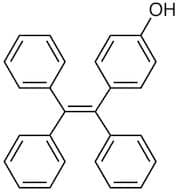
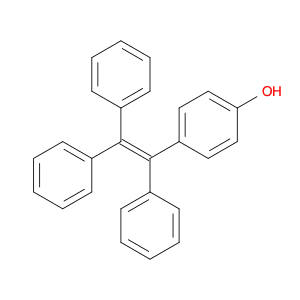
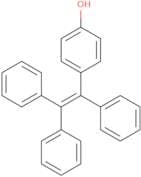
Fenol, 4-(trifeniletenil)-, también conocido por su número CAS 76115-06-5, es un compuesto orgánico caracterizado por la presencia de un grupo hidroxilo fenólico (-OH) unido a un átomo de carbono que también está unido a un grupo triphenylethenyl. Esta estructura confiere propiedades únicas, incluyendo su posible uso en síntesis orgánica y ciencia de materiales. El compuesto típicamente exhibe un estado sólido a temperatura ambiente y es conocido por sus características aromáticas debido a la presencia de múltiples anillos de fenilo, que contribuyen a su estabilidad y reactividad. Puede mostrar propiedades ópticas interesantes, lo que lo convierte en un candidato para aplicaciones en fotónica o como colorante. Además, la presencia del grupo hidroxilo sugiere un potencial para enlaces de hidrógeno, influyendo en su solubilidad e interacción con otras sustancias. Se deben tener en cuenta consideraciones de seguridad, ya que los compuestos fenólicos pueden ser tóxicos y requieren un manejo cuidadoso en entornos de laboratorio. En general, Fenol, 4-(trifeniletenil)- es un compuesto versátil con aplicaciones en varios campos de la química.
Fórmula:C26H20O
Ordenar por
Pureza (%)
0
100
|
0
|
50
|
90
|
95
|
100
Encontrado 5 productos.
4-(1,2,2-Triphenylvinyl)phenol
CAS:Fórmula:C26H20OPureza:>95.0%(GC)Forma y color:White to Almost white powder to crystalPeso molecular:348.454-(1,2,2-Triphenylethenyl)phenol
CAS:Fórmula:C26H20OPureza:96%Forma y color:SolidPeso molecular:348.43644-(1,2,2-Triphenylvinyl)phenol
CAS:4-(1,2,2-Triphenylvinyl)phenolPureza:98%Peso molecular:348.45g/mol4-(1,2,2-triphenylvinyl)phenol
CAS:4-(1,2,2-triphenylvinyl)phenol is a fluorescent molecule that can be used as a biomarker for Listeria monocytogenes. The fluorescence of 4-(1,2,2-triphenylvinyl)phenol is quenched when it binds to the bacteria and then restored when it is removed from the bacteria. This molecule has been shown to bind to bacterial DNA and proteins. It has also been shown to have hydrophobic properties and can be used for fingerprint analysis. 4-(1,2,2-triphenylvinyl)phenol has been synthesized through a Suzuki coupling reaction with chloroacetophenone and 1,4-dibromobutane. It has two isomers: one with two phenyl groups on either side of the vinyl group and one with only one phenyl group on either side of the vinyl group.Fórmula:C26H20OPureza:Min. 95%Forma y color:SolidPeso molecular:348.44 g/mol