CAS 7659-95-2
:Betanina
Descripción:
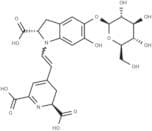
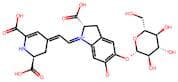
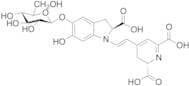
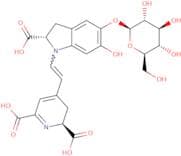
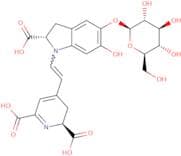
Betanina, con el número CAS 7659-95-2, es un pigmento natural derivado principalmente de la remolacha (Beta vulgaris). Pertenece a la clase de las betalaínas, que son pigmentos solubles en agua que contribuyen a la coloración rojo-violeta de las remolachas. Betanina es conocido por sus propiedades antioxidantes y se utiliza a menudo como colorante alimentario natural en diversas aplicaciones culinarias, particularmente en bebidas, confitería y productos lácteos. El compuesto es estable en condiciones ácidas, pero puede degradarse cuando se expone a altas temperaturas o ambientes alcalinos. Betanina exhibe un fuerte espectro de absorción en el rango visible, que es responsable de su color vibrante. Además, tiene beneficios potenciales para la salud, incluyendo propiedades antiinflamatorias y anticancerígenas, lo que lo convierte en un tema de interés en estudios nutricionales. Sin embargo, su estabilidad y eficacia pueden verse influenciadas por factores como el pH, la luz y la temperatura, que son consideraciones importantes para su aplicación en productos alimenticios.
Fórmula:C24H26N2O13
InChI:InChI=1S/C24H26N2O13/c27-8-17-18(29)19(30)20(31)24(39-17)38-16-6-10-5-14(23(36)37)26(13(10)7-15(16)28)2-1-9-3-11(21(32)33)25-12(4-9)22(34)35/h1-3,6-7,12,14,17-20,24,27-31H,4-5,8H2,(H,32,33)(H,34,35)(H,36,37)/t12-,14-,17+,18+,19-,20+,24+/m0/s1
Clave InChI:InChIKey=CTMLKIKAUFEMLE-FMOSSLLZSA-N
SMILES:C(=CC=1C[C@@H](C(O)=O)N=C(C(O)=O)C1)N2C=3C(C[C@H]2C(O)=O)=CC(O[C@@H]4O[C@H](CO)[C@@H](O)[C@H](O)[C@H]4O)=C(O)C3
Sinónimos:- (15S)-Betanin
- (1E)-2-carboxy-1-[2-(2,6-dicarboxy-2,3-dihydropyridin-4(1H)-ylidene)ethylidene]-6-hydroxy-2,3-dihydro-1H-indolium-5-yl hexopyranoside
- (1E,2S)-1-{(2E)-2-[(2S)-2,6-dicarboxy-2,3-dihydropyridin-4(1H)-ylidene]ethylidene}-5-(beta-D-glucopyranosyloxy)-6-hydroxy-2,3-dihydro-1H-indolium-2-carboxylate
- (2S)-4-[2-[(2S)-2-Carboxy-5-(β-<span class="text-smallcaps">D</span>-glucopyranosyloxy)-2,3-dihydro-6-hydroxy-1H-indol-1-yl]ethenyl]-2,3-dihydro-2,6-pyridinedicarboxylic acid
- (2S)-4-{2-[(2S)-2-carboxy-5-(beta-D-glucopyranosyloxy)-6-hydroxy-2,3-dihydro-1H-indol-1-yl]ethenyl}-2,3-dihydropyridine-2,6-dicarboxylic acid
- 2,6-Pyridinedicarboxylic acid, 4-[2-[(2S)-2-carboxy-5-(β-<span class="text-smallcaps">D</span>-glucopyranosyloxy)-2,3-dihydro-6-hydroxy-1H-indol-1-yl]ethenyl]-2,3-dihydro-, (2S)-
- 2,6-Pyridinedicarboxylic acid, 4-[2-[2-carboxy-5-(β-<span class="text-smallcaps">D</span>-glucopyranosyloxy)-2,3-dihydro-6-hydroxy-1H-indol-1-yl]ethenyl]-2,3-dihydro-, [S-(R*,R*)]-
- 2-Carboxy-1-[2-(2,6-dicarboxy-2,3-dihydro-4(1H)-pyridylidene)ethylidene]-5-(β-<span class="text-smallcaps">D</span>-glucopyranosyloxy)-6-hydroxyindolinium hydroxide, inner salt
- B 0397
- Betacyanine
- Betanidin 5-β-<span class="text-smallcaps">D</span>-glucopyranoside
- Betanine
- NSC 170989
- Phytolaccanin
- Betanin
- 2,6-Pyridinedicarboxylic acid, 4-[2-[(2S)-2-carboxy-5-(β-D-glucopyranosyloxy)-2,3-dihydro-6-hydroxy-1H-indol-1-yl]ethenyl]-2,3-dihydro-, (2S)-
- 2,6-Pyridinedicarboxylic acid, 4-[2-[2-carboxy-5-(β-D-glucopyranosyloxy)-2,3-dihydro-6-hydroxy-1H-indol-1-yl]ethenyl]-2,3-dihydro-, [S-(R*,R*)]-
- (2S)-4-[2-[(2S)-2-Carboxy-5-(β-D-glucopyranosyloxy)-2,3-dihydro-6-hydroxy-1H-indol-1-yl]ethenyl]-2,3-dihydro-2,6-pyridinedicarboxylic acid
- Ver más sinónimos
Ordenar por
Pureza (%)
0
100
|
0
|
50
|
90
|
95
|
100
Encontrado 8 productos.
Betanin (Red Beet extract diluted with Dextrin)
CAS:Forma y color:Red to Dark red to Dark purple powder to crystal(2S)-4-[2-[(2S)-2-Carboxy-5-(β-D-glucopyranosyloxy)-2,3-dihydro-6-hydroxy-1H-indol-1-yl]ethenyl]-2,3-dihydro-2,6-pyridinedicarboxylic acid
CAS:Fórmula:C24H26N2O13Pureza:1%Forma y color:SolidPeso molecular:550.4688Betanin
CAS:Betanin (Betanine) is a natural red-violet food dye obtained from beets.Fórmula:C24H26N2O13Pureza:97.92%Forma y color:Pink To Deep Red LiquidPeso molecular:550.47Betanin (Red Beet extract diluted with Dextrin)
CAS:Producto controladoFórmula:C24H26N2O13Forma y color:NeatPeso molecular:550.47Betanin
CAS:Betanin is a natural pigment, which is a betalain that is derived from the roots of the red beet plant (Beta vulgaris). Betanin's mode of action involves its role as an antioxidant; it is capable of scavenging free radicals due to its chemical structure, thus providing protection against oxidative stress. This makes betanin not only a valuable colorant but also a compound of interest for its potential health benefits.Betanin is widely used in the food industry as a coloring agent, imparting a red to pink hue to various products such as beverages, dairy products, and confectioneries. Its natural origin makes it a preferred choice in formulations where synthetic dyes are undesirable. Beyond its coloring properties, betanin's antioxidant activity is being explored for applications in nutraceuticals, cosmetics, and pharmaceuticals where oxidative stability is needed. In research contexts, betanin is also of interest for its potential protective effects in cellular models, making it a compound worth consideration for further study in biochemistry and medicinal chemistry.Fórmula:C24H26N2O13Peso molecular:550.47 g/molBetanin, red beet extract diluted with dextrin
CAS:Betanin is a natural colorant, which is derived from the red beetroot, specifically from the Beta vulgaris species. It is often available as a red beet extract diluted with dextrin. This compound acts by imparting a deep red to pink hue, depending on pH and concentration, through its inherent chromophoric groups. The mode of action involves its structure allowing for light absorption and reflection at specific wavelengths, making it suitable for use as a colorant.
Fórmula:C24H26N2O13Pureza:Min. 95%Forma y color:PowderPeso molecular:550.47 g/mol


![(2S)-4-[2-[(2S)-2-Carboxy-5-(β-D-glucopyranosyloxy)-2,3-dihydro-6-hydroxy-1H-indol-1-yl]ethenyl]-2…](/_next/image/?url=https%3A%2Fstatic.cymitquimica.com%2Fproducts%2FIN%2Fthumb%2FDA0034IO.jpg&w=3840&q=75)