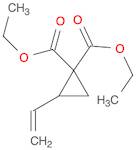
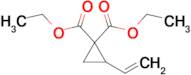
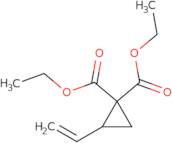
CAS 7686-78-4
:1,1-Dietil 2-etenvil-1,1-ciclopropanodicarboxilato
Descripción:
1,1-Dietil 2-etenvil-1,1-ciclopropanodicarboxilato, con el número CAS 7686-78-4, es un compuesto orgánico caracterizado por su estructura única de ciclopropano y la presencia de dos grupos etilo y un grupo vinilo. Este compuesto presenta un anillo de ciclopropano que está sustituido con dos grupos de éster carboxilato, que contribuyen a su reactividad y aplicaciones potenciales en la síntesis orgánica. La presencia del grupo vinilo mejora su capacidad para someterse a polimerización y otras reacciones típicas de los alquenos. Típicamente es un líquido incoloro a amarillo pálido con un olor característico. El compuesto es soluble en disolventes orgánicos, lo que lo hace útil en varias reacciones y aplicaciones químicas, incluyendo como un intermedio en la síntesis de moléculas más complejas. Su reactividad, particularmente en presencia de nucleófilos, permite la formación de diversos derivados, lo que lo convierte en un compuesto valioso en la química orgánica sintética. Se deben observar precauciones de seguridad al manipular este compuesto, ya que puede representar riesgos para la salud si se inhala o ingiere.
Fórmula:C11H16O4
InChI:InChI=1/C11H16O4/c1-4-8-7-11(8,9(12)14-5-2)10(13)15-6-3/h4,8H,1,5-7H2,2-3H3
Clave InChI:InChIKey=UOQTXZICFVMERR-UHFFFAOYSA-N
SMILES:C(OCC)(=O)C1(C(OCC)=O)C(C=C)C1
Sinónimos:- 1,1-Bis(ethoxycarbonyl)-2-vinylcyclopropane
- 1,1-Cyclopropanedicarboxylic acid, 2-ethenyl-, 1,1-diethyl ester
- 1,1-Cyclopropanedicarboxylic acid, 2-ethenyl-, diethyl ester
- 1,1-Cyclopropanedicarboxylic acid, 2-vinyl-, diethyl ester
- 1,1-Cyclopropanedicarboxylic acid, vinyl-, diethyl ester
- 1,1-Diethoxycarbonyl-2-vinylcyclopropane
- 1,1-Diethyl 2-ethenyl-1,1-cyclopropanedicarboxylate
- Diethyl 2-Ethenylcyclopropane-1,1-Dicarboxylate
- Diethyl 2-vinylcyclopropane-1,1-dicarboxylate
- 2-Ethenylcyclopropane-1,1-dicarboxylic acid diethyl ester
- 2,2-(3-Butene-1,2-diyl)malonic acid diethyl ester
- 2-VINYLCYCLOPROPANE-1,1-DICARBOXYLIC ACID DIETHYL ESTER
- 2-Vinyl-1,1-cyclopropanedicarboxylic acid diethyl ester
- Ver más sinónimos
Filtrar por
Porcentaje de pureza
0
100
|
0
|
50
|
90
|
95
|
100
Se han encontrado 5 productos.
- Precio más bajo
- Precio más alto
- Pureza más baja
- Pureza más alta
- Entrega estimada más rápida
Diethyl 2-Vinylcyclopropane-1,1-Dicarboxylate
CAS:Diethyl 2-Vinylcyclopropane-1,1-DicarboxylateFórmula:C11H16O4Pureza:99%Forma y color:LiquidPeso molecular:212.24Diethyl 2-vinylcyclopropane-1,1-dicarboxylate
CAS:Fórmula:C11H16O4Pureza:97%Forma y color:LiquidPeso molecular:212.2423Diethyl 2-vinylcyclopropane-1,1-dicarboxylate
CAS:Diethyl 2-vinylcyclopropane-1,1-dicarboxylateFórmula:C11H16O4Pureza:97%Peso molecular:212.24DIETHYL 2-VINYLCYCLOPROPANE-1,1-DICARBOXYLATE
CAS:Fórmula:C11H16O4Pureza:97%Forma y color:LiquidPeso molecular:212.2452-Vinylcyclopropane-1,1-dicarboxylic acid diethyl ester
CAS:2-Vinylcyclopropane-1,1-dicarboxylic acid diethyl ester (VCPD) is a molecule that is synthesized by the nucleophilic attack of an alcohol on the double bond of a cyclopropane ring. VCPD is used in the production of polymers and copolymers. VCPD can be copolymerized with other monomers such as styrene, chloromethylstyrene, acrylonitrile, vinyl acetate, vinyl chloride and butadiene to produce various types of polymers. The polymerization process involves three steps: initiation, propagation and termination. Initiation takes place when persulfate is added to VCPD and water at high temperature. The polymerization process ends when there are no more VCPD molecules available for reaction or when all the monomers have been consumed during the reaction.Fórmula:C11H16O4Pureza:Min. 95%Peso molecular:212.24 g/mol