CAS 76880-29-0
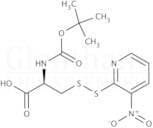
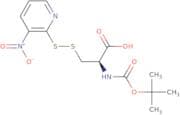
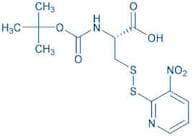
:N(alpha)-boc-S-(3-nitro-2-piridiltio)-L-cisteína
Descripción:
N(alpha)-boc-S-(3-nitro-2-piridiltio)-L-cisteína es un derivado del aminoácido L-cisteína, caracterizado por la presencia de un grupo protector tert-butyloxycarbonyl (Boc) en el grupo amino y un moiety 3-nitro-2-piridiltiol unido al átomo de azufre. Este compuesto se utiliza típicamente en la síntesis de péptidos y en química medicinal debido a su capacidad para formar enlaces disulfuro y participar en varias reacciones bioquímicas. El grupo Boc sirve para proteger el grupo amino durante la síntesis, permitiendo reacciones selectivas en otros sitios funcionales. El grupo 3-nitro-2-piridiltiol mejora la reactividad del compuesto y puede facilitar interacciones con objetivos biológicos, lo que lo hace de interés en el desarrollo de fármacos. La presencia del grupo nitro también introduce características de atracción de electrones, lo que puede influir en la reactividad general y la solubilidad del compuesto. Al igual que muchos compuestos que contienen azufre, puede exhibir propiedades únicas como una mayor nucleofilia y potencial para reacciones redox. Las condiciones adecuadas de manejo y almacenamiento son esenciales debido a la reactividad potencial del grupo tiol.
Fórmula:C13H17N3O6S2
InChI:InChI=1/C13H17N3O6S2/c1-13(2,3)22-12(19)15-8(11(17)18)7-23-24-10-9(16(20)21)5-4-6-14-10/h4-6,8H,7H2,1-3H3,(H,15,19)(H,17,18)/t8-/m0/s1
SMILES:CC(C)(C)OC(=N[C@@H](CSSc1c(cccn1)N(=O)=O)C(=O)O)O
Sinónimos:- Boc-Cys(Npys)-OH
- N-(tert-butoxycarbonyl)-3-[(3-nitropyridin-2-yl)disulfanyl]-L-alanine
Ordenar por
Pureza (%)
0
100
|
0
|
50
|
90
|
95
|
100
Encontrado 6 productos.
L-Alanine, N-[(1,1-dimethylethoxy)carbonyl]-3-[(3-nitro-2-pyridinyl)dithio]-
CAS:Fórmula:C13H17N3O6S2Pureza:98%Forma y color:SolidPeso molecular:375.4206Boc-cys(Npys)-oh
CAS:Boc-cys(Npys)-oh is an active substance that inhibits the growth of mouse tumors and has been shown to inhibit a number of different biological processes. It is a cross-linking agent for amino acids and has been shown to have an inhibitory effect on the synthesis of proteins by blocking the formation of disulfide bonds. This compound belongs to the class of chemicals known as sulfonamides, which are used in the treatment of bacterial infections. Boc-cys(Npys)-oh also specifically binds to antigen sites on cells, inhibiting their growth, and can be used as an antitumor agent. The molecule can be chemically linked with other molecules such as trifluoroacetic acid (TFA), resulting in a product with different properties than those found in Boc-cys(Npys)-oh. The chemical ligation process is used to produce subcutaneous tumors in mice that are then treated with hydrogen fluoride (Fórmula:C13H17N3O6S2Pureza:Min. 95%Forma y color:Off-White PowderPeso molecular:375.42 g/molBoc-Cys(NPys)-OH
CAS:Npys allows site-directed disulfide bond formation, as it is cleaved by thiols. Galande and Spatola obtained disulfide heterodimers of peptides via coupling Boc-Cys(NPys)-OH together with Fmoc-Cys(Mmt)-OH to MBHA-resin followed by Mmt removal with 1% TFA in dichloromethane. Mourier et al. used BCNP for the identification of T-cell epitopes in Cys and/or Cyt-containing proteins.Fórmula:C13H17N3O6S2Pureza:> 99%Forma y color:Yellow PowderPeso molecular:375.43
![L-Alanine, N-[(1,1-dimethylethoxy)carbonyl]-3-[(3-nitro-2-pyridinyl)dithio]-](/_next/image/?url=https%3A%2Fstatic.cymitquimica.com%2Fproducts%2FIN%2Fthumb%2FDA003OG3.jpg&w=3840&q=75)