CAS 769-42-6
:Ácido dimetilbarbitúrico
Descripción:
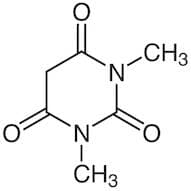
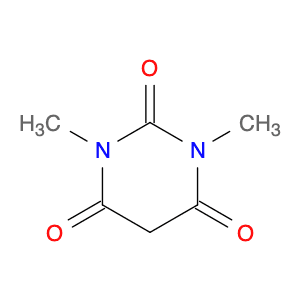
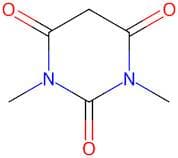
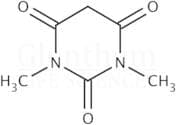
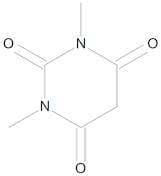
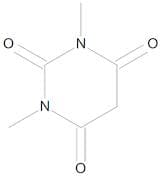
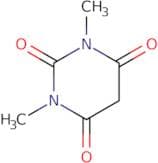
Ácido dimetilbarbitúrico, con el número CAS 769-42-6, es un compuesto químico que pertenece a la clase de fármacos barbitúricos, que son derivados del ácido barbitúrico. Se caracteriza por su estructura, que incluye dos grupos metilo unidos a los átomos de nitrógeno del marco del ácido barbitúrico. Este compuesto es típicamente un sólido cristalino blanco que es soluble en agua y exhibe propiedades débilmente ácidas debido a la presencia de grupos funcionales de ácido carboxílico. Ácido dimetilbarbitúrico es conocido por sus efectos sedantes e hipnóticos, aunque se utiliza con menos frecuencia en entornos clínicos en comparación con otros barbitúricos. Su actividad farmacológica se atribuye a su capacidad para modular la actividad del neurotransmisor ácido gamma-aminobutírico (GABA) en el receptor GABA-A, lo que lleva a una depresión del sistema nervioso central. Además, tiene aplicaciones en investigación bioquímica y como intermediario en la síntesis orgánica. Las precauciones de seguridad y manejo son esenciales debido a su potencial de toxicidad y dependencia.
Fórmula:C6H8N2O3
InChI:InChI=1/C6H8N2O3/c1-7-4(9)3-5(10)8(2)6(7)11/h3H2,1-2H3
Clave InChI:InChIKey=VVSASNKOFCZVES-UHFFFAOYSA-N
SMILES:CN1C(=O)N(C)C(=O)CC1=O
Sinónimos:- 1,3-Dimethyl-1,3-diazacyclohexane-2,4,6-trione
- 1,3-Dimethyl-1,3-diazinane-2,4,6-trione
- 1,3-Dimethyl-2,4,6(1H,3H,5H)-pyrimidinetrione
- 1,3-Dimethyl-pyrimidine-2,4,6-trione
- 1,3-dimethylpyrimidine-2,4,6(1H,3H,5H)-trione
- 2,4,6(1H,3H,5H)-Pyrimidinetrione, 1,3-dimethyl-
- 6-Hydroxy-1,3-dimethyluracil
- Barbituric acid, 1,3-dimethyl-
- Dimethylbarbituric acid
- N,N'-Dimethylbarbituric acid
- N,N′-Dimethyl-2,4,6-pyrimidinetrione
- Nsc 61918
- 1,3-Dimethylbarbituric acid
- 1,3-Dimethylpyrimidine-2,4,6(1H,2H,5H)-trione
- 1,3-Dimethylhexahydropyrimidine-2,4,6-trione
- AKOS B029702
- 1,3-Dimethylbarbituric acid, 99% (dry wt.) water < 6%
- Hexahydro-1,3-dimethylpyrimidine-2,4,6-trione
- 1,3-dimethyl-4,6(1h,3h,5h)-pyrimidinetrione
- 1,3-Dimethyl-2,4,6-Trihydroxy-Pyrimidine
- 6(1h,3h,5h)-pyrimidinetrione,1,3-dimethyl-4
- Ver más sinónimos
Ordenar por
Pureza (%)
0
100
|
0
|
50
|
90
|
95
|
100
Se han encontrado 11 productos.
1,3-Dimethylbarbituric Acid
CAS:Fórmula:C6H8N2O3Pureza:>98.0%(GC)(T)Forma y color:White to Light yellow to Light orange powder to crystalPeso molecular:156.141,3-Dimethylbarbituric acid, 99% (dry wt.), water <6%
CAS:1,3-Dimethylbarbituric acid is used as a catalyst in the Knoevenagel condensation of a series of aromatic aldehydes. It is also used in the synthesis of 5-aryl-6-(alkyl- or aryl-amino)-1,3-dimethylfuro [2,3-d]pyrimidine derivatives and enantioselective synthesis of isochromene pyrimidinedione derivaFórmula:C6H8N2O3Pureza:99%Forma y color:White to cream or pale yellow, Crystals or powder or crystalline powderPeso molecular:156.14Ref: IN-DA003DKC
10kgA consultar10g20,00€5g21,00€25g24,00€50g28,00€100g41,00€250g63,00€500g83,00€1kg117,00€5kg346,00€1,3-Dimethylbarbituric acid
CAS:1,3-Dimethylbarbituric acidFórmula:C6H8N2O3Pureza:99%Forma y color:SolidPeso molecular:156.14Urapidil Impurity 4 (1,3-Dimethylbarbituric Acid)
CAS:Fórmula:C6H8N2O3Forma y color:White To Off-White SolidPeso molecular:156.141,3-Dimethylbarbituric acid
CAS:Fórmula:C6H8N2O3Pureza:≥ 99.0%Forma y color:White to off-white crystalline powderPeso molecular:156.141,3-Dimethyl Barbituric Acid
CAS:Producto controladoApplications 1,3-Dimethyl Barbituric Acid (Urapidil Impurity 4) is a derivative of Barbituric acid (B118650). All of the barbituric acid derivatives which have been reported to have pronounced hypnotic activity are disubstituted in the 5-position.
References Gupta, K., et al.: Eur. J. Med. Chem., 17, 448 (1982), Weber, L., et al.: Curr. Med. Chem., 9, 2085 (2002), Skiles, J., et al.: Curr. Med. Chem., 11, 2911 (2004),Fórmula:C6H8N2O3Forma y color:NeatPeso molecular:156.141,3-Dimethyl-2,4,6(1H,3H,5H)-pyrimidinetrione
CAS:Producto controlado1,3-Dimethyl-2,4,6(1H,3H,5H)-pyrimidinetrione is a heterocyclic organic compound, which is synthesized via established chemical procedures involving catalytic methods or direct condensation reactions. This compound is well-known for its role in the biochemical field as a urease inhibitor. Urease, an enzyme that catalyzes the hydrolysis of urea, is targeted by this compound to potentially mitigate issues related to excessive ammonia production in agricultural and medical settings.In addition to its enzymatic inhibition properties, 1,3-Dimethyl-2,4,6(1H,3H,5H)-pyrimidinetrione serves as a pivotal intermediate in barbiturate synthesis. Barbiturates are psychoactive compounds used historically in medicine for their sedative and anesthetic properties. The compound's structure allows it to participate in the Knoevenagel condensation, facilitating the formation of complex molecules essential in pharmaceutical development. These multifunctional applications make it a valuable tool in various scientific research contexts, exploring both inhibitory mechanisms and synthetic pathways for drug discovery and development.Fórmula:C6H8N2O3Pureza:Min. 98 Area-%Forma y color:PowderPeso molecular:156.14 g/mol