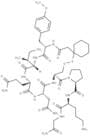
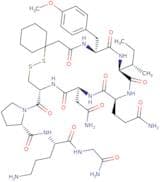
![1-{[(10S,13S,16S,22S)-13-(2-amino-2-oxoethyl)-16-(3-amino-3-oxopropyl)-19-[(2S)-butan-2-yl]-22-(4-…](/_next/image/?url=https%3A%2Fstatic.cymitquimica.com%2Fcas-image%2Fthumb-webp%2F42892-1-10s-13s-16s-22s-13-2-amino-2-oxoethyl-16-3-amino-3-oxopropyl-19-2s-butan-2-yl-22-4-methoxybenzyl-1215182124-pentaoxo-78-dithia-1114172023-pentaazaspiro-5-19-pentacos-10-yl-carbonyl-l-prolyl-l-ornithylglycinamide.webp&w=3840&q=75)
CAS 77327-45-8
:1-{[(10S,13S,16S,22S)-13-(2-amino-2-oxoetil)-16-(3-amino-3-oxopropil)-19-[(2S)-butan-2-il]-22-(4-metoxibencil)-12,15,18,21,24-pentaoxo-7,8-ditia-11,14,17,20,23-pentaazaspiro[5.19]pentacos-10-il]carbonil}-L-prolil-L-ornitilglicinamida
Descripción:
La sustancia química conocida como "1-{[(10S,13S,16S,22S)-13-(2-amino-2-oxoetil)-16-(3-amino-3-oxopropil)-19-[(2S)-butan-2-il]-22-(4-metoxibencil)-12,15,18,21,24-pentaoxo-7,8-ditia-11,14,17,20,23-pentaazaspiro[5.19]pentacos-10-il]carbonil}-L-prolil-L-ornitilglicinamida" con número CAS 77327-45-8 es un compuesto orgánico complejo caracterizado por su estructura intrincada, que incluye múltiples grupos funcionales y estereocentros. Este compuesto presenta un marco espiraloide, incorporando átomos de azufre y nitrógeno, lo que indica su posible actividad biológica. La presencia de residuos de aminoácidos, como la prolina y la ornitina, sugiere que puede interactuar con sistemas biológicos, posiblemente sirviendo como una molécula péptida o similar a un péptido. Sus múltiples grupos carbonilo y el sustituyente metoxibenzilo contribuyen a su reactividad química y propiedades de solubilidad. La complejidad estructural del compuesto también puede implicar características conformacionales específicas que podrían influir en su perfil farmacológico. En general, esta sustancia es de interés en la química medicinal y la bioquímica, particularmente en el desarrollo de agentes terapéuticos.
Fórmula:C48H74N12O12S2
InChI:InChI=1/C48H74N12O12S2/c1-4-27(2)40-46(70)56-31(16-17-36(50)61)42(66)57-33(23-37(51)62)43(67)58-34(47(71)60-21-9-11-35(60)45(69)55-30(10-8-20-49)41(65)53-25-38(52)63)26-73-74-48(18-6-5-7-19-48)24-39(64)54-32(44(68)59-40)22-28-12-14-29(72-3)15-13-28/h12-15,27,30-35,40H,4-11,16-26,49H2,1-3H3,(H2,50,61)(H2,51,62)(H2,52,63)(H,53,65)(H,54,64)(H,55,69)(H,56,70)(H,57,66)(H,58,67)(H,59,68)/t27-,30-,31-,32-,33-,34+,35-,40?/m0/s1
Ordenar por
Pureza (%)
0
100
|
0
|
50
|
90
|
95
|
100
Encontrado 4 productos.
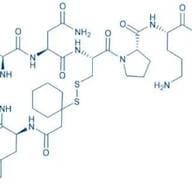
(d(CH₂)₅¹,Tyr(Me)²,Orn⁸)-Oxytocin
CAS:Potent oxytocin antagonist with a pA₂ value of 7.35 ± 0.08. (d(CH₂)₅¹,Tyr(Me)²,Orn⁸)-Vasotocin has been used to support the hypothesis that pituitary secretion of oxytocin is associated with coactivation of centrally projecting brain oxytocin pathways, some of which are causally related to the induced inhibition of food intake. Furthermore, this compound competitively inhibited arginine vasotocin (AVT) contractions without affecting AVT efficacy.Fórmula:C48H74N12O12S2Pureza:99.2%Forma y color:White PowderPeso molecular:1075.32[β-Mercapto-β,β-cyclopentamethylenepropionyl1, O-Me-Tyr2, Orn8]-Oxytocin
CAS:Fórmula:C48H74N12O12S2Peso molecular:1075.30(d(CH2)51,Tyr(Me)2,Orn8)-Oxytocin
CAS:(d(CH2)51,Tyr(Me)2, Orn8)-Oxytocin (OVT) is an antagonist of the oxytocin receptor that finds application in the study of neurological diseases [1].Fórmula:C48H74N12O12S2Pureza:98%Forma y color:SolidPeso molecular:1075.3(d(CH2)51,Tyr(Me)2, Orn 8)-Oxytocin trifluoroacetate salt
CAS:Oxytocin is a hormone that is produced in the hypothalamus and released by the posterior pituitary gland. It is used to facilitate childbirth and breastfeeding, as well as for postpartum hemorrhage. Oxytocin has been shown to have dose-dependent effects on various tissues such as the kidney, heart, uterus, and brain. Oxytocin also has an effect on cellular functions such as cell growth and proliferation. This drug has been shown to increase blood pressure in rats and may also have some effect on sexual behavior by acting on response element-binding protein in tissues of the brain.Fórmula:C48H74N12O12S2Pureza:Min. 95%Peso molecular:1,075.31 g/mol

![[β-Mercapto-β,β-cyclopentamethylenepropionyl1, O-Me-Tyr2, Orn8]-Oxytocin](/_next/image/?url=https%3A%2Fstatic.cymitquimica.com%2Fproducts%2F7W%2Fthumb%2FGL3626.jpg&w=3840&q=75)