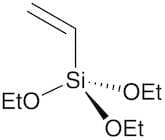
CAS 78-08-0
:Viniltrietoxisilano
- A 151
- A 151Ntj
- A 1522
- A 1522 (crosslinker)
- Ac 75
- Ah 151
- Cg-V 151
- Db 151
- Dl 151
- Dow Corning 6518
- Dynasylan VTEO
- Dynasylan VTEU
- Eb 151
- Ethenyltriethoxysilane
- Fd 151
- Geniosil GF 56
- Gf 56
- Gx 150
- Jh-V 151
- Kbe 1003
- Kh 151
- Kh 188
- Kh 858
- Lmd 151
- Ls 2300
- Lt 151
- Nq 71
- Nsc 151
- Nv 1107
- Polyscience VTES
- S 220
- SG-Si 151
- Sca 1613
- Sca-V 71E
- Sg 151
- Si 151
- Si 255
- Sila-Ace S 220
- Silanamine, Ethenyltriethoxy-
- Silane A 151
- Silane, triethoxyvinyl-
- Silaplane S 220
- Silquest A 151
- Silquest A 151NT
- Silquest A 151NTJ
- T 103647
- Tm 12
- Tri(ethoxo)(vinyl)silane
- Triaethoxy-Vinyl-Silan
- Triethoxy(vinyl)silan
- Triethoxy(vinyl)silane
- Triethoxyvinylsilane
- Trietoxi(Vinil)Silano
- Tsl 8311
- Uc-A 151
- Unisilan 612
- Unisilan U 612
- V 4910
- VP-Si 225
- Vinyltriethoxysilane
- Vtes
- Vts-E
- WD 20 (silane)
- Wd 20
- Xiameter OFS 6518
- Ydh 151
- Ygo 1203
- Z 6518
- Z 6519
- Ethenyltriethyloxy-silane
- ethenyl(triethoxy)silane
- Silane Coupling Agent A-151
- Trietoxyvinylsilane
- VTEO
- Ver más sinónimos
Vinyltriethoxysilane, 97%
CAS:Vinyltriethoxysilane is used as an adhesive for glass slides. It acts as a coupling agent on inorganic substances blended into polymers that function as adhesion promoters, crosslinkers, and surface modifiers. Further, it is used to prepare polymers. This Thermo Scientific Chemicals brand product waFórmula:C8H18O3SiPureza:97%Forma y color:Clear colorless, LiquidPeso molecular:190.31Triethoxyvinylsilane
CAS:Fórmula:C8H18O3SiPureza:>98.0%(GC)Forma y color:Colorless to Almost colorless clear liquidPeso molecular:190.31Vinyltriethoxysilane
CAS:S21975 - Vinyltriethoxysilane
Fórmula:C8H18O3SiPureza:= 98% (GC)Forma y color:Liquid, Clear LiquidPeso molecular:190.314VINYLTRIETHOXYSILANE
CAS:Olefin Functional Trialkoxy Silane
Silane coupling agents have the ability to form a durable bond between organic and inorganic materials to generate desired heterogeneous environments or to incorporate the bulk properties of different phases into a uniform composite structure. The general formula has two classes of functionality. The hydrolyzable group forms stable condensation products with siliceous surfaces and other oxides such as those of aluminum, zirconium, tin, titanium, and nickel. The organofunctional group alters the wetting or adhesion characteristics of the substrate, utilizes the substrate to catalyze chemical transformations at the heterogeneous interface, orders the interfacial region, or modifies its partition characteristics, and significantly effects the covalent bond between organic and inorganic materials.
Alkenylsilane Cross-Coupling Agent
The cross-coupling reaction is a highly useful methodology for the formation of carbon-carbon bonds. It involves two reagents, with one typically being a suitable organometallic reagent - the nucleophile - and the other a suitable organic substrate, normally an unsaturated halide, tosylate or similar - the electrophile.
Vinyltriethoxysilane; Triethoxyvinylsilane; TEVS; VTES; Ethenyltriethoxysilane; Triethoxysilylethylene; Triethoxy(vinyl)silane
ΔHvap: 6.8 kcal/molΔHform: -463.5 kcal/molDipole moment: 1.69 debyeSpecific wetting surface area: 412 m2/gCopolymerization parameters- e,Q: -0.42, 0.028γc of treated surfaces: 25 mN/mVapor pressure, 20 °C: 5 mmSpecific heat: 0.25 cal/g/°Relative hydrolysis rate versus SIV9220.0, vinyltrimethoxysilane; 0.05Forms copolymers with ethylene for moisture induced coupling of polyethyleneCouples fillers or fiberglass to resinsSee VEE-005 for polymeric versionReacts with enamines to give (E)-β:-silylenamines, which cross-couple with aryl iodides to give β-aryl enaminesEmployed as a coupling agent, adhesion promoter, and crosslinking agentUsed in microparticle surface modification for fillersCompatible with sulfur and peroxide cured rubber, polyester, polyolefin, styrene, and acrylic based materialsFor vinylationsAvailable as an oligomeric hydrolysate, SIV9112.2Extensive review of silicon based cross-coupling agents: Denmark, S. E. et al. "Organic Reactions, Volume 75" Denmark, S. E. ed., John Wiley and Sons, 233, 2011Fórmula:C8H18O3SiPureza:97%Forma y color:LiquidPeso molecular:190.31Vinyltriethoxysilane, min. 97%
CAS:Vinyltriethoxysilane, min. 97%
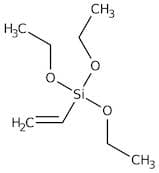
Fórmula:CH2CHSi(OC2H5)3Pureza:min. 97%Forma y color:colorless liq.Peso molecular:190.32