

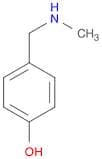
![Phenol, 4-[(methylamino)methyl]-](/_next/image/?url=https%3A%2Fstatic.cymitquimica.com%2Fcas-image%2Fthumb-webp%2F227093-phenol-4-methylamino-methyl.webp&w=3840&q=75)
CAS 78507-19-4
:Fenol, 4-[(metilamino)metil]-
Descripción:
Fenol, 4-[(metilamino)metil]- es un compuesto orgánico caracterizado por la presencia de un grupo fenólico y una cadena lateral de metilamina. Presenta un grupo hidroxilo (-OH) unido a un anillo bencénico, lo que contribuye a sus propiedades ácidas y a su capacidad para participar en enlaces de hidrógeno. El grupo metilamina (-NH(CH3)2) mejora su solubilidad en disolventes polares y puede influir en su reactividad y actividad biológica. Este compuesto es típicamente un líquido o sólido incoloro a amarillo pálido, dependiendo de su pureza y temperatura. Exhibe toxicidad moderada y puede actuar como irritante de la piel. En términos de aplicaciones, puede ser utilizado en la síntesis de productos farmacéuticos, agroquímicos o como un intermedio en la síntesis orgánica. Su comportamiento químico está influenciado tanto por las funcionalidades fenólicas como por las aminas, lo que le permite participar en varias reacciones químicas, incluyendo la sustitución aromática electrofilica y reacciones nucleofílicas. Se deben observar precauciones de seguridad al manipular este compuesto debido a sus posibles riesgos para la salud.
Fórmula:C8H11NO
Sinónimos:- 4-[(Methylamino)methyl]-phenol
Ordenar por
Pureza (%)
0
100
|
0
|
50
|
90
|
95
|
100
Encontrado 4 productos.
4-((Methylamino)methyl)phenol
CAS:Fórmula:C8H11NOPureza:97%Forma y color:SolidPeso molecular:137.17904-[(Methylamino)methyl]phenol
CAS:4-[(Methylamino)methyl]phenolPureza:98%Peso molecular:137.17904g/mol4-[(Methylamino)methyl]phenol
CAS:4-[(Methylamino)methyl]phenol is a metabolite of 4-aminobiphenyl, which is found in cigarette smoke and other combustion products. It is an end product of the oxidative metabolism of polycyclic aromatic hydrocarbons (PAHs). This chemical has been shown to cause cancer tissue damage in lung cells and metabolic disorders in mice. The thermal expansion coefficient of 4-[(methylamino)methyl]phenol has been measured on calf thymus DNA and found to be similar to that of water. Chronic exposure to this chemical causes an increase in body mass index, increased risk for cardiovascular disease, and increased risk for atherosclerosis. Studies have shown that 4-[(methylamino)methyl]phenol can be eliminated from the body with a half-life of about 8 hours. Logistic regression analysis showed that high-sensitivity C-reactive protein (hsCRP) levels are significantly higher in people who areFórmula:C8H11NOPureza:Min. 95%Peso molecular:137.18 g/mol

![4-[(Methylamino)methyl]phenol](/_next/image/?url=https%3A%2Fstatic.cymitquimica.com%2Fproducts%2F54%2Fthumb%2FOR927144.jpg&w=3840&q=75)


![4-[(Methylamino)methyl]phenol](/_next/image/?url=https%3A%2Fstatic.cymitquimica.com%2Fproducts%2F3D%2Fthumb%2FDDA50719.jpg&w=3840&q=75)
