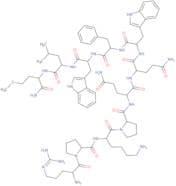
CAS 80434-86-2
:(D-pro2
- (D-Pro2,D-Trp79)-Substance P
- H-Arg-D-Pro-Lys-Pro-Gln-Gln-D-Trp-Phe-D-Trp-Leu-Met-NH2
- (D-pro2
- [D-PRO2,D-TRP7,9]-SUBSTANCE P HYDROCHLORIDE
- 2,D-Trp7,9>-SP
- (D-Pro2,D-Trp7
- 2-Pro-7,9-Trp-substance p
- dt79
- 2-Pro-7,9-Trp-sp
- L-Arg-D-Pro-L-Lys-L-Pro-L-Gln-L-Gln-D-Trp-L-Phe-D-Trp-L-Leu-L-Met-NH2
- Substance p, 2-D-proline-7-D-tryptophan-9-D-tryptophan-
- Pttsp
- Substance P, (D-Pro2, D-Trp7,9) acetate
- L-Arg-D-Pro-L-Lys-L-Pro-L-Glu(NH2)-L-Glu(NH2)-D-Trp-L-Phe-D-Trp-L-Leu-L-Met-NH2
- ARG-D-PRO-LYS-PRO-GLN-GLN-D-TRP-PHE-D-TRP-LEU-MET-NH2 3HCL 6H2O
- Substance p, Pro(2)-Trp(7,9)-
- Pt-sp
- L-Methioninamide, L-arginyl-D-prolyl-L-lysyl-L-prolyl-L-glutaminyl-L-glutaminyl-D-tryptophyl-L-phenylalanyl-D-tryptophyl-L-leucyl-
- ARG-D-PRO-LYS-PRO-GLN-GLN-D-TRP-PHE-D-TRP-LEU-MET-NH2
- [D-PRO2,D-TRP7,9]-SUBSTANCE P 3HCL 6H2O
- substance P, prolyl(2)-tryptophan(7,9)-
- ARG-D-PRO-LYS-PRO-GLN-GLN-D-TRP-PHE-D-TRP-LEU-MET-NH2 HYDROCHLORIDE
- Ver más sinónimos
[D-Pro2,D-Trp7,9]-Substance P
CAS:This product is a Substance P antagonist and is available as a 0.5mg vial. Substance P is a neuropeptide that is involved in the transmission of pain signals and inflammation. It is a member of the tachykinin neuropeptide family and is produced in the central nervous system and acts through its specific receptor neurokinin 1 receptor (NK-1R). NK-1R is present in neurons and on glial cell types. Substance P is involved in: pain perceptions as a neurotransmitter; gut motility; increased inflammation in the lungs, gastrointestinal tract and the skin and neuroinflammation. Interestingly the levels of Substance P are raised in inflammatory bowel diseases and through its involvement in cytokine release, it contributes to asthma pathology. These diverse selection of functions makes substance P a target for therapeutic research.
Fórmula:C74H106N20O13SPureza:Min. 95%Peso molecular:1,515.8 g/mol(D-Pro2,D-Trp7·9)-Substance P acetate salt
CAS:Substance P is a neuropeptide that is involved in pain perception, the cardiovascular system, and cancer. It has been shown to affect blood pressure in rats by activating the sympathetic nervous system and increasing blood vessel tone. It also has anticancer activity and may be used as a potential therapeutic agent for the treatment of cancer. Research has shown that Substance P may be an important regulator of cancer cell proliferation and metastasis. In addition, this peptide is a potent analgesic, with effects on both fast-twitch muscle tissue and slow-twitch muscle tissue. The effect on slow-twitch muscle tissue is not blocked by antagonists of the neurokinin-1 receptor (NK1R), suggesting that it may not be mediated through NK1 receptors.Fórmula:C74H106N20O13SPureza:Min. 95%Peso molecular:1,515.83 g/mol
![[D-Pro2,D-Trp7,9]-Substance P](/_next/image/?url=https%3A%2Fstatic.cymitquimica.com%2Fproducts%2F3D%2Fthumb%2FPSP-4113-V.jpg&w=3840&q=75)