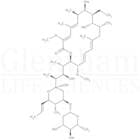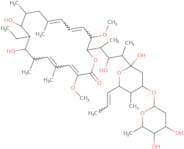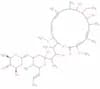
CAS 81552-34-3
:Concanamicina C
Descripción:
Concanamicina C es un producto natural que pertenece a la clase de los antibióticos macrólidos, derivado específicamente de la fermentación de la bacteria *Streptomyces griseus*. Se conoce por sus potentes efectos inhibitorios sobre la ATPasa vacuolar (V-ATPasa), una enzima crítica para varios procesos celulares, incluyendo la regulación del pH y el transporte de nutrientes. Esta inhibición conduce a efectos biológicos significativos, lo que hace de Concanamicina C un compuesto valioso en la investigación, particularmente en estudios relacionados con el metabolismo celular y la apoptosis. La sustancia exhibe una estructura molecular compleja caracterizada por múltiples anillos y grupos funcionales, lo que contribuye a su actividad biológica. Concanamicina C se utiliza típicamente en entornos de laboratorio para explorar los mecanismos de muerte celular y para investigar posibles aplicaciones terapéuticas en cáncer y otras enfermedades. Su estabilidad y solubilidad en disolventes orgánicos lo hacen adecuado para diversas condiciones experimentales. Sin embargo, al igual que con muchos compuestos bioactivos, el manejo cuidadoso y la consideración de los protocolos de seguridad son esenciales debido a sus potentes efectos biológicos.
Fórmula:C45H74O13
InChI:InChI=1/C45H74O13/c1-13-16-34-28(7)37(56-38-22-33(46)42(50)31(10)55-38)23-45(52,58-34)30(9)41(49)29(8)43-35(53-11)18-15-17-24(3)19-26(5)39(47)32(14-2)40(48)27(6)20-25(4)21-36(54-12)44(51)57-43/h13,15-18,20-21,26-35,37-43,46-50,52H,14,19,22-23H2,1-12H3/b16-13+,18-15-,24-17-,25-20-,36-21+/t26?,27?,28?,29?,30?,31-,32?,33-,34?,35?,37?,38-,39?,40?,41?,42-,43?,45?/m1/s1
Clave InChI:InChIKey=XKYYLWWOGLVPOR-GKJVGUBMSA-N
SMILES:[C@@H]([C@@H]([C@H](C)[C@@]1([C@@H](OC)/C=C/C=C(\C)/C[C@@H](C)[C@H](O)[C@H](CC)[C@H](O)[C@H](C)/C=C(\C)/C=C(\OC)/C(=O)O1)[H])O)(C)[C@@]2(O)C[C@@H](O[C@H]3C[C@@H](O)[C@H](O)[C@@H](C)O3)[C@H](C)[C@@H](/C=C/C)O2
Sinónimos:- (3Z,5E,7R,8R,9S,10S,11R,13E,15E,17S,18R)-18-[(1S,2R,3S)-3-[(2R,4R,5S,6R)-4-[(2,6-Dideoxy-β-<span class="text-smallcaps">D</span>-arabino-hexopyranosyl)oxy]tetrahydro-2-hydroxy-5-methyl-6-(1E)-1-propen-1-yl-2H-pyran-2-yl]-2-hydroxy-1-methylbutyl]-9-ethyl-8,10-dihydroxy-3,17-dimethoxy-5,7,11,13-tetramethyloxacyclooctadeca-3,5,13,15-tetraen-2-one
- 2,4-dideoxy-3-O-(2,6-dideoxy-α-D-arabino-hexopyranosyl)-1-C-{3-[(16E)-11-ethyl-10,12-dihydroxy-3,17-dimethoxy-7,9,13,15-tetramethyl-18-oxooxacyclooctadeca-4,6,14,16-tetraen-2-yl]-2-hydroxy-1-methylbutyl}-4-methyl-5-[(1E)-prop-1-en-1-yl]pentopyranose
- 4'-O-De(aminocarbonyl)concanamycin A
- Concanamycin A, 4'-O-de(aminocarbonyl)-
- Concanamycin C
- Oxacyclooctadeca-3,5,13,15-tetraen-2-one, 18-[(1S,2R,3S)-3-[(2R,4R,5S,6R)-4-[(2,6-dideoxy-β-<span class="text-smallcaps">D</span>-arabino-hexopyranosyl)oxy]tetrahydro-2-hydroxy-5-methyl-6-(1E)-1-propen-1-yl-2H-pyran-2-yl]-2-hydroxy-1-methylbutyl]-9-ethyl-8,10-dihydroxy-3,17-dimethoxy-5,7,11,13-tetramethyl-, (3Z,5E,7R,8R,9S,10S,11R,13E,15E,17S,18R)-
- Oxacyclooctadeca-3,5,13,15-tetraen-2-one, 18-[(1S,2R,3S)-3-[(2R,4R,5S,6R)-4-[(2,6-dideoxy-β-<span class="text-smallcaps">D</span>-arabino-hexopyranosyl)oxy]tetrahydro-2-hydroxy-5-methyl-6-(1E)-1-propenyl-2H-pyran-2-yl]-2-hydroxy-1-methylbutyl]-9-ethyl-8,10-dihydroxy-3,17-dimethoxy-5,7,11,13-tetramethyl-, (3Z,5E,7R,8R,9S,10S,11R,13E,15E,17S,18R)-
- Oxacyclooctadecane, concanamycin A deriv.
- (3Z,5E,7R,8R,9S,10S,11R,13E,15E,17S,18R)-18-[(1S,2R,3S)-3-[(2R,4R,5S,6R)-4-[(2,6-Dideoxy-β-D-arabino-hexopyranosyl)oxy]tetrahydro-2-hydroxy-5-methyl-6-(1E)-1-propen-1-yl-2H-pyran-2-yl]-2-hydroxy-1-methylbutyl]-9-ethyl-8,10-dihydroxy-3,17-dimethoxy-5,7,11,13-tetramethyloxacyclooctadeca-3,5,13,15-tetraen-2-one
- Oxacyclooctadeca-3,5,13,15-tetraen-2-one, 18-[(1S,2R,3S)-3-[(2R,4R,5S,6R)-4-[(2,6-dideoxy-β-D-arabino-hexopyranosyl)oxy]tetrahydro-2-hydroxy-5-methyl-6-(1E)-1-propen-1-yl-2H-pyran-2-yl]-2-hydroxy-1-methylbutyl]-9-ethyl-8,10-dihydroxy-3,17-dimethoxy-5,7,11,13-tetramethyl-, (3Z,5E,7R,8R,9S,10S,11R,13E,15E,17S,18R)-
- Oxacyclooctadeca-3,5,13,15-tetraen-2-one, 18-[(1S,2R,3S)-3-[(2R,4R,5S,6R)-4-[(2,6-dideoxy-β-D-arabino-hexopyranosyl)oxy]tetrahydro-2-hydroxy-5-methyl-6-(1E)-1-propenyl-2H-pyran-2-yl]-2-hydroxy-1-methylbutyl]-9-ethyl-8,10-dihydroxy-3,17-dimethoxy-5,7,11,13-tetramethyl-, (3Z,5E,7R,8R,9S,10S,11R,13E,15E,17S,18R)-
Ordenar por
Pureza (%)
0
100
|
0
|
50
|
90
|
95
|
100
Encontrado 3 productos.
Concanamycin C
CAS:Concanamycin C, a natural macrolide antibiotic, was initially isolated from Streptomyces and identified as an inhibitor of T-cell proliferation in response to concanavalin A (1,2). It exhibits cytotoxicity to fungi, including yeasts, by inhibiting vacuolar-type ATPases (3,4).Fórmula:C45H74O13Forma y color:SolidPeso molecular:823.1Concanamycin C
CAS:Concanamycin C is an analog of the human kinase inhibitor that has been shown to have potent anticancer activity. This compound induces apoptosis in cancer cells by inhibiting the activity of protein kinases involved in cell cycle regulation and tumor growth. Concanamycin C is a medicinal compound that has been used as a research tool in the development of novel kinase inhibitors for cancer therapy. This potent inhibitor has been shown to be effective against various types of cancer, making it a promising candidate for further investigation as an anticancer drug. Its unique properties make it an attractive target for the development of new and more effective kinase inhibitors.
Fórmula:C45H74O13Pureza:Min. 95%Peso molecular:823.1 g/mol