CAS 83-34-1
:Escatol
Descripción:
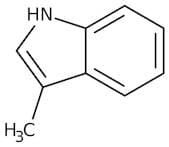
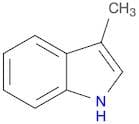
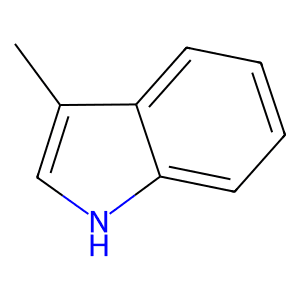
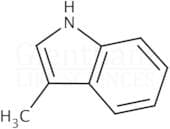
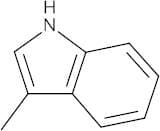
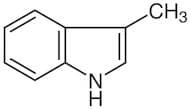
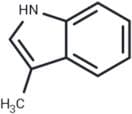
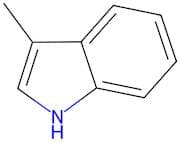
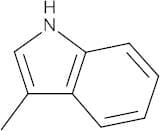
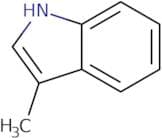
Escatol, también conocido como 3-metilindol, es un compuesto orgánico con la fórmula química C9H9N. Es un sólido incoloro a amarillo pálido a temperatura ambiente y tiene un olor fecal característico, por lo que a menudo se asocia con el olor de las heces. Escatol es un derivado del indol y se produce en el cuerpo humano durante la digestión del triptófano, un aminoácido que se encuentra en varios alimentos. Es soluble en disolventes orgánicos como el etanol y el éter, pero tiene una solubilidad limitada en agua. Escatol se utiliza en la industria de fragancias por su fuerte aroma y también se estudia por sus posibles actividades biológicas, incluyendo su papel en el desarrollo de ciertos feromonas. Además, se ha investigado Escatol por sus efectos en el comportamiento animal y sus posibles aplicaciones en agricultura como repelente natural de insectos. Debido a su fuerte olor, Escatol se maneja con cuidado en entornos de laboratorio para evitar exposiciones desagradables.
Fórmula:C9H9N
InChI:InChI=1S/C9H9N/c1-7-6-10-9-5-3-2-4-8(7)9/h2-6,10H,1H3
Clave InChI:InChIKey=ZFRKQXVRDFCRJG-UHFFFAOYSA-N
SMILES:CC=1C=2C(=CC=CC2)NC1
Sinónimos:- 1H-Indole, 3-methyl-
- 3-Methyindole
- 3-Methyl indole
- 3-Methyl-1H-indole
- 3-Methyl-4,5-benzopyrrole
- 3-Methylindol
- 3-Metilindol
- Beta-Methylindole
- Fema 3019
- Indole(1H), 3-Methyl-
- Indole, 3-methyl-
- Indole, 3-methyl-(skatole)
- Nsc 122024
- Scatole
- Skatol
- Skatole
- β-Methylindole
- Ver más sinónimos
Ordenar por
Pureza (%)
0
100
|
0
|
50
|
90
|
95
|
100
Encontrado 11 productos.
3-Methylindole, 99%
CAS:3-Methylindole is often used as a component of commercial fragrances and perfumes.It helps fluorescent guanosine analogue, which in a dimethoxytrityl, phosphoramidite protected form, can be site-specifically inserted into oligonucleotides through a 3?5?phosphodiester linkage using an automated DNA sFórmula:C9H9NPureza:99%Forma y color:White to pale brown, Crystals or powder or crystalline powder or flakesPeso molecular:131.183-Methylindole
CAS:Fórmula:C9H9NPureza:>98.0%(GC)Forma y color:White to Light yellow powder to crystalPeso molecular:131.18Skatole
CAS:Skatole (3-Methyl-1H-indole), produced by bacteria, regulates intestinal epithelial cellular functions through activating aryl hydrocarbon receptors and p38.Fórmula:C9H9NPureza:99.74%Forma y color:Leaves From Petroleum Ether; White-Brown Scales SolidPeso molecular:131.173-Methylindole
CAS:Applications A naturally abundant pneumotoxin, found primarily in mammalian feces providing its strong fecal odor. In lower concentrations however, the compound has a pleasent aroma, giving orange blossoms and jasmine their pleasing scent. It is often a component of commercial fragrances and perfumes. This compound is a contaminant of emerging concern (CECs)
Not a dangerous good if item is equal to or less than 1g/ml and there is less than 100g/ml in the package
References Nakashima, T., et al.: Biol. Pharm. Bull., 32, 832 (2009), Xu, H., et al.: Chem. Pharm. Bull., 57, 321 (2009), Bodoor, K., et al.: J. Med. Chem., 52, 3753 (2009), Naskar, S., et al.: J. Chem. Res., 3, 174 (2009), Sollner, K., et al.: J. Agric. Food Chem., 57, 4319 (2009),Fórmula:C9H9NForma y color:NeatPeso molecular:131.173-Methylindole
CAS:Also called Skatole. It occurs naturally in the feces of mammals and birds and is the primary contributor to fecal odour.Fórmula:C9H9NPureza:Min. 97.5%Forma y color:White PowderPeso molecular:131.17 g/mol3-Methyl-1H-Indole
CAS:Fórmula:C9H9NPureza:97%Forma y color:White to slightly pale yellow powderPeso molecular:131.178