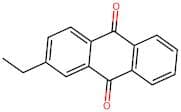
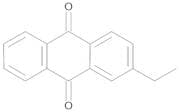
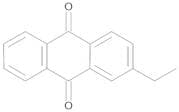
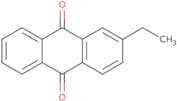
CAS 84-51-5
:2-Etilantraquinona
- 2-Eaq
- 2-Ethyl Anthraquinone
- 2-Ethyl-9,10-anthracenedione
- 2-Ethyl-9,10-anthraquinone
- 2-Ethyl-9,10-dihydroanthracene-9,10-dione
- 2-Ethylanthracene-9,10-Dione
- 9,10-Anthracenedione, 2-ethyl-
- Anthraquinone, 2-ethyl-
- Ethylanthraquinone
- Kayacure 2-EAQ
- NSC 7216
- β-Ethylanthraquinone
- 2-Ethylanthraquinone
- Photoinitiator-2-EAQ
- usafso-1
- 10-Anthracenedione,2-ethyl-9
- TIMTEC-BB SBB008818
- beta-ethylanthraquinone
- 2-ethyl-anthraquinon
- SYNCUREEHA2-ETHYLHEXYL-4-(DIMETHYLAMINO)BENZOATE
- 2-ETHYL ANTHROQUINONE
- 2-ethyl-10-anthracenedione
- 2-ETHYLANTHRAQUINONE, 97+%
- USAF so-1
- Ethylanthraquinone,98%
- 2-Ethylanthrachinon
- Ver más sinónimos
2-Ethylanthraquinone
CAS:Fórmula:C16H12O2Pureza:>98.0%(GC)Forma y color:Light yellow to Amber to Dark green powder to crystalPeso molecular:236.272-Ethylanthraquinone, 98%
CAS:2-Ethylanthraquinone can be used as a photoinitiator of crosslinking or degradation of polyethylene. It is used to produce hydrogen peroxide by hydrogenation with the help of Pd/polyaniline as the catalysts. This Thermo Scientific Chemicals brand product was originally part of the Alfa Aesar productFórmula:C16H12O2Pureza:98%Forma y color:Crystals or powder or crystalline powder or flakes, YellowPeso molecular:236.279,10-Anthracenedione, 2-ethyl-
CAS:Fórmula:C16H12O2Pureza:98%Forma y color:SolidPeso molecular:236.26532-Ethyl-anthraquinone
CAS:Applications 2-Ethyl-anthraquinone can be used as a photoinitiator of crosslinking or degradation of polyethylene.
Not a dangerous good if item is equal to or less than 1g/ml and there is less than 100g/ml in the package
References Zamotaev, P., et al.: Plasticheskie Massy, 9, 31 (1986); Litsov, N., et al.: Polym. Degrad. Stabil., 32, 1 (1991); Hwang, J., et al.: Stud. Surf. Sci. Catal., 135, 4469 (2001)Fórmula:C16H12O2Forma y color:Light Yellow To YellowPeso molecular:236.272-Ethylanthracene-9,10-dione
CAS:Fórmula:C16H12O2Pureza:98%Forma y color:Liquid, No data available.Peso molecular:236.272-Ethyl anthraquinone
CAS:2-Ethyl anthraquinone is a white solid that is soluble in organic solvents. It is a cationic surfactant with a melting point of 150 °C and a boiling point of 290 °C. 2-Ethyl anthraquinone has been used as a hydrogenation catalyst, but can also be used as a catalyst for the acylation reaction. The primary use of 2-ethyl anthraquinone is in wastewater treatment, where it functions as both an oxygen scavenger and flocculent. 2-Ethyl anthraquinone can be synthesized by reacting potassium dichromate with benzaldehyde and ethyl bromoacetate. 2-Ethyl anthraquinone reacts with hydrogen to form acetaldehyde and water, which can be detected using gas chromatography.
Fórmula:C16H12O2Pureza:Min. 95%Peso molecular:236.27 g/mol