CAS 84-63-9
:Bis(4-Metil-2-pentilo) ftalato
Descripción:
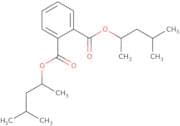
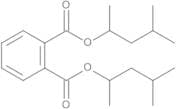
Bis(4-Metil-2-pentilo) ftalato, comúnmente conocido como un éster de ftalato, es un compuesto orgánico caracterizado por sus grupos funcionales de éster derivados del ácido ftálico. Típicamente es un líquido incoloro a amarillo pálido con una textura ligeramente aceitosa y un leve olor aromático. Esta sustancia se utiliza principalmente como plastificante, mejorando la flexibilidad y durabilidad de los plásticos, particularmente el cloruro de polivinilo (PVC). Su estructura molecular incluye dos grupos 4-metil-2-pentilo unidos a una columna vertebral de ftalato, lo que contribuye a sus propiedades. Bis(4-Metil-2-pentilo) ftalato es conocido por su volatilidad relativamente baja y buena estabilidad térmica, lo que lo hace adecuado para diversas aplicaciones industriales. Sin embargo, al igual que muchos ftalatos, ha suscitado preocupaciones ambientales y de salud debido a sus posibles efectos disruptores endocrinos y ha estado sujeto a un escrutinio regulatorio. El manejo y la eliminación adecuados son esenciales para mitigar cualquier riesgo asociado con la exposición.
Fórmula:C20H30O4
InChI:InChI=1S/C20H30O4/c1-13(2)11-15(5)23-19(21)17-9-7-8-10-18(17)20(22)24-16(6)12-14(3)4/h7-10,13-16H,11-12H2,1-6H3
Clave InChI:InChIKey=UAFXUVUVOTXFND-UHFFFAOYSA-N
SMILES:C(OC(CC(C)C)C)(=O)C1=C(C(OC(CC(C)C)C)=O)C=CC=C1
Sinónimos:- Phthalic acid, bis(1,3-dimethylbutyl) ester
- Di-(4-Methyl-2-pentyl)phthalate
- 1,2-Benzenedicarboxylic acid, 1,2-bis(1,3-dimethylbutyl) ester
- 1,2-Benzenedicarboxylic acid, bis(1,3-dimethylbutyl) ester
- 2-Pentanol, 4-methyl-, phthalate (2:1)
Ordenar por
Pureza (%)
0
100
|
0
|
50
|
90
|
95
|
100
Se han encontrado 13 productos.
Phthalic acid, bis-4-methyl-2-pentyl ester
CAS:Fórmula:C20H30O4Forma y color:NeatPeso molecular:334.45Bis(4-methyl-2-pentyl) phthalate
CAS:Dibutyl phthalate is a mixture of two isomers, butyl benzyl phthalate and dibutyl phthalate. It is used as a plasticizer in the manufacture of polyvinyl chloride plastics. The health effects of dibutyl phthalate are not well-studied, although it has been shown to cause liver toxicity in rats. Dibutyl phthalate can be analyzed by gas chromatography or high-performance liquid chromatography. The chromatographic method for determining the presence of dibutyl phthalate is based on the chemical properties of the functional groups, which are determined by the type of solvent and the matrix effect. Dibutyl phthalate can also be determined using magnetic particles. This technique uses an analytical method that involves preparing a solution with a known concentration, followed by adding magnetic particles to the solution and measuring their response to an applied magnetic field.Fórmula:C20H30O4Pureza:Min. 95%Forma y color:PowderPeso molecular:334.45 g/molBis(4-Methyl-2-pentyl) Phthalate
CAS:Producto controladoFórmula:C20H30O4Forma y color:NeatPeso molecular:334.45