CAS 855-38-9
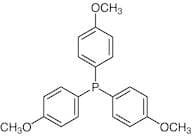
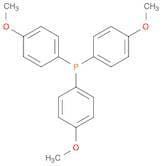
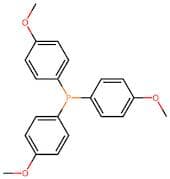
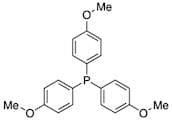
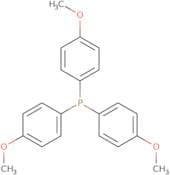
:Tris(4-metoxifenil)fosfina
Descripción:
Tris(4-metoxifenil)fosfina, con el número CAS 855-38-9, es un compuesto organofosforado caracterizado por la presencia de un átomo de fósforo unido a tres grupos 4-metoxifenilo. Este compuesto típicamente aparece como un sólido blanco a amarillo claro y es soluble en disolventes orgánicos como el diclorometano y el cloroformo. Exhibe una estabilidad térmica relativamente alta, lo que lo hace adecuado para diversas aplicaciones químicas. Los grupos metoxi mejoran su solubilidad y reactividad, permitiéndole participar en varias reacciones orgánicas, incluidas aquellas que involucran sustitución nucleofílica y química de coordinación. Tris(4-metoxifenil)fosfina se utiliza a menudo como un ligando en complejos de metales de transición, contribuyendo a la catálisis y la ciencia de materiales. Además, puede exhibir propiedades electrónicas interesantes debido a la presencia de los sustituyentes metoxi, que pueden influir en la distribución electrónica dentro de la molécula. Se deben observar precauciones de seguridad al manipular este compuesto, al igual que con muchos compuestos organofosforados, debido a la posible toxicidad y preocupaciones ambientales.
Fórmula:C21H21O3P
InChI:InChI=1S/C21H21O3P/c1-22-16-4-10-19(11-5-16)25(20-12-6-17(23-2)7-13-20)21-14-8-18(24-3)9-15-21/h4-15H,1-3H3
Clave InChI:InChIKey=UYUUAUOYLFIRJG-UHFFFAOYSA-N
SMILES:P(C1=CC=C(OC)C=C1)(C2=CC=C(OC)C=C2)C3=CC=C(OC)C=C3
Sinónimos:- Ai3-62578
- Nsc 136458
- Phosphine, tris(4-methoxyphenyl)-
- Phosphine, tris(p-methoxyphenyl)-
- Tri(4-methoxyphenyl)phosphine
- Tri(p-methoxyphenyl)phosphine
- Tri-p-anisylphosphine
- Trianisylphosphine
- Tris(4-Methoxyphenyl)Phosphane
- Tris(4-anisyl)phosphine
- Tris(4-methoxylphenyl)phosphine
- Tris(p-anisyl)phosphine
- tris(p-Methoxyphenyl)phosphine
- Ver más sinónimos
Ordenar por
Pureza (%)
0
100
|
0
|
50
|
90
|
95
|
100
Encontrado 7 productos.
Tris(4-methoxyphenyl)phosphine
CAS:Fórmula:C21H21O3PPureza:>97.0%(T)Forma y color:White to Yellow to Orange powder to crystalPeso molecular:352.37Tris(4-Methoxyphenyl)Phosphine
CAS:Fórmula:C21H21O3PPureza:95%Forma y color:SolidPeso molecular:352.3634Ref: IN-DA0035S1
1kgA consultar5kgA consultar50gA consultar1g24,00€5g27,00€10g36,00€25g58,00€100g141,00€250g280,00€500g672,00€Tris(p-methoxyphenyl)phosphine
CAS:Tris(p-methoxyphenyl)phosphineFórmula:C21H21O3PPureza:97%Forma y color: white crystalline solidPeso molecular:352.36g/molTris(4-methoxyphenyl)phosphine
CAS:Fórmula:C21H21O3PPureza:95%Forma y color:Solid, White to yellow crystal powderPeso molecular:352.37Tris(4-methoxyphenyl)phosphine
CAS:Producto controladoFórmula:C21H21O3PForma y color:NeatPeso molecular:352.36Tris(p-methoxyphenyl)phosphine, 98%
CAS:Tris(p-methoxyphenyl)phosphine, 98%
Fórmula:(pCH3OC6H4)3PPureza:98%Forma y color:white to pale yellow xtl.Peso molecular:352.37Tris(4-methoxyphenyl)phosphine
CAS:Tris(4-methoxyphenyl)phosphine (TMPP) is a molecule that exhibits a variety of biological properties. TMPP has been shown to inhibit transcription and DNA replication in prostate cancer cells. It also has the ability to form palladium complexes, which are used in analytical methods for the determination of metal ions. The binding constants of TMPP have been determined by x-ray crystal structures and molecular modeling techniques. TMPP is water soluble and is able to bind metal ions such as zinc or mercury, which may be due to its zwitterion structure. TMPP has been used as a chemiluminescence agent in titration calorimetry experiments, where it reacts with oxygen to produce light at a wavelength of 560 nm. This reaction is exothermic and can be used to measure energy changes in chemical reactions without the need for expensive equipment.Fórmula:C21H21O3PPureza:Min. 95%Forma y color:Yellow PowderPeso molecular:352.36 g/mol