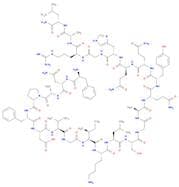
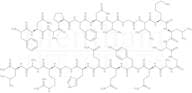
CAS 869705-22-6
:L-leucinamida, L-fenilalanil-L-asparaginil-L-alanil-L-prolil-L-fenilalanil-L-a-aspártico-L-valil-glicil-L-isoleucil-L-lisil-L-leucil-L-seril-glicil-L-alanil-L-glutaminil-L-tirosil-L-glutaminil-L-glutaminil-L-histidil-glicil-L-arginil-L-alanil-
- Mouseobestatin
- Obestatin (mouse)
- Obestatin (Rat)
Obestatin (rat)
CAS:FNAPFDVGIKLSGAQYQQHGRAL-amide corresponds also to the sequence of mouse obestatin.Fórmula:C114H174N34O31Pureza:> 98%Peso molecular:2516.85Obestatin(rat)
CAS:Endogenous peptide that suppresses food intake and body weight-gainFórmula:C114H174N34O31Pureza:98%Forma y color:SolidPeso molecular:2516.81Obestatin (Rat, Mouse)
CAS:Obestatin is a 23 amino acid gastrointestinal peptide, encoded for by the ghrelin gene and is known to reduce food intake through supressing appetite. This peptide has been found to influence the pancreas, cardiovascular system and adipose tissues as well as the gastrointestinal system. One study showed that when high-fat diet fed rats were given chronic administration of obestatin it prevented the development of non-alcoholic fatty liver disease. Consequently Obestatin has the potential to be used in preventing obesity-related diseases.Fórmula:C114H174N34O31Pureza:Min. 95%Peso molecular:2,516.87 g/molObestatin (rat) trifluoroacetate salt
CAS:Please enquire for more information about Obestatin (rat) trifluoroacetate salt including the price, delivery time and more detailed product information at the technical inquiry form on this pageFórmula:C114H174N34O31Pureza:Min. 95%Peso molecular:2,516.81 g/molObestatin (Rat, Mouse)
CAS:Obestatin is a peptide that was originally isolated from rat and mouse brain. It is a potent inhibitor of Kv1.3 and Kv1.5 potassium channels, with an IC50 of about 1 nM for both channels, but has no effect on other ion channels. Obestatin also inhibits the binding of antibodies to epitopes on the surface of cells, which may be due to its ability to inhibit cell-cell adhesion. The antibody-binding activity of obestatin is also inhibited by peptides corresponding to residues in the N-terminal region of obestatin, but not by peptides corresponding to residues in the C-terminal region. Obestatin has been shown to activate receptor tyrosine kinase (RTK) pathways and induce signaling cascades that lead to the proliferation and differentiation of tumor cells.
Fórmula:C114H174N34O31Pureza:Min. 95%Peso molecular:2,516.8 g/mol