CAS 870-50-8
:Azodicarboxilato de di-terc-butilo
Descripción:
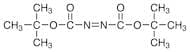
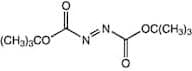
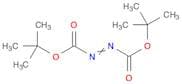
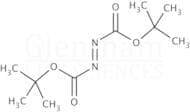
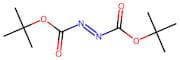
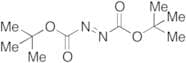
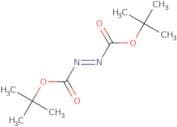
Azodicarboxilato de di-terc-butilo (DBAD) es un compuesto orgánico caracterizado por su estructura de azodicarboxilato, que presenta dos grupos tert-butilo unidos a los átomos de nitrógeno del grupo funcional azo. Típicamente es un líquido incoloro a amarillo pálido con un olor distintivo. Se conoce que el DBAD es estable en condiciones normales, pero puede descomponerse al exponerse al calor o a la luz, liberando gas nitrógeno. Este compuesto se utiliza a menudo como reactivo en síntesis orgánica, particularmente en reacciones radicales y como fuente de radicales libres en procesos de polimerización. Su solubilidad en disolventes orgánicos lo hace versátil para diversas aplicaciones en síntesis química. Además, el DBAD es reconocido por su papel como agente de transferencia de cadena en la producción de polímeros, contribuyendo al control del peso molecular y la arquitectura del polímero. Se requieren precauciones de seguridad al manipular este compuesto, ya que puede ser peligroso si se ingiere o inhala, y se deben tomar medidas de protección adecuadas para mitigar cualquier riesgo asociado con su uso.
Fórmula:C10H18N2O4
InChI:InChI=1S/C10H18N2O4/c1-9(2,3)15-7(13)11-12-8(14)16-10(4,5)6/h1-6H3
Clave InChI:InChIKey=QKSQWQOAUQFORH-UHFFFAOYSA-N
SMILES:O(C(C)(C)C)C(N=NC(OC(C)(C)C)=O)=O
Sinónimos:- 1,2-Diazenedicarboxylic acid, 1,2-bis(1,1-dimethylethyl) ester
- Azodicarboxylic acid di-tert-butyl ester
- Bis(1,1-dimethylethyl)azodicarboxylate
- Dbad
- Di-Tert-Butyl Diazene-1,2-Dicarboxylate
- Di-tert-butyl azodiformate
- Di-tert-butyl diazodicarboxylate
- Diazenedicarboxylic acid, bis(1,1-dimethylethyl) ester
- Formic acid, azodi-, di-tert-butyl ester
- NSC 109889
- di-tert-butyl (E)-diazene-1,2-dicarboxylate
- Ver más sinónimos
Ordenar por
Pureza (%)
0
100
|
0
|
50
|
90
|
95
|
100
Encontrado 8 productos.
Di-tert-butyl Azodicarboxylate (20% in Toluene)
CAS:Fórmula:C10H18N2O4Forma y color:Light yellow to Brown clear liquidPeso molecular:230.26Di-tert-butyl azodicarboxylate, 98%
CAS:Di-tert-butyl azodicarboxylate is a reagent used in the preparation of acyl hydrazinedicarboxylates. It is also used in the electrophilic amination of beta-keto esters catalyzed by an axially chiral guanidine. It serves as a precursor in an enantioselective synthesis of 3,6-dihyropyridazines employiFórmula:C10H18N2O4Pureza:98%Forma y color:Yellow, Crystals or powder or crystalline powder or fused solid or flakesPeso molecular:230.26Di-tert-butyl diazene-1,2-dicarboxylate
CAS:Fórmula:C10H18N2O4Pureza:95%Forma y color:SolidPeso molecular:230.2609Ref: IN-DA003PRR
1gA consultar5g22,00€10g26,00€1kg159,00€25g28,00€50g38,00€5kgA consultar100g53,00€500g113,00€Di-tert-butylazodicarboxylate
CAS:Fórmula:C10H18N2O4Pureza:97%Forma y color:Solid, Powder or Crystalline Powder or Solid or FlakesPeso molecular:230.264Di-(tert-butyl) diazene-1,2-dicarboxylate
CAS:Di-(tert-butyl) diazene-1,2-dicarboxylateFórmula:C10H18N2O4Pureza:98%Forma y color: yellow crystalsPeso molecular:230.26091g/molDi-tert-butyl Azodicarboxylate
CAS:Producto controladoApplications Di-tert-butyl azodicarboxylate is a reagent used in the preparation of acyl hydrazinedicarboxylates via photoorganocatalytic hydroacylation of dialkyl azodicarboxylates with aldehydes in presence of phenylglyoxylic acid as photocatalyst.
References Papadopoulos, G. N., et al.: Chem. Eur. J., 20, 13811 (2014);Fórmula:C10H18N2O4Forma y color:YellowPeso molecular:230.26Di-tert-butyl azodicarboxylate
CAS:Di-tert-butyl azodicarboxylate (DTBA) is an organic compound that is used in organic synthesis as a dienophile. DTBA reacts with various electrophiles to form dihydro derivatives through a transfer mechanism, which can be monitored by the change in magnetic resonance spectroscopy signals. The reaction of DTBA with trifluoroacetic acid and hydrogen chloride forms the desired product, 3-amino-2,4,6-trichloropyridine. DTBA is also used for the synthesis of 1,4-dihydropyridines from 2-aminobenzene derivatives and bromoacetaldehyde diethyl acetal. This process is catalyzed by palladium on carbon. DTBA is asymmetric at position C5 and C6 because it has two chiral centers: one at C3 and one at C5 or C6. The use of this reagent allows for the scalableFórmula:C10H18N2O4Pureza:Min. 98%Forma y color:PowderPeso molecular:230.26 g/mol