CAS 873-74-5
:4-Aminobenzonitrilo
Descripción:
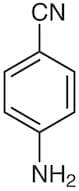
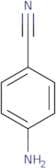
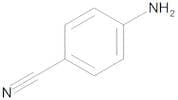
4-Aminobenzonitrilo, también conocido como p-aminobenzonitrilo, es un compuesto orgánico caracterizado por la presencia de un grupo amino (-NH2) y un grupo nitrilo (-C≡N) unidos a un anillo bencénico. Su fórmula molecular es C7H6N2, lo que indica que contiene siete átomos de carbono, seis átomos de hidrógeno y dos átomos de nitrógeno. Este compuesto generalmente aparece como un sólido cristalino blanco a amarillo claro y es soluble en disolventes polares como agua y alcoholes. 4-Aminobenzonitrilo se utiliza principalmente en la síntesis de varios productos farmacéuticos, agroquímicos y colorantes, debido a su reactividad y capacidad para sufrir transformaciones químicas adicionales. Exhibe toxicidad moderada, y se deben tomar las medidas de seguridad adecuadas al manipularlo, incluyendo el uso de equipo de protección personal. El punto de fusión y el punto de ebullición del compuesto pueden variar según la pureza y las condiciones ambientales, pero generalmente es estable en condiciones estándar. Al igual que muchos compuestos orgánicos, debe almacenarse en un lugar fresco y seco, alejado de sustancias incompatibles.
Fórmula:C7H6N2
InChI:InChI=1S/C7H6N2/c8-5-6-1-3-7(9)4-2-6/h1-4H,9H2
Clave InChI:InChIKey=YBAZINRZQSAIAY-UHFFFAOYSA-N
SMILES:C(#N)C1=CC=C(N)C=C1
Sinónimos:- 1-Amino-4-cyanobenzene
- 4-Amino Benzonitrile
- 4-Amino-Benzonitril
- 4-Aminobenzenenitrile
- 4-Aminobenzonitril
- 4-Aminobenzonitrilo
- 4-Aminophenylnitrile
- 4-Cyanoaniline
- 4-Cyanobenzenamine
- 4-Cyanobenzeneamine
- 4-Cyanobenzonitrile
- 4-Cyanophenylamine
- Aniline, p-cyano-
- Benzonitrile, 4-amino-
- Benzonitrile, p-amino-
- Nsc 7625
- P-Amino-Benzonitril
- P-Aminobenzonitrile
- P-Cyanoaniline
- Pabn
- Para-Amino Benzo Nitrile
- Timtec-Bb Sbb008363
- Vicure 55
- p-Cyanophenylamine
- Ver más sinónimos
Ordenar por
Pureza (%)
0
100
|
0
|
50
|
90
|
95
|
100
Encontrado 10 productos.
4-Aminobenzonitrile
CAS:Fórmula:C7H6N2Pureza:>98.0%(GC)(T)Forma y color:White to Light yellow to Green powder to crystalPeso molecular:118.144-Aminobenzonitrile, 98%
CAS:4-Aminobenzonitrile is used as an amino substituted benzonitrile with hypotensive activity and as a radioprotective agent. It is also used as a derivatization reagent in the capillary zone electrophoretic analysis of aldoses, ketoses and uronic acid. Further, it is used in the preparation of methacrFórmula:C7H6N2Pureza:98%Forma y color:Crystals or powder or crystalline powder, Pale cream to cream to yellow to orange to brown to greyPeso molecular:118.144-Aminobenzonitrile
CAS:4-AminobenzonitrileFórmula:C7H6N2Pureza:≥95%Forma y color: pale yellow solidPeso molecular:118.14g/mol4-Aminobenzonitrile
CAS:4-Aminobenzonitrile is a chemical compound that has been shown to be an antimicrobial agent. It has been found to be active against bacteria and fungi, such as Candida albicans and Aspergillus niger. 4-Aminobenzonitrile binds with epidermal growth factor (EGF) by intramolecular hydrogen bonding, which leads to the disruption of the protein's tertiary structure. The nitrogen atoms in this compound have been shown to react with water vapor at high temperatures, which results in the release of hydrogen gas. This reaction can be used for phase transition temperature studies. 4-Aminobenzonitrile also shows intermolecular hydrogen bonding with fatty acids, which causes the molecule to change its shape and protonation state. These changes affect its frequency shift and molecular modeling study results.Fórmula:C7H6N2Pureza:Min. 95%Forma y color:Off-White PowderPeso molecular:118.14 g/mol4-Aminobenzonitrile
CAS:Producto controladoStability Toxic
Applications 4-Aminobenzonitrile is an amino substituted benzonitrile with hypotensive activity. 4-Aminobenzonitrile is used as radioprotective agent. 4-Aminobenzonitrile is a metabolite of 4-cyanoacetanilide.
Not a dangerous good if item is equal to or less than 1g/ml and there is less than 100g/ml in the package
References Fernandez, J.P.: Farm. Ediz. Sci., 41, 41 (1986); Cheav, S.L. et al.: Ann. Pharm. Fran., 44, 363 (1987); Hesk, D. et al.: Xenobiotica, 18, 955 (1988);Fórmula:C7H6N2Forma y color:NeatPeso molecular:118.14