CAS 88-05-1
:2,4,6-Trimetilanilina
Descripción:
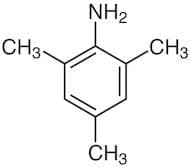
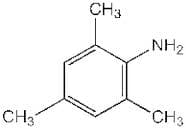
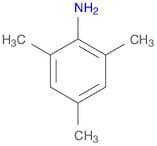
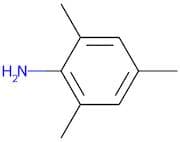
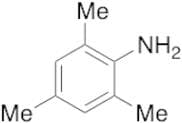
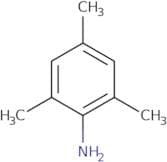
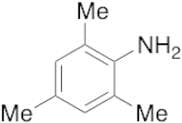
2,4,6-Trimetilanilina, con el número CAS 88-05-1, es un compuesto orgánico que pertenece a la clase de las anilinas, que son aminas aromáticas. Presenta un anillo bencénico sustituido con tres grupos metilo en las posiciones 2, 4 y 6 y un grupo amino (-NH2) en la posición 1. Este compuesto es típicamente un líquido o sólido incoloro a amarillo pálido, dependiendo de la temperatura, y tiene un olor característico a amina. Es soluble en disolventes orgánicos, pero tiene una solubilidad limitada en agua debido a sus grupos metilo hidrofóbicos. 2,4,6-Trimetilanilina se utiliza principalmente en la producción de colorantes, pigmentos y como intermediario en la síntesis de varios productos químicos. Exhibe propiedades básicas debido a la presencia del grupo amino, lo que le permite participar en varias reacciones químicas, incluida la sustitución aromática electrofílica. Sin embargo, es importante manejar este compuesto con cuidado, ya que puede representar riesgos para la salud, incluida la irritación de la piel y del sistema respiratorio, y se considera peligroso para el medio ambiente.
Fórmula:C9H13N
InChI:InChI=1S/C9H13N/c1-6-4-7(2)9(10)8(3)5-6/h4-5H,10H2,1-3H3
Clave InChI:InChIKey=KWVPRPSXBZNOHS-UHFFFAOYSA-N
SMILES:NC1=C(C)C=C(C)C=C1C
Sinónimos:- 1-Amino-2,4,6-trimethylbenzene
- 2,4,6-Trimethylanilin
- 2,4,6-Trimethylaniline (mesidine)
- 2,4,6-Trimethylbenzenamine
- 2,4,6-Trimethylphenylamine
- 2,4,6-Trimetilanilina
- 2-Aminomesitylene
- Aminomesitylene
- Aniline, 2,4,6-Trimethyl-
- Benzenamine, 2,4,6-trimethyl-
- Mesidin
- Mesidine
- Mesitylamine
- Mesitylene, 2-amino-
- Ver más sinónimos
Ordenar por
Pureza (%)
0
100
|
0
|
50
|
90
|
95
|
100
Encontrado 10 productos.
2,4,6-Trimethylaniline
CAS:Fórmula:C9H13NPureza:>98.0%(GC)(T)Forma y color:Colorless to Yellow to Orange clear liquidPeso molecular:135.212,4,6-Trimethylaniline, 98%
CAS:2,4,6-Trimethylaniline is useful for the preparation of Grubbs' catalyst. It is used as a precursor to dyes. It undergoes condensation reaction with glyoxal to prepare glyoxal-bis(mesitylimine). It is also involved in the preparation of 1,3-diketimines ligands by condensation with 1,3-diketones. FurFórmula:C9H14ClNPureza:98%Forma y color:Clear, pale yellow to orange or brown, LiquidPeso molecular:171.672,4,6-Trimethylaniline
CAS:2,4,6-Trimethylaniline is an aromatic amine compound, widely used in biochemical experiments and drug synthesis research.Fórmula:C9H13NPureza:99.87%Forma y color:SolidPeso molecular:135.212,4,6-Trimethylaniline
CAS:2,4,6-TrimethylanilineFórmula:C9H13NPureza:98%Forma y color: colourless to light yellow liquidPeso molecular:135.21g/mol2,4,6-Trimethylaniline
CAS:2,4,6-Trimethylaniline is a trifluoroacetic acid derivative that has been used in analytical chemistry as a reagent for the quantitative determination of hydrogen peroxide (H2O2) and ammonia (NH3). It can be synthesized by reacting 2,4,6-trimethylaniline hydrochloride with trifluoroacetic acid. 2,4,6-Trimethylaniline is not toxic to liver cells at concentrations up to 100 mM. This compound is a bicyclic heterocycle containing two amines and two nitrogen atoms. The reaction mechanism of 2,4,6-trimethylaniline has been studied extensively and it is known that this chemical reacts with molecular oxygen to form an excited state species which then emits light. The phase transition temperature of 2,4,6-trimethylaniline has also been determined experimentally to be approximately -10 °C.Fórmula:C9H13NPureza:Min. 98%Forma y color:Clear LiquidPeso molecular:135.21 g/mol2,4,6-Trimethylaniline
CAS:Producto controladoApplications 2,4,6-Trimethylaniline is a sterically hindered, aromatic amine that is present in tobacco and tobacco smoke. 2,4,6-Trimethylaniline is also an industrial chemical that is known to be a hepatoxic and carcinogenic agent to humans.
Not a dangerous good if item is equal to or less than 1g/ml and there is less than 100g/ml in the package
References Pilotti, A., et al.: Toxicology, 5, 49 (1975); Shu, C., et al.: Angew. Chem. Int. Edit., 43, 4797 (2004); Weisburger, J. & Goodall, C.: Life Sci., 7, 263 (1968)Fórmula:C9H13NForma y color:Yellow To BrownPeso molecular:135.21