CAS 88321-09-9
:Loxistatina
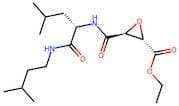
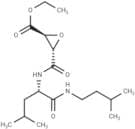
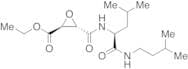
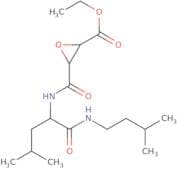
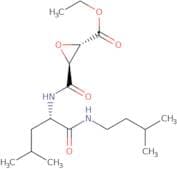
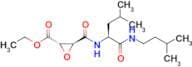
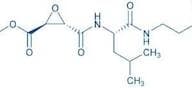
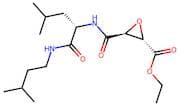
- 2-Oxiranecarboxylic acid, 3-[[[(1S)-3-methyl-1-[[(3-methylbutyl)amino]carbonyl]butyl]amino]carbonyl]-, ethyl ester, (2S,3S)-
- Aloxistatin
- E 64c ethyl ester
- E-64d
- E64d
- E64d/pepstatin
- EST
- EST (pharmaceutical)
- Ep 453
- Loxistatin
- NSC 694281
- Oxiranecarboxylic acid, 3-[[[(1S)-3-methyl-1-[[(3-methylbutyl)amino]carbonyl]butyl]amino]carbonyl]-, ethyl ester, (2S,3S)-
- Oxiranecarboxylic acid, 3-[[[3-methyl-1-[[(3-methylbutyl)amino]carbonyl]butyl]amino]carbonyl]-, ethyl ester, [2S-[2α,3β(R*)]]-
- Pepstatin E64d
- ethyl (2S,3S)-3-({(2S)-4-methyl-1-[(3-methylbutyl)amino]-1-oxopentan-2-yl}carbamoyl)oxirane-2-carboxylate
- Ver más sinónimos
L-trans-Epoxysuccinyl-Leu-3-methylbutylamide-ethyl ester
CAS:E64d (EST), a membrane permeable analog of E64c, was expected to be useful as an oral drug for muscular dystrophy due to its potent inhibitory activities against the cysteine proteinases involved in the myofibrillar protein degradation that occurs in this disease. E64d attenuates the effects of parathyroid hormone on osteoblasts in vitro. By inhibiting cathepsin B, a cysteine protease showing β-secretase activity, E64d could reduce brain Aβ and improve memory deficits in Alzheimer’s disease animal models.Fórmula:C17H30N2O5Pureza:> 99%Forma y color:WhitePeso molecular:342.442-Oxiranecarboxylic acid, 3-[[[(1S)-3-methyl-1-[[(3-methylbutyl)amino]carbonyl]butyl]amino]carbonyl]-, ethyl ester, (2S,3S)-
CAS:Fórmula:C17H30N2O5Pureza:98%Forma y color:SolidPeso molecular:342.4305E-64d [for Biochemical Research]
CAS:Fórmula:C17H30N2O5Pureza:>95.0%(HPLC)Forma y color:White to Almost white powder to crystalPeso molecular:342.44E-64d protease inhibitor
CAS:Fórmula:C17H30N2O5Pureza:≥ 95.0%Forma y color:White powderPeso molecular:342.43E-64d
CAS:E-64dFórmula:C17H30N2O5Pureza:98.8% (hplc) (Typical Value in Batch COA)Forma y color:PowderPeso molecular:342.43g/molAloxistatin
CAS:Aloxistatin (E64d) inhibits cysteine proteases, blocks calpain in platelets, and prevents blood clotting.Fórmula:C17H30N2O5Pureza:99.46% - 99.69%Forma y color:SolidPeso molecular:342.43E-64d
CAS:Producto controladoApplications E-64d is an inhibitor of cathepsins B and L as well as a potential inhibitor of calpain. E-64d has been shown to inhibit lysosomal proteases. E-64d has been used in combination with Prepstatin A to interfere with autolysosomal digestion. E-64d displays neurovascular and neuronal protective effects after focal cerebral ischemia in rats.
References Wilcox, D. et al.: Biochem. J., 285, 495 (1992); McGowan, E.B. et al.: Biochem. Biophys. Res. Comm., 158, 432 (1989); Tsubokawa, T. et al.: J. Neurosci. Res., 84, 832 (2006);Fórmula:C17H30N2O5Forma y color:NeatPeso molecular:342.43E-64-d
CAS:E-64-d is a research tool that is used in cell biology, pharmacology, and biochemistry to study protein interactions. E-64-d is an activator, ligand, or receptor for ion channels and has been shown to inhibit the activity of high purity K+ channels. This peptide binds to the extracellular loop of voltage-gated potassium channels (Kv1.2) and inhibits the opening of these channels by blocking their access to ATP. E-64-d also binds to an antibody as a competitive inhibitor of the antigen binding site on the antibody.
Fórmula:C17H30N2O5Pureza:Min. 95%Peso molecular:342.43 g/mol(2S,3S)-trans-Epoxysuccinyl-L-leucylamido-3-methylbutane ethyl ester
CAS:Inhibitor of cathepsinsFórmula:C17H30N2O5Pureza:Min. 95%Forma y color:PowderPeso molecular:342.43 g/molL-TRANS-EPOXYSUCCINYL-LEU-3-METHYLBUTYLAMIDE-ETHYL ESTER
CAS:Pureza:95.0%Peso molecular:342.4360046386719

![2-Oxiranecarboxylic acid, 3-[[[(1S)-3-methyl-1-[[(3-methylbutyl)amino]carbonyl]butyl]amino]carbony…](/_next/image/?url=https%3A%2Fstatic.cymitquimica.com%2Fproducts%2FIN%2Fthumb%2FDA0048C1.jpg&w=3840&q=75)


![E-64d [for Biochemical Research]](/_next/image/?url=https%3A%2Fstatic.cymitquimica.com%2Fproducts%2F3B%2Fthumb%2FE1337.jpg&w=3840&q=75)