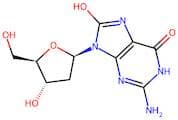
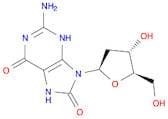
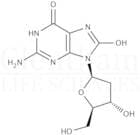
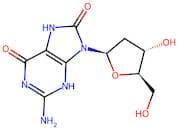
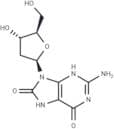
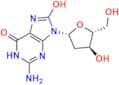
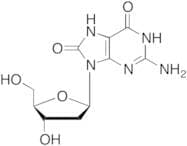
CAS 88847-89-6
:8-Hidroxi-2'-desoxiguanosina
- 2'-Deoxy-8-Oxoguanosine
- 2′-Deoxy-7,8-dihydro-8-oxoguanosine
- 7,8-Dihydro-2'-deoxy-8-oxoguanosine
- 7,8-Dihydro-8-oxo-2′-deoxyguanosine
- 7,8-Dihydro-8-oxodeoxyguanosine
- 8-Hydroxydeoxyguanosine
- 8-Oxo-2'-deoxyguanine
- 8-Oxo-2′-deoxyguanosine
- 8-Oxo-7,8-dihydro-2'-deoxyguanosine
- 8-Oxo-7,8-dihydrodeoxyguanosine
- 8-Oxo-7-hydrodeoxyguanosine
- 8-Oxo-dG
- 8-Oxodeoxyguanosine
- Ccris 8239
- Guanosine, 2'-deoxy-7,8-dihydro-8-oxo-
- Guanosine, 7,8-dihydro-2'-deoxy-8-oxo-
- 8-Hydroxy-2'-deoxyguanosine
- Ver más sinónimos
8-Hydroxy-2'-deoxyguanosine
CAS:8-Hydroxy-2'-deoxyguanosineFórmula:C10H13N5O5Pureza:95%Forma y color:SolidPeso molecular:283.242'-Deoxy-8-oxoguanosine
CAS:Fórmula:C10H13N5O5Pureza:≥ 95.0%Forma y color:White to off-white powder or crystalline powderPeso molecular:283.248-Hydroxy-2'-deoxyguanosine
CAS:8-Hydroxy-2'-deoxyguanosineFórmula:C10H13N5O5Pureza:≥95%Peso molecular:283.248-Hydroxy-2'-deoxyguanosine
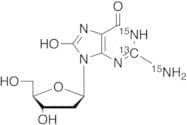
CAS:8-Hydroxy-2'-deoxyguanosine (8-OHdG) is a good biomarker for risk assessment of various cancers and degenerative diseases.Fórmula:C10H13N5O5Pureza:99.10%Forma y color:White SolidPeso molecular:283.248-Oxo-2’-deoxyguanosine-13C,15N2
CAS:Producto controladoApplications A marker compound indicative of DNA damage associated with mutagenesis and carcinogenesis. Can induce differentiation of Friend murine erythroleukemia cells in vitro.
References Ueda, T., et al.: Chem. Pharm. Bull., 26, 2122 (1978), Jiang, F., et al.: Nature, 183, 382 (1996),Fórmula:C913CH13N315N2O5Forma y color:NeatPeso molecular:286.228-Oxo-2’-deoxyguanosine
CAS:Producto controladoApplications A marker compound indicative of DNA damage associated with mutagenesis and carcinogenesis. Can induce differentiation of Friend murine erythroleukemia cells in vitro.
References Ueda, T., et al.: Chem. Pharm. Bull., 26, 2122 (1978), Jiang, F., et al.: Nature, 183, 382 (1996),Fórmula:C10H13N5O5Forma y color:NeatPeso molecular:283.242'-Deoxy-8-oxoguanosine
CAS:2'-Deoxy-8-oxoguanosine (8-OHdG) is a product of oxidative DNA damage. The presence of 8-OHdG in urine has been used to detect and measure the degree of oxidative DNA damage in humans and animals, which may be linked to cancer and aging. When 8-OHdG is excreted into urine, it can react with other molecules such as protein or inorganic phosphorus, causing more oxidative DNA damage. 2'-Deoxy-8-oxoguanosine has also been shown to cause cell toxicity by damaging the cell's squamous epithelium, leading to cancer.For the 15N5 labelled version please check ND09970.
Fórmula:C10H13N5O5Pureza:Min. 95 Area-%Forma y color:White PowderPeso molecular:283.25 g/mol2-Amino-9-((2R,4S,5R)-4-hydroxy-5-(hydroxymethyl)tetrahydrofuran-2-yl)-3H-purine-6,8(7H,9H)-dione
CAS:Fórmula:C10H13N5O5Pureza:95%Forma y color:SolidPeso molecular:283.244