CAS 890707-28-5
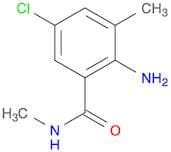
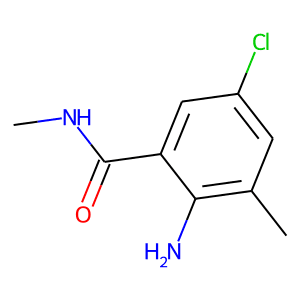
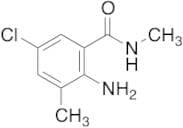
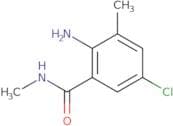
:2-Amino-5-cloro-N,3-dimetilbenzamida
Descripción:
2-Amino-5-cloro-N,3-dimetilbenzamida es un compuesto orgánico caracterizado por su grupo funcional amida, que se deriva del ácido benzoico. Este compuesto presenta un anillo bencénico sustituido con un grupo amino en la posición 2, un átomo de cloro en la posición 5 y dos grupos metilo en la posición 3. La presencia del grupo amino contribuye a su basicidad, mientras que el átomo de cloro introduce características electronegativas que pueden influir en su reactividad y solubilidad. La sustitución dimetílica mejora sus propiedades estéricas, lo que puede afectar sus interacciones con objetivos biológicos. Este compuesto puede exhibir diversas actividades biológicas, lo que lo hace de interés en la investigación farmacéutica. Su estructura molecular sugiere aplicaciones potenciales en química medicinal, particularmente en el desarrollo de nuevos agentes terapéuticos. Además, la estabilidad y solubilidad del compuesto en disolventes orgánicos pueden variar, lo que es importante para sus aplicaciones prácticas en síntesis y formulación. Al igual que con muchos compuestos orgánicos, se deben observar precauciones de seguridad y manejo debido a la posible toxicidad o reactividad.
Fórmula:C9H11ClN2O
InChI:InChI=1S/C9H11ClN2O/c1-5-3-6(10)4-7(8(5)11)9(13)12-2/h3-4H,11H2,1-2H3,(H,12,13)
Clave InChI:InChIKey=WOBVZGBINMTNKL-UHFFFAOYSA-N
SMILES:C(NC)(=O)C1=C(N)C(C)=CC(Cl)=C1
Sinónimos:- 2-Amino-5-chloro-N,3-dimethylhenzamide
- 2-Amino-5-chloro-N-methyl-3-methylbenzamide
- Benzamide, 2-amino-5-chloro-N,3-dimethyl-
- 2-Amino-5-chloro-N,3-dimethylbenzamide
- Bardoxolone Powder C9h11cln2o
- 2-Amino-5-chloro-N,3-dimethylbenzamide 98%
Ordenar por
Pureza (%)
0
100
|
0
|
50
|
90
|
95
|
100
Encontrado 8 productos.
2-Amino-5-chloro-N,3-dimethylbenzamide
CAS:Fórmula:C9H11ClN2OPureza:95%Forma y color:SolidPeso molecular:198.64942-Amino-5-chloro-N,3-dimethylbenzamide
CAS:2-Amino-5-chloro-N,3-dimethylbenzamidePureza:95%Peso molecular:198.65g/mol2-Amino-5-chloro-N,3-dimethylbenzamide
CAS:Producto controladoApplications 2-Amino-5-chloro-N,3-dimethylbenzamide is the key intermediate used in the synthesis of chlorantraniliprole, a novel insecticide.
References Zhang, T., et al.: Jingxi Huagong Zhongjianti, 40, 17 (2010); Peng, Y., et al.: Nongyao, 48, 326 (2009)Fórmula:C9H11ClN2OForma y color:NeatPeso molecular:198.6492-Amino-5-chloro-N,3-dimethylbenzamide
CAS:2-Amino-5-chloro-N,3-dimethylbenzamide is a synthetic compound. It has been shown to induce necrotic cell death in mammalian cells. This compound was synthesized by the reaction of 2-aminoquinoline with a Grignard reagent, followed by nitration of the resultant amine. The synthesis of this compound was thermodynamically favorable and exhibited good solubility in water. The chlorantraniliprole and anthranilic acid moieties are activated with an acylation reaction, which allows them to bind to the ryanodine receptor and inhibit calcium release from the sarcoplasmic reticulum (SR) with ammonolysis. This inhibition leads to ferroptosis, a type of programmed necrosis.Fórmula:C9H11ClN2OPureza:Min. 95%Forma y color:PowderPeso molecular:198.65 g/mol