CAS 89466-08-0
:Ácido 2-hidroxibenzenoborónico
Descripción:
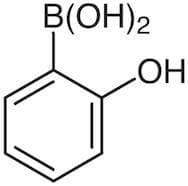
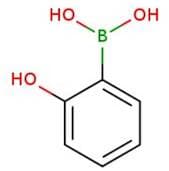
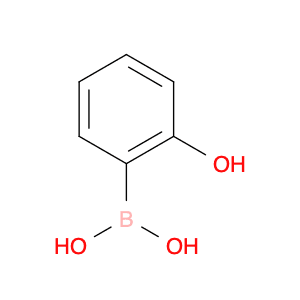
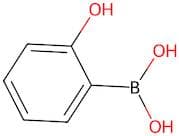
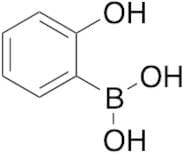
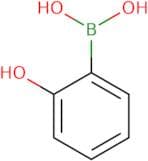
Ácido 2-hidroxibenzenoborónico, también conocido como ácido salicilborónico, es un compuesto organoboro caracterizado por la presencia de un grupo funcional ácido bórico unido a un anillo de benceno sustituido por un hidroxilo. Su estructura molecular presenta un grupo hidroxilo fenólico (-OH) orto al grupo ácido bórico (-B(OH)2), lo que contribuye a su reactividad y propiedades únicas. Este compuesto es típicamente un sólido blanco a blanco sucio y es soluble en disolventes polares como agua y alcoholes, lo que lo hace útil en diversas aplicaciones químicas. Ácido 2-hidroxibenzenoborónico es conocido por su capacidad para formar enlaces covalentes reversibles con dioles, lo que es significativo en el desarrollo de sensores y sistemas de liberación de fármacos. Además, juega un papel en las reacciones de acilo cruzado de Suzuki-Miyaura, facilitando la formación de enlaces carbono-carbono en la síntesis orgánica. Su funcionalidad de ácido bórico también le permite participar en la complejación con biomoléculas, lo que lo hace valioso en la investigación y aplicaciones bioquímicas. En general, Ácido 2-hidroxibenzenoborónico es un compuesto versátil con importantes implicaciones tanto en la química sintética como en la medicinal.
Fórmula:C6H7BO3
InChI:InChI=1/C6H7BO3/c8-6-4-2-1-3-5(6)7(9)10/h1-4,8-10H
SMILES:c1ccc(c(c1)B(O)O)O
Sinónimos:- 2-Boronophenol
- 2-Hydroxyphenylboronic acid
Ordenar por
Pureza (%)
0
100
|
0
|
50
|
90
|
95
|
100
Se han encontrado 7 productos.
2-Hydroxyphenylboronic Acid (contains varying amounts of Anhydride)
CAS:Fórmula:C6H7BO3Forma y color:White to Light yellow to Light orange powder to crystalPeso molecular:137.932-Hydroxybenzeneboronic acid, 97%
CAS:2-Hydroxybenzeneboronic acid is used as a pharmaceutical intermediate. This Thermo Scientific Chemicals brand product was originally part of the Alfa Aesar product portfolio. Some documentation and label information may refer to the legacy brand. The original Alfa Aesar product / item code or SKU reFórmula:C6H7BO3Pureza:97%Forma y color:Powder, White to pale creamPeso molecular:137.932-Hydroxybenzeneboronic acid
CAS:2-Hydroxybenzeneboronic acid
Fórmula:C6H7BO3Pureza:≥95%Forma y color: white to off-white powderPeso molecular:137.92898g/mol2-Hydroxyphenylboronic acid
CAS:Fórmula:C6H7BO3Pureza:98%Forma y color:White to off-white solidPeso molecular:137.932-Hydroxyphenylboronic acid
CAS:Producto controladoApplications 2-Hydroxyphenylboronic acid
Fórmula:C6H7BO3Forma y color:NeatPeso molecular:137.93(2-Hydroxyphenyl)boronic acid
CAS:(2-Hydroxyphenyl)boronic acid is an organic compound that contains a boronate ester group and a hydroxyl group. It is used in the synthesis of lysine-containing peptides, proteins, and other compounds. (2-Hydroxyphenyl)boronic acid is synthesized by cross-coupling reactions using palladium-catalyzed coupling reactions. The most common type of reaction is the Suzuki coupling reaction, which involves the addition of an aryl halide to an aryl or vinyl boronate ester. This reaction is carried out at elevated temperature in organic solvents such as tetrahydrofuran or dioxane. The yield for this reaction can be improved by using catalytic amounts of palladium acetate, which speeds up the rate at which the reaction occurs. The use of catalysts also decreases the need for high temperatures, making it possible to perform this process atFórmula:C6H7BO3Pureza:Min. 95%Peso molecular:137.93 g/mol