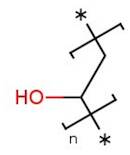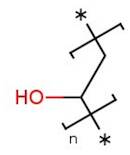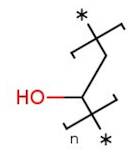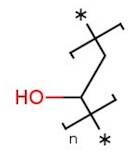
CAS 9002-89-5
:Poli(alcohol vinílico)
Descripción:
Poli(alcohol vinílico) (PVA) es un polímero sintético caracterizado por su solubilidad en agua, biocompatibilidad y propiedades formadoras de película. Se produce a través de la hidrólisis del poli(acetato de vinilo) y es conocido por su excelente adhesión, flexibilidad y resistencia a aceites y grasas. El PVA se utiliza típicamente en diversas aplicaciones, incluidos adhesivos, recubrimientos y películas, debido a su capacidad para formar fuertes enlaces de hidrógeno con las moléculas de agua, lo que mejora su solubilidad. El grado de hidrólisis y el peso molecular pueden influir significativamente en sus propiedades, como la viscosidad y la resistencia mecánica. El PVA también es biodegradable, lo que lo convierte en una opción respetuosa con el medio ambiente en muchas aplicaciones. Además, exhibe buena estabilidad térmica y puede ser modificado para mejorar sus propiedades para usos específicos, como en aplicaciones biomédicas o como componente en materiales compuestos. En general, el PVA es un polímero versátil con una amplia gama de aplicaciones industriales y comerciales.
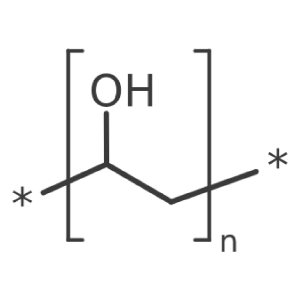
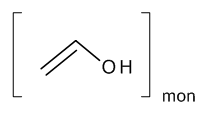
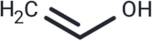
Fórmula:(C2H4O)x
InChI:InChI=1S/C2H4O/c1-2-3/h2-3H,1H2
Clave InChI:InChIKey=IMROMDMJAWUWLK-UHFFFAOYSA-N
SMILES:C(=C)O
Sinónimos:- 100-27H
- 100-37H
- 100-40H
- 1799S
- 1R2110
- 22-99H
- 9P75R
- 9X75Rs
- 9X75Sr
- Alvyl
- Bijam+
- Bovlon
- CST
- Claria
- Clinicel
- Covol
- Duslo
- Elvanol
- Fiberol
- Fibrilbond
- Fsam-H
- Gelutol
- Gelvatol
- Gh-Jy
- Gohsenol
- Kuragel
- Lemol
- LentiKats
- Liquifilm
- Merocel
- Microbreath
- Mowibase
- Mowiol
- PPL
- PVA
- PVS
- Polydesis
- Polyvinol
- Polyvinylalkohol
- Polyviol
- Poval
- PualCob
- Pva-Cst
- Pva-Ec
- Pva-H
- Pva-Hc
- Pva-Ld
- Pva-Sm
- Pva-Sn
- Pva-Uv
- Pvoh
- Px-CVG
- Px-CVR
- Rhodoviol
- SI
- TTF
- Vf-Hp
- Vf-Lh
- Vf-Pm
- Vf-Ps
- Vf-Px
- Vf-Xh
- Vf-Xs
- Vinalak
- Vinarol
- Vinol
- Wash-A-Way
- Winacol
- Lemol 5-98
- Vinyl alcohol, polymers
- Lemol 5-88
- Ethenol, homopolymer
- Ver más sinónimos
Filtrar por
Porcentaje de pureza
0
100
|
0
|
50
|
90
|
95
|
100
- Precio más bajo
- Precio más alto
- Pureza más baja
- Pureza más alta
- Entrega estimada más rápida
Poly(vinyl Alcohol) (n=approx. 2000) (degree of saponification ca. 80mol%)
CAS:Forma y color:White to Light yellow powder to crystalPolyvinyl alcohol, 98-99% hydrolyzed, high molecular weight
CAS:Polyvinyl alcohol is used in food industries as a binding and coating agent. Its viscosity favors the application as coating agent to tablets and capsules. Mixed-matrix membrane prepared by dispersion of NaA zeolite particles is used to study the pervaporative separation of water-butanol mixtures.Fórmula:(C2H4O)nPureza:98-99%Forma y color:Granular powder, Pale creamPolyvinyl alcohol, 87-89% hydrolyzed, high molecular weight
CAS:Polyvinyl alcohol is used as a biological reagent to test the dispersion of zinc oxide nanoparticles. It is an effective protein resistant material and is used to stabilize gold colloids of diameter 3-8nm. It is used as an emulsion polymerization aid to make polyvinyl acetate, as a protective colloiFórmula:(C2H4O)nPureza:87-89%Forma y color:White to off-white, Powder or crystals or crystalline powder or granulesPolyvinyl alcohol, 86-89% hydrolyzed, medium molecular weight
CAS:Polyvinyl alcohol is used as a biological reagent to test the dispersion of zinc oxide nanoparticles. It is an effective protein resistant material and is used to stabilize gold colloids of diameter 3-8nm. It is used as an emulsion polymerization aid to make polyvinyl acetate, as a protective colloiFórmula:(C2H4O)nPureza:86-89%Forma y color:White to off-white, PowderPolyvinyl alcohol, 98-99% hydrolyzed, medium molecular weight
CAS:Polyvinyl alcohol is used in papermaking, textiles, and in a variety of coatings. It is used as an emulsion polymerization aid to make polyvinyl acetate, as a protective colloid, as a film used in the water transfer printing process, as a surfactant for the formation of polymer encapsulated nanobeadFórmula:(C2H4O)nPureza:98-99%Forma y color:Powder, Whit to off-white to creamPolyvinyl alcohol, 86-89% hydrolyzed, low molecular weight
CAS:Polyvinyl alcohol is used as a biological reagent to test the dispersion of zinc oxide nanoparticles. It is an effective protein resistant material and is used to stabilize gold colloids of diameter 3-8nm. It is used as an emulsion polymerization aid to make polyvinyl acetate, as a protective colloiFórmula:(C2H4O)nPureza:86-89%Forma y color:White to pale yellow, Granular powderPolyvinyl alcohol, 98-99% hydrolyzed, low molecular weight
CAS:Polyvinyl alcohol is used as a biological reagent to test the dispersion of zinc oxide nanoparticles. It is an effective protein resistant material and is used to stabilize gold colloids of diameter 3-8nm. It is used as an emulsion polymerization aid to make polyvinyl acetate, as a protective colloiFórmula:(C2H4O)nPureza:98-99%Forma y color:Granular powder, WhiteVinyl Alcohol Homopolymer 60000
CAS:Polyvinyl alcohols, whether or not containing unhydrolyzed acetate groupsFórmula:(C2H4O)nForma y color:White GranularPolyvinyl Alcohol
CAS:Polyvinyl alcohols, whether or not containing unhydrolyzed acetate groupsFórmula:H(C2H4O)m(C4H6O2)nHForma y color:PowderPeso molecular:46.0684Poly Vinyl Alcohol
CAS:Poly Vinyl AlcoholFórmula:(C2H4O)xPureza:≥95%Forma y color:SolidPeso molecular:44.05Polyvinyl Alcohol (PVA)
CAS:Fórmula:C2H4OnForma y color:White To Off-White SolidPeso molecular:86000 (average)Polyvinyl Alcohol
CAS:Producto controladoApplications Polyvinyl Alcohol is a useful research chemical. Polyvinyl Alcohol/ZnS composite films are used as nanocatalyst for organ dye degradation.
References Khan, R., et al.: ACS Omega, 4, 6144 (2019)Fórmula:(C2H4O)nForma y color:NeatPeso molecular:44.05Poly Vinyl Alcohol
CAS:Polyvinyl alcohol: water-soluble, biodegradable polymer; used for biomedical applications and medical excipients.Fórmula:(C2H4O)nPureza:98%Forma y color:White SolidPeso molecular:30000-70000 (Average)