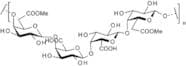
CAS 9049-37-0
:Pectato de sodio
Descripción:
Pectato de sodio es una sal sódica del ácido pectínico, derivada principalmente del polisacárido natural pectina, que se encuentra en las paredes celulares de frutas y verduras. Se utiliza comúnmente como agente gelificante, espesante y estabilizador en productos alimenticios, particularmente en mermeladas y gelatinas. Pectato de sodio se caracteriza por su capacidad para formar geles en presencia de azúcar y ácido, lo que lo hace valioso en el procesamiento de alimentos. Típicamente es un polvo blanco a blanco sucio que es soluble en agua, formando una solución viscosa. La sustancia es generalmente reconocida como segura (GRAS) para el consumo y también se utiliza en formulaciones farmacéuticas y cosméticas debido a su biocompatibilidad y propiedades espesantes. Además, Pectato de sodio tiene aplicaciones en agricultura como acondicionador del suelo y en el campo biomédico para sistemas de entrega de medicamentos. Su estructura molecular consiste en una columna vertebral de unidades de ácido galacturónico, que pueden ser metilésterificadas, influyendo en sus propiedades de gelificación y funcionalidad.
Fórmula:Unspecified
Sinónimos:- Pectic acid, sodium salt
- Sodium pectate
- Sodium polypectate
- NaPP
Ordenar por
Pureza (%)
0
100
|
0
|
50
|
90
|
95
|
100
Encontrado 2 productos.
Sodium pectate
CAS:The characteristic structure of pectin is a linear chain of α-(1,4)-linked D-galacturonic acid that forms the pectin-backbone, a homogalacturonan (pectic acid). The polygalacturonic acid is partly esterified with methyl groups and the free acid groups may be partly or fully neutralized with sodium, potassium or ammonium ions. The ratio of esterified galacturonic acid groups to total galacturonic acid groups - termed the degree of esterification (DE) - has vital influence on the properties of pectin, especially the solubility and the gel forming characteristics. The mechanism for gel formation with calcium ions is known as ‘The egg box’. Into this backbone, there are regions where galacturonic acid is replaced by (1,2)-linked L-rhamnose. From the rhamnose residues, sidechains of various neutral sugars branch off. This type of pectin is called rhamnogalacturonan-I (RG-I). Up to every 25th galacturonic acid in the main chain is replaced with rhamnose. Some stretches consist of alternating galacturonic acid and rhamnose – “hairy regions”, others with lower density of rhamnose – “smooth regions”. The neutral sugars are mainly D-galactose, L-arabinose and D-xylose, the types and proportions of neutral sugars varying with the origin of pectin. Another structural type of pectin is rhamnogalacturonan II (RG-II), which is a less frequent complex, highly branched polysaccharide.Pureza:Min. 95%Forma y color:Powder