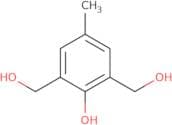
CAS 91-04-3
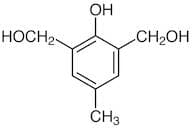
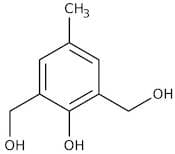
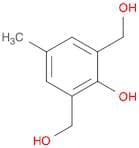
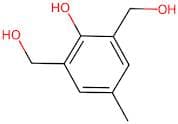
:2,6-Bis(hidroximetil)-p-cresol
Descripción:
2,6-Bis(hidroximetil)-p-cresol, comúnmente conocido como un compuesto fenólico, se caracteriza por su estructura, que incluye dos grupos hidroximetilo unidos al anillo aromático del p-cresol. Este compuesto es típicamente un sólido cristalino blanco a blanco sucio a temperatura ambiente y es soluble en agua y disolventes orgánicos, lo que lo hace versátil para diversas aplicaciones. Exhibe propiedades antioxidantes, lo que lo hace útil para estabilizar plásticos y otros materiales contra la degradación oxidativa. Además, tiene aplicaciones en las industrias farmacéutica y cosmética debido a sus propiedades antimicrobianas. El compuesto también es conocido por su capacidad para actuar como conservante, ayudando a extender la vida útil de los productos. Los datos de seguridad indican que debe manejarse con cuidado, ya que puede causar irritación al contacto con la piel o los ojos. En general, 2,6-Bis(hidroximetil)-p-cresol es un químico valioso con diversas aplicaciones, particularmente en la mejora de la estabilidad y longevidad de diversas formulaciones.
Fórmula:C9H12O3
InChI:InChI=1S/C9H12O3/c1-6-2-7(4-10)9(12)8(3-6)5-11/h2-3,10-12H,4-5H2,1H3
Clave InChI:InChIKey=KUMMBDBTERQYCG-UHFFFAOYSA-N
SMILES:C(O)C1=C(O)C(CO)=CC(C)=C1
Sinónimos:- (2-Hydroxy-5-methyl-1,3-phenylene)dimethanol
- 1,3-Benzenedimethanol, 2-hydroxy-5-methyl-
- 2,3-Bis(Hydroxymethyl)-4-Methylphenol
- 2,6-Bis(Hydroxymethyl)-4-Methylphenol
- 2,6-Bis(hydroxymethyl)-p-cresol
- 2,6-Di(Hydroxymethyl)-4-Methylphenol
- 2,6-Di(hydroxymethyl)-p-cresol
- 2,6-Dimethylol-4-methylphenol
- 2,6-Dimethylol-p-cresol
- 26Dmpc
- 4-Methyl-2,6-bis(hydroxymethyl)phenol
- AV Lite 26DMPC
- Dml-Pc
- NSC 15838
- α<sup>1</sup>,α<sup>3</sup>,2-Trihydroxymesitylene
- α<sup>1</sup>,α<sup>3</sup>-Mesitylenediol, 2-hydroxy-
- α1,α3-Mesitylenediol, 2-hydroxy-
- Ver más sinónimos
Ordenar por
Pureza (%)
0
100
|
0
|
50
|
90
|
95
|
100
Encontrado 6 productos.
2,6-Bis(hydroxymethyl)-p-cresol
CAS:Fórmula:C9H12O3Pureza:>98.0%(GC)Forma y color:White to Yellow to Orange powder to crystalPeso molecular:168.192,6-Bis(hydroxymethyl)-p-cresol, tech. 90%
CAS:This Thermo Scientific Chemicals brand product was originally part of the Alfa Aesar product portfolio. Some documentation and label information may refer to the legacy brand. The original Alfa Aesar product / item code or SKU reference has not changed as a part of the brand transition to Thermo SciFórmula:C9H12O3Pureza:90%Forma y color:Cream or orange to pale brown, powderPeso molecular:168.192,6-Bis(hydroxymethyl)-p-cresol
CAS:Fórmula:C9H12O3Pureza:97%Forma y color:SolidPeso molecular:168.18982,6-Bis(hydroxymethyl)-4-methylphenol
CAS:2,6-Bis(hydroxymethyl)-4-methylphenolFórmula:C9H12O3Pureza:95%Forma y color: pale brown crystals/ powderPeso molecular:168.19g/mol(2-Hydroxy-5-methyl-1,3-phenylene)dimethanol
CAS:Fórmula:C9H12O3Pureza:95%Forma y color:Solid, No data available.Peso molecular:168.1922,6-Bis(hydroxymethyl)-p-cresol
CAS:2,6-Bis(hydroxymethyl)-p-cresol (BHMC) is a cross-linking agent that reacts with the hydroxyl groups of polymers to form covalent bonds. This reaction is irreversible and has been shown to be effective in thermal expansion applications. BHMC is insoluble in water and so can be used as a proton donor for the synthesis of polymer hydrogels. BHMC has also been used as a molecular modeling probe for studying protein structure and function. This compound reacts with nucleophiles by nucleophilic attack on the carbonyl carbon atom, producing an intermediate that tautomerizes to the corresponding enone. The reaction mechanism involves formation of a tetranuclear transition state followed by acid catalysis. Functional groups such as -OH, -NH2, or -COOH are required for this reaction to occur. NMR spectra have shown that there are three different chemical structuresFórmula:C9H12O3Pureza:Min. 95%Forma y color:PowderPeso molecular:168.19 g/mol