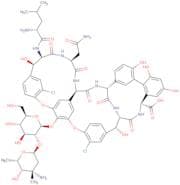
CAS 91700-98-0
:Norvancomicina
Descripción:
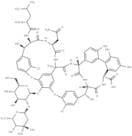
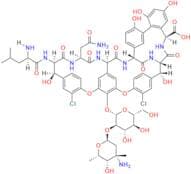
Norvancomicina es un antibiótico glicopéptido derivado de la vancomicina, utilizado principalmente en el tratamiento de infecciones causadas por bacterias Gram-positivas, particularmente aquellas resistentes a otros antibióticos. Exhibe un mecanismo de acción similar al de la vancomicina, inhibiendo la síntesis de la pared celular bacteriana al unirse al terminus D-alanil-D-alanina de los precursores de la pared celular. Esta acción interrumpe la integridad de la pared celular bacteriana, llevando a la lisis celular y a la muerte. Norvancomicina es particularmente efectivo contra cepas de Staphylococcus aureus, incluyendo Staphylococcus aureus resistente a meticilina (MRSA). El compuesto se caracteriza por su estructura compleja, que incluye múltiples anillos aromáticos y moieties de azúcar, contribuyendo a su solubilidad y estabilidad. Su farmacocinética, incluyendo absorción, distribución, metabolismo y excreción, es similar a la de la vancomicina, aunque los parámetros específicos pueden variar. Norvancomicina se administra típicamente por vía intravenosa, especialmente en infecciones severas, y su uso se monitorea de cerca para prevenir toxicidad y desarrollo de resistencia. En general, Norvancomicina representa una opción terapéutica importante en la lucha contra infecciones bacterianas resistentes.
Fórmula:C65H73Cl2N9O24
InChI:InChI=1/C65H73Cl2N9O24/c1-5-22(2)44(69)58(88)75-48-50(82)25-7-10-36(31(66)13-25)96-38-15-27-16-39(54(38)100-64-55(53(85)52(84)40(21-77)98-64)99-42-20-65(4,70)56(86)23(3)95-42)97-37-11-8-26(14-32(37)67)51(83)49-62(92)74-47(63(93)94)30-17-28(78)18-35(80)43(30)29-12-24(6-9-34(29)79)45(59(89)76-49)73-60(90)46(27)72-57(87)33(19-41(68)81)71-61(48)91/h6-18,22-23,33,40,42,44-53,55-56,64,77-80,82-86H,5,19-21,69-70H2,1-4H3,(H2,68,81)(H,71,91)(H,72,87)(H,73,90)(H,74,92)(H,75,88)(H,76,89)(H,93,94)/t22?,23-,33-,40+,42-,44+,45+,46+,47+,48+,49-,50+,51+,52+,53-,55+,56+,64-,65-/m0/s1
Clave InChI:InChIKey=NUAQIRUAZSJTAI-YRPZDAAMSA-N
SMILES:O(C=1C2=CC3=CC1OC=4C(Cl)=CC(=CC4)[C@@H](O)[C@@H](NC([C@@H](CC(C)C)N)=O)C(=O)N[C@@H](CC(N)=O)C(=O)N[C@]3(C(=O)N[C@@]5(C=6C=C(C=7C([C@@H](C(O)=O)NC(=O)[C@]([C@H](O)C=8C=C(Cl)C(O2)=CC8)(NC5=O)[H])=CC(O)=CC7O)C(O)=CC6)[H])[H])[C@H]9[C@H](O[C@H]%10C[C@](C)(N)[C@H](O)[C@H](C)O%10)[C@@H](O)[C@H](O)[C@@H](CO)O9
Sinónimos:- 56-Demethylvancomycin
- N-Demethylvancomycin
- Antibiotic A 51568A
- Vancomycin, 56-demethyl-
- 22H-8,11:18,21-Dietheno-23,36-(iminomethano)-13,16:31,35-dimetheno-1H,16H-[1,6,9]oxadiazacyclohexadecino[4,5-m][10,2,16]benzoxadiazacyclotetracosine, vancomycin deriv.
Ordenar por
Pureza (%)
0
100
|
0
|
50
|
90
|
95
|
100
Encontrado 5 productos.
N-Demethylvancomycin
CAS:N-Demethylvancomycin is a glycopeptide antibiotic that can be extracted from Nocardia orientalis and exhibits activity against various strains of Staphylococcus aureus and Staphylococcus epidermidis. It is utilized in research related to infections.Fórmula:C65H73Cl2N9O24Forma y color:SolidPeso molecular:1435.23Norvancomycin Trifluoroacetic Acid Salt >85%
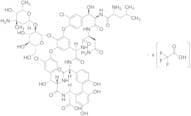
CAS:Producto controladoFórmula:C65H73Cl2N9O24(freeamine)Pureza:>85%Forma y color:NeatPeso molecular:1435.23Norvancomycin trifluoroacetate
CAS:Norvancomycin trifluoroacetate is an antibiotic compound, which is a glycopeptide derived from the bacterium Amycolatopsis orientalis. Its mode of action involves inhibiting bacterial cell wall synthesis. Specifically, Norvancomycin disrupts the cross-linking of peptidoglycan layers in the bacterial cell wall by binding to the D-alanyl-D-alanine terminus of cell wall precursors. This disruption weakens the bacterial cell wall, ultimately leading to cell lysis and death, thereby exerting a bactericidal effect.Fórmula:C65H73Cl2N9O24•(C2HF3O2)xPureza:Min. 95%Norvancomycin
CAS:Norvancomycin is an antimicrobial agent that is used as a treatment for infectious diseases. It prevents bacterial growth by binding to the D-alanyl-D-alanine moiety of the peptidoglycan cell wall, which inhibits cell wall synthesis. Norvancomycin has been shown to be effective against Gram-positive bacteria such as Staphylococcus aureus and Enterococcus faecalis and Gram-negative bacteria such as Escherichia coli and Pseudomonas aeruginosa. Norvancomycin also has the ability to inhibit transcriptional regulation, leading to decreased production of proteins essential for bacterial growth. Norvancomycin has been shown to have a long half-life in humans, making it useful for pharmacokinetic studies in human serum.
Fórmula:C65H73Cl2N9O24Pureza:Min. 95%Peso molecular:1,435.23 g/molRef: 3D-FN164675
Producto descatalogado