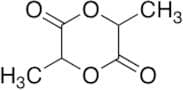
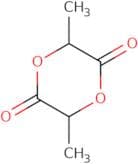
CAS 95-96-5
:Lactida
Descripción:
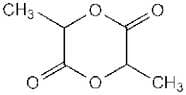
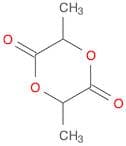
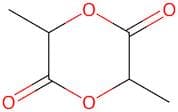
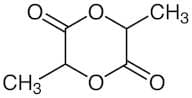
Lactida, con el número CAS 95-96-5, es un diéster cíclico derivado del ácido láctico, específicamente un dimero de ácido láctico. Es un sólido cristalino incoloro que es soluble en disolventes orgánicos como el cloroformo y la acetona, pero tiene una solubilidad limitada en agua. Lactida es notable por su papel en la producción de ácido poliláctico (PLA), un termoplástico biodegradable y bioactivo hecho de recursos renovables. El compuesto existe en dos formas estereoisoméricas, L-Lactida y D-Lactida, que pueden combinarse para formar una mezcla racémica. Lactida se caracteriza por su capacidad para someterse a la polimerización por apertura de anillo, un proceso que le permite formar largas cadenas poliméricas, lo que lo hace valioso en diversas aplicaciones, incluidas plásticos biodegradables, dispositivos médicos y sistemas de liberación de fármacos. Además, Lactida es no tóxico y biocompatible, lo que aumenta su atractivo en aplicaciones biomédicas. Su producción y uso se alinean con prácticas sostenibles, contribuyendo al desarrollo de materiales respetuosos con el medio ambiente.
Fórmula:C6H8O4
InChI:InChI=1/C6H8O4/c1-3-5(7)10-4(2)6(8)9-3/h3-4H,1-2H3
Clave InChI:InChIKey=JJTUDXZGHPGLLC-UHFFFAOYSA-N
SMILES:CC1C(=O)OC(C)C(=O)O1
Sinónimos:- (+/-)-3,6-Dimethyl-1,4-dioxane-2,5-dione
- 1,4-Dioxane-2,5-dione, 3,6-dimethyl-
- 2,5-Dimethyl-3,6-dioxo-1,4-dioxane
- 2,5-Dioxo-3,6-dimethyl-1,4-dioxane
- 3,6-Diketo-2,5-dimethyl-1,4-dioxane
- 3,6-Dimethyl-2,5-dioxo-1,4-dioxane
- 3,6-Dimethyl-p-dioxane-2,5-dione
- <span class="text-smallcaps">D</smallcap>,<smallcap>L</span>-Lactide
- <span class="text-smallcaps">DL</span>-Dilactide
- <span class="text-smallcaps">DL</span>-Lactide
- DL-Dilactide
- DL-Lactide
- Dilactide
- Dimethylglycolide
- Ingeo M 700
- Lactic acid, bimol. cyclic ester
- Lactide
- Lactide,98%
- Lactoyl lactic acid
- NSC 403080
- Novalact
- Olygos DMR
- Propanoic acid, 2-hydroxy-, bimol. cyclic ester
- Purasorb DL
- p-Dioxane-2,5-dione, 3,6-dimethyl-
- rac-Lactide
- lacticacid,bimol.cyclicester
- DL
- 3,6-DiMethyl-1,4-dioxane-2,5-dione, 99% 25GR
- DL-3,6-Dimethyl-1,4-dioxane-2,5-dione
- TIMTEC-BB SBB008348
- 3,6-Dimethyl-1,4-dioxane-2,5-dione,99%
- PURASORB(R) DL
- TIMTEC-BB SBB007949
- DL-Lactide,97%
- 5-Dione,3
- LACTIC ANHYDRIDE
- LACTIDE(D,L-)
- 3,6-dimethyl-p-dioxane-5-dione
- 2-hydroxy-propanoicacibimol.cyclicester
- rac-(3R*)-3β*,6β*-Dimethyl-1,4-dioxane-2,5-dione
- 5-dione,3,6-dimethyl-4-dioxane-2
- 2,5-Dimethyl-1,4-dioxane-3,6-dione
- D,L-Lactide S
- (n)-3,6-dimethyl-1,4-dioxane-2,5-dione
- CIS-(+/-)-3,6-DIMETHYL-1,4-DIOXANE-2,5-DIONE
- DL-LACTIDE 98+%
- rac-(2R*)-2α*,5α*-Dimethyl-1,4-dioxane-3,6-dione
- Ver más sinónimos
Ordenar por
Pureza (%)
0
100
|
0
|
50
|
90
|
95
|
100
Encontrado 8 productos.
DL-Lactide, 99%
CAS:DL-Lactide is used to produce 2-hydroxy-propionic acid 1-(1-phenyl-ethoxycarbonyl)-ethyl ester. It acts as an important raw material and an intermediate used in organic synthesis, pharmaceuticals, agrochemicals and dyes. It is involved in enzymatic alcoholysis to produce both alkyl (R)-lactates andFórmula:C6H8O4Pureza:99%Forma y color:White, Crystals or crystalline powderPeso molecular:144.133,6-Dimethyl-1,4-dioxane-2,5-dione
CAS:Fórmula:C6H8O4Pureza:95%Forma y color:SolidPeso molecular:144.1253Dl-lactide
CAS:Dl-lactideFórmula:C6H8O4Pureza:98%Forma y color: white solidPeso molecular:144.13g/molDL-Lactide
CAS:Fórmula:C6H8O4Pureza:>98.0%(T)Forma y color:White to Almost white powder to crystalPeso molecular:144.13DL-Lactide
CAS:Producto controladoApplications DL-Lactide (cas# 95-96-5) is a useful research chemical.
Fórmula:C6H8O4Forma y color:NeatPeso molecular:144.133,6-Dimethyl-1,4-dioxane-2,5-dione
CAS:Fórmula:C6H8O4Pureza:97%Forma y color:SolidPeso molecular:144.126DL-Lactide
CAS:DL-Lactide is a biocompatible polymer that can be synthesized from L-lactide. It has been used as an experimental model for hydroxyl group reactions, and to investigate the effect of angiogenic factors on cell culture. DL-Lactide is also a cationic polymer that can be synthesized through chemical reactions involving trifluoromethanesulfonic acid, hydrogen bond, and methyl ethyl amine. This polymer is used in analytical chemistry as an antibody response and growth factor receptor binding assay.Fórmula:C6H8O4Pureza:Min. 95%Forma y color:PowderPeso molecular:144.13 g/mol