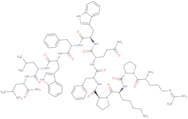
CAS 96736-12-8
:L-Leucinamida, D-arginil-L-prolil-L-lisil-L-prolil-D-fenilalanil-L-glutaminil-D-triptofanil-L-fenilalanil-D-triptofanil-L-leucil-
Descripción:
L-Leucinamida, D-arginilo-L-prolilo-L-lisilo-L-prolilo-D-fenilalanina-L-glutamina-D-triptófano-L-fenilalanina-D-triptófano-L-leucina es un péptido complejo compuesto por varios aminoácidos, incluyendo tanto enantiómeros L como D. Esta estructura sugiere que puede exhibir propiedades biológicas únicas debido a la presencia de ambas formas de aminoácidos, que pueden influir en sus interacciones con sistemas biológicos. La presencia de múltiples residuos de prolina puede contribuir a su estabilidad estructural y potencial para formar conformaciones específicas. La secuencia del péptido indica un posible papel en procesos biológicos, posiblemente relacionado con funciones de señalización o estructurales en proteínas. Su número CAS, 96736-12-8, permite una identificación precisa en bases de datos químicas. Sin embargo, la información detallada sobre su solubilidad, estabilidad y actividades biológicas específicas requeriría estudios empíricos, ya que estas características pueden variar significativamente según la conformación y el entorno del péptido. En general, este compuesto representa un área fascinante de estudio en química de péptidos y bioquímica.
Fórmula:C79H109N19O12
Sinónimos:- SubstanceP,1-D-arginine-5-D-phenylalanine-7-D-tryptophan-9-D-tryptophan-11-L-leucinamide-
- L 756867
- [D-Arg1,D-Phe5,D-Trp7,9,Leu11]substance P
- D-Arg-Pro-Lys-Pro-D-Phe-Gln-D-Trp-Phe-D-Trp-Leu-Leu-Nh2
Ordenar por
Pureza (%)
0
100
|
0
|
50
|
90
|
95
|
100
Encontrado 5 productos.
(D-Arg¹,D-Phe⁵,D-Trp⁷·⁹,Leu¹¹)-Substance P
CAS:(D-Arg¹,D-Phe⁵,D-Trp⁷·⁹,Leu¹¹)-Substance P initially described as a low potency ghrelin receptor antagonist has surprisingly been found to be a full inverse agonist (EC₅₀ = 5.2 nM). In COS-7 cells transiently transfected with the ghrelin receptor the substance P analog rPKPfQwFwLL decreased the constitutive signaling down to levels observed in untransfected cells. Assuming that constitutive signaling of the ghrelin receptor is of physiological relevance in the regulation of appetite control, inverse agonists of the ghrelin receptor could be interesting for the treatment of obesity. So, Asakawa et al. found that peripherally administered H-6395 decreased food intake in lean mice, in mice with diet induced obesity, and in ob/ob obese mice.Fórmula:C79H109N19O12Pureza:98.2%Forma y color:White LyophilisatePeso molecular:1516.86[D-Arg1,D-Phe5,D-Trp7,9,Leu11]-Substance P
CAS:Broad-spectrum inverse agonist; potent at ghrelin receptor (EC50=5.2 nM); blocks other neuropeptide receptors; induces apoptosis; inhibits tumor growth.Fórmula:C79H109N19O12Pureza:98%Forma y color:SolidPeso molecular:1516.85[D-Arg1, D-Phe5, D-Trp7,9, Leu11]-Substance P
CAS:Fórmula:C79H109N19O12Pureza:≥ 95.0%Forma y color:White powderPeso molecular:1516.83[D-Arg1,D-Phe5,D-Trp7,9,Leu11]-Substance P
CAS:Substance P is a neuropeptide that belongs to the Feeding Regulatory Peptides family. It is synthesized in the hypothalamus and secreted by neurons in the spinal cord, brainstem, and gut. Substance P has been shown to regulate feeding behavior through its interaction with opioid receptors and the release of other neurotransmitters. The synthetic form of this peptide has been shown to reduce body fat in animal models and increased sensitivity to insulin in diabetic patients. This peptide also reduces camp levels in rats, which may be due to its ability to stimulate secretion of camp from pancreatic cells.Fórmula:C79H109N19O12Pureza:Min. 95%Peso molecular:1,516.87 g/mol(D-Arg1,D-Phe5,D-Trp7·9,Leu11)-Substance P
CAS:Substance P is a neuropeptide that binds to the tachykinin receptor NK1. It has potent anti-inflammatory and mitogenic activities, which are mediated through its binding to the NK1 receptor. Substance P can stimulate lung cancer cells to proliferate and inhibit their apoptosis, which may be due to an autocrine mechanism. In addition, it has been shown that substance P can potentiate the growth of some cancers such as colon cancer in vitro and in vivo by increasing DNA synthesis and cell proliferation. This peptide also has a dose-dependent effect on cell growth, with high doses inhibiting cell proliferation at higher levels than low doses.Fórmula:C79H109N19O12Pureza:Min. 95%Peso molecular:1,516.83 g/mol
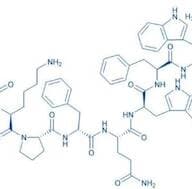

![[D-Arg1,D-Phe5,D-Trp7,9,Leu11]-Substance P](/_next/image/?url=https%3A%2Fstatic.cymitquimica.com%2Fproducts%2FTM%2Fthumb%2FTP1931.jpg&w=3840&q=75)

![[D-Arg1, D-Phe5, D-Trp7,9, Leu11]-Substance P](/_next/image/?url=https%3A%2Fstatic.cymitquimica.com%2Fproducts%2F7W%2Fthumb%2FGL9471.jpg&w=3840&q=75)

![[D-Arg1,D-Phe5,D-Trp7,9,Leu11]-Substance P](/_next/image/?url=https%3A%2Fstatic.cymitquimica.com%2Fproducts%2F3D%2Fthumb%2FPGH-3652-PI.jpg&w=3840&q=75)