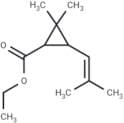
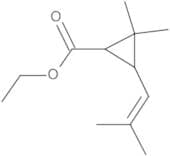
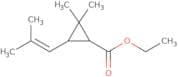
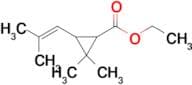
CAS 97-41-6
:Crisantemato de etilo
Descripción:
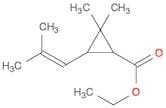
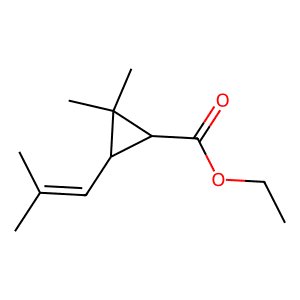
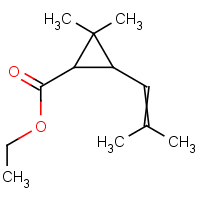
Crisantemato de etilo, con el número CAS 97-41-6, es un compuesto orgánico clasificado como un éster. Se deriva del ácido crisantémico y el etanol, resultando en una estructura que típicamente exhibe un agradable aroma floral, lo que lo hace útil en las industrias de fragancias y saborizantes. Crisantemato de etilo se caracteriza por su volatilidad relativamente baja y su solubilidad moderada en disolventes orgánicos, mientras que es menos soluble en agua. Se conoce que el compuesto es estable en condiciones normales, aunque puede sufrir hidrólisis en presencia de ácidos o bases fuertes. Sus aplicaciones se extienden más allá de la perfumería para incluir usos potenciales en formulaciones agrícolas, particularmente como repelente o atrayente de insectos debido a su aroma atractivo. Los datos de seguridad indican que, al igual que muchos ésteres, debe manejarse con cuidado, ya que puede causar irritación al contacto con la piel o los ojos. En general, Crisantemato de etilo es valorado por sus propiedades aromáticas y versatilidad en diversas aplicaciones industriales.
Fórmula:C12H20O2
InChI:InChI=1S/C12H20O2/c1-6-14-11(13)10-9(7-8(2)3)12(10,4)5/h7,9-10H,6H2,1-5H3
Clave InChI:InChIKey=VIMXTGUGWLAOFZ-UHFFFAOYSA-N
SMILES:C(=C(C)C)C1C(C(OCC)=O)C1(C)C
Sinónimos:- Chrysanthemic acid ethyl ester
- Chrysanthemum Monocarboxylic Acid Ethyl Ester
- Chrysanthemumic acid ethyl ester
- Chrysanthemummonocarboxylic acid, ethyl ester
- Cyclopropanecarboxylic acid, 2,2-dimethyl-3-(2-methyl-1-propen-1-yl)-, ethyl ester
- Cyclopropanecarboxylic acid, 2,2-dimethyl-3-(2-methyl-1-propenyl)-, ethyl ester
- Cyclopropanecarboxylic acid, 2,2-dimethyl-3-(2-methylpropenyl)-, ethyl ester
- Ethyl 2,2-Dimethyl-3-(2-Methylprop-1-En-1-Yl)Cyclopropanecarboxylate
- Ethyl 2,2-Dimethyl-3-(2-methyl-1-propenyl)cyclopropanecarboxylate
- Ethyl 2,2-dimethyl-3-(1-isobutenyl)cyclopropane-1-carboxylate
- Ethyl Chrysanthemate (Primary)
- Ethyl Chrysanthemate, Mixed Isomers Cis And Trans
- Ethyl chrysanthemat
- Ethyl chrysanthemate
- Ethyl chrysanthemumate
- NSC 10819
- Primary ethyl chrysanthemate
- ethyl (1R,3R)-2,2-dimethyl-3-(2-methylprop-1-en-1-yl)cyclopropanecarboxylate
- ethyl (1R,3R)-2,2-dimethyl-3-(2-methylprop-1-enyl)cyclopropanecarboxylate
- ethyl (1R,3S)-2,2-dimethyl-3-(2-methylprop-1-en-1-yl)cyclopropanecarboxylate
- ethyl (1S,3R)-2,2-dimethyl-3-(2-methylprop-1-en-1-yl)cyclopropanecarboxylate
- Ver más sinónimos
Ordenar por
Pureza (%)
0
100
|
0
|
50
|
90
|
95
|
100
Encontrado 12 productos.
Ethyl 2,2-Dimethyl-3-(2-methyl-1-propenyl)cyclopropanecarboxylate
CAS:Fórmula:C12H20O2Pureza:95%Forma y color:LiquidPeso molecular:196.2860Ethyl 2,2-Dimethyl-3-(2-methyl-1-propenyl)cyclopropane-1-carboxylate
CAS:Fórmula:C12H20O2Pureza:>95.0%(GC)Forma y color:Colorless to Light yellow to Light orange clear liquidPeso molecular:196.29Ethyl chrysanthemate
CAS:Ethyl chrysanthemate (Ethyl chrysanthemumate) is an allelochemical compound used as an attractantFórmula:C12H20O2Pureza:98.41%Forma y color:Clear LiquidPeso molecular:196.29Ethyl Chrysanthemate
CAS:Producto controladoApplications Ethyl Chrysanthemate is an organic building block used in the synthesis of various chemical compounds, such as insecticide, Resmethrin (R144685). It is used in the preparation of trans-norchrysanthemates and trans-norpyrethrates, having insecticidal activity.
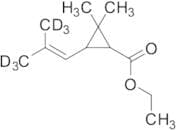
References Guorui, G., et al.: Youji Huaxue, 29, 589 (2009); Munoz, E., et al.: J. AOAC Int., 95, 1777 (2012);Fórmula:C12H20O2Forma y color:NeatPeso molecular:196.29Ethyl Chrysanthemate-D6
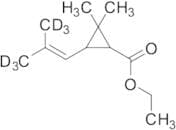
CAS:Producto controladoFórmula:C10D6H10O2Forma y color:NeatPeso molecular:174.27Chrysanthemum monocarboxylic acid ethyl ester
CAS:Chrysanthemum monocarboxylic acid ethyl ester is a chemical compound that belongs to the group of chrysanthemic acid derivatives. It is synthesized by reacting the carboxylic acid with an alcohol in the presence of hydrochloric acid and sodium ethoxide. Chrysanthemum monocarboxylic acid ethyl ester has been shown to have genotoxic effects, as well as fatty acids that can induce lysine residues. This drug also has a pharmaceutical use for tissue culture, which may be due to its ability to inhibit l-tartaric acid, an alkanoic acid.Fórmula:C12H20O2Pureza:Min. 95%Peso molecular:196.29 g/molEthyl Chrysanthemumate
CAS:Fórmula:C12H20O2Pureza:95%(GC-MS);RGForma y color:LiquidPeso molecular:196.29Ethyl Chrysanthemate-D6
CAS:Producto controladoFórmula:C10D6H10O2Forma y color:NeatPeso molecular:174.27